
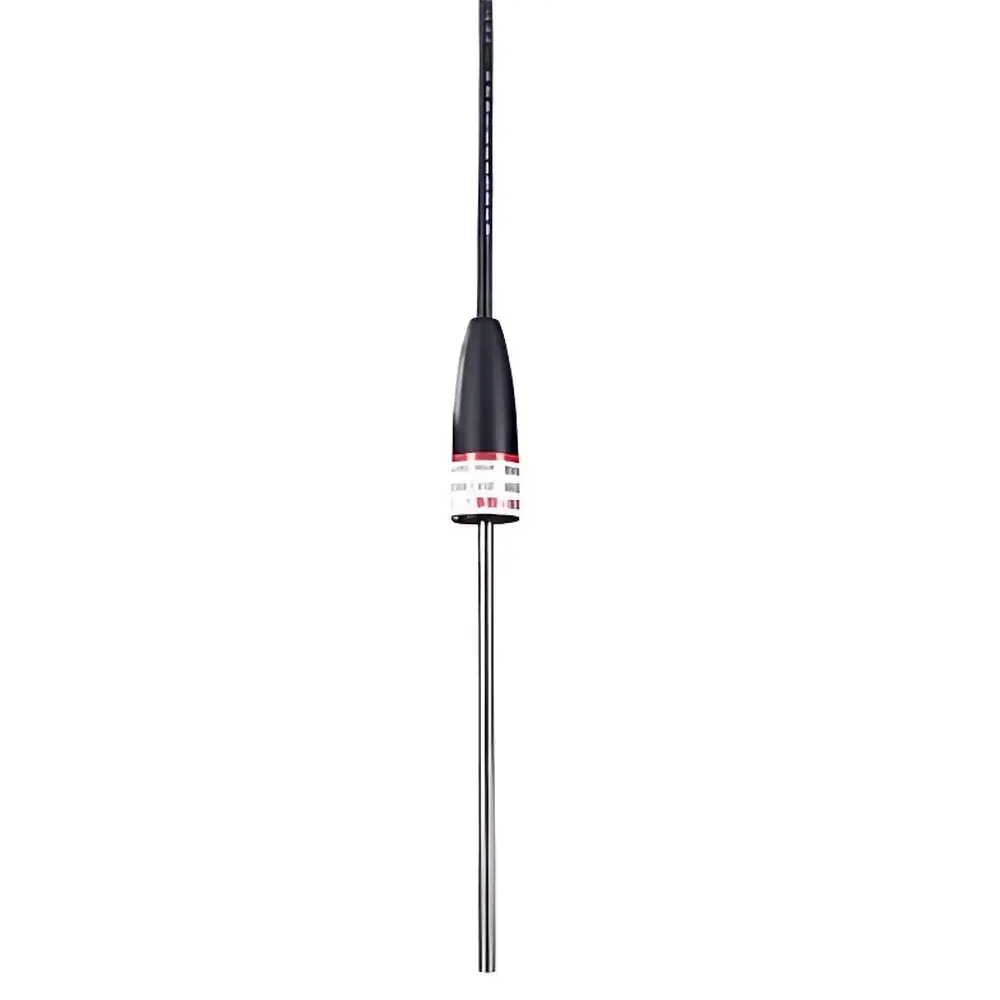
OHAUS STTEMP30 Temperature Electrode
| Brand | OHAUS |
|---|---|
| Origin | Shanghai, China |
| Manufacturer Type | Manufacturer |
| Product Origin | Domestic (China) |
| Model | STTEMP30 |
| Pricing | Upon Request |
| Electrode Type | Temperature Sensor Probe |
| Temperature Measurement Range | 0 – 100 °C |
| Cable Length | 1.1 m |
| Shaft Material | Stainless Steel (316 SS typical for lab-grade probes) |
| Overall Dimensions | 120 mm × 12 mm (L × Ø) |
| Net Weight | 80 g |
| Thermistor Resistance | 30 kΩ nominal at 25 °C |
| Operating Environment | 10 – 40 °C, ≤85% RH, non-condensing |
Overview
The OHAUS STTEMP30 is a precision-engineered, stainless-steel-shafted temperature electrode designed for integration with OHAUS ST-series benchtop and portable meters—including pH, ORP, conductivity, and dissolved oxygen instruments. It operates on the principle of resistance-based temperature sensing using a high-stability 30 kΩ negative temperature coefficient (NTC) thermistor, calibrated to deliver traceable, repeatable readings across its full operational range of 0–100 °C. Unlike generic thermocouples or RTDs, the STTEMP30 is optimized for electrochemical measurement systems where thermal compensation must be tightly synchronized with potentiometric or conductometric signal acquisition. Its compact 12 mm diameter and 120 mm immersion length ensure compatibility with standard sample vessels, reaction flasks, and calibration baths while maintaining mechanical robustness in routine laboratory use.
Key Features
- Stainless steel (316-grade equivalent) shaft construction for chemical resistance, mechanical durability, and ease of sterilization
- Integrated 30 kΩ NTC thermistor with tight tolerance (±0.2 °C typical at 25 °C) and low thermal lag (<3 s response time in stirred water)
- 1.1-meter shielded PVC cable with molded strain relief and universal BNC or DIN-compatible connector (configurable per host meter model)
- Compact form factor (120 mm × 12 mm) enabling precise positioning in narrow-necked containers and flow cells
- Designed for continuous immersion in aqueous, buffered, and mildly aggressive solutions—validated for compliance with IEC 60529 IP67 when connected to compatible OHAUS meters
- No internal batteries or active electronics; fully passive operation ensures long-term stability and zero drift under proper storage conditions
Sample Compatibility & Compliance
The STTEMP30 is intended for direct-contact temperature measurement in liquid-phase samples encountered in quality control, academic research, and industrial process monitoring—including buffer solutions, cell culture media, titration matrices, and environmental water samples. It is not rated for use in organic solvents, strong oxidizers (e.g., concentrated HNO₃), or high-pressure/autoclave environments unless explicitly validated by the end user. From a regulatory standpoint, the probe supports GLP- and GMP-aligned workflows when used with OHAUS meters that provide audit-trail-capable data logging (e.g., ST5000 series). While the STTEMP30 itself carries no standalone ISO/IEC 17025 certification, its performance characteristics align with ASTM E2877-22 (Standard Guide for Thermistor-Based Temperature Probes) and supports compliance with USP and thermal validation requirements when deployed within documented calibration intervals.
Software & Data Management
As a passive analog sensor, the STTEMP30 does not interface directly with PC-based software. Instead, it feeds real-time temperature data to OHAUS ST-series meters, which convert the thermistor resistance into calibrated °C values using embedded polynomial algorithms (Steinhart-Hart coefficients preloaded per batch). Meters with USB or Bluetooth connectivity (e.g., ST2000+, ST5000) export timestamped temperature logs—including simultaneous pH/conductivity readings—to CSV or Excel formats. All exported data retain instrument ID, probe serial number (where applicable), operator ID, and calibration verification timestamps—meeting minimum traceability requirements under FDA 21 CFR Part 11 when paired with appropriate access controls and electronic signature protocols.
Applications
- Automatic temperature compensation (ATC) during pH and ORP measurements in QC labs per ISO 7027 and ASTM D1293
- In-process thermal monitoring during titrations, dissolution testing, and enzymatic assays
- Calibration verification of reference temperature baths using NIST-traceable standards
- Long-term stability assessment of incubated biological samples in microbiology and cell biology workflows
- Field-deployable temperature profiling in wastewater treatment and environmental sampling where ruggedized passive probes are preferred over digital alternatives
FAQ
Is the STTEMP30 compatible with non-OHAUS meters?
Yes—provided the host instrument accepts 30 kΩ NTC input with standard Steinhart-Hart coefficient configuration (A = 1.129148×10⁻³, B = 2.34125×10⁻⁴, C = 8.76741×10⁻⁸). Users must verify input impedance and excitation current specifications.
Does the probe require periodic recalibration?
While the thermistor itself exhibits excellent long-term stability, OHAUS recommends annual verification against a NIST-traceable reference thermometer at three points (0 °C, 25 °C, and 70 °C) per ISO/IEC 17025 Clause 6.5.
Can the STTEMP30 be autoclaved?
No—its PVC cable and epoxy-sealed junction are not rated for steam sterilization. For sterile applications, use disposable thermistor probes or validate alternative cleaning protocols (e.g., 70% ethanol wipe, UV-C exposure).
What is the maximum immersion depth?
Full submersion up to the cable entry point is permissible; however, prolonged exposure above 60 °C may accelerate PVC jacket aging. For extended high-temperature use (>60 °C), consider optional PTFE-insulated cable variants.
How is traceability maintained across instrument fleets?
Each STTEMP30 is supplied with a factory test report listing batch-specific resistance values at 0 °C, 25 °C, and 100 °C. Laboratories should assign unique asset IDs and log calibration history in accordance with internal SOPs aligned with ISO/IEC 17025 Section 6.4.





