
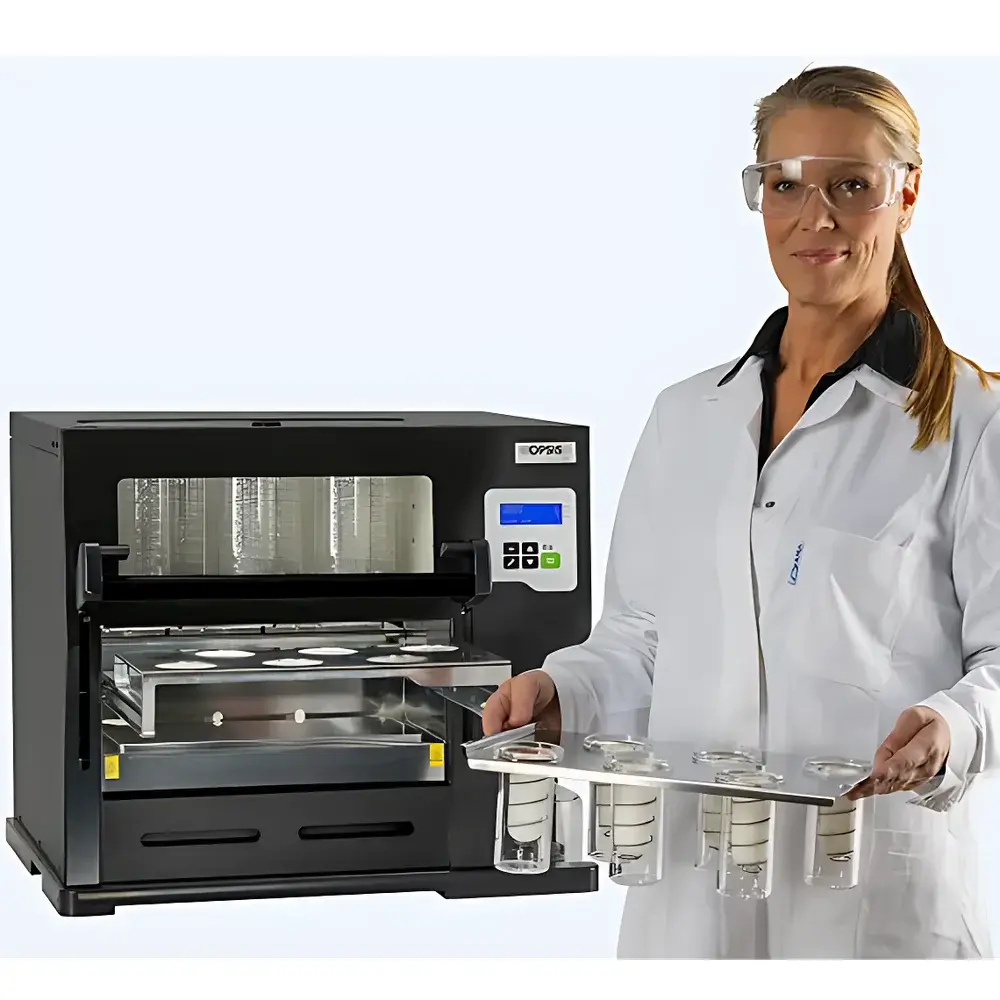
OPSIS SX-320 Dual-Position Automated Fat Analyzer
| Brand | OPSEUS/OPSIS |
|---|---|
| Origin | Sweden |
| Manufacturer Type | Authorized Distributor |
| Origin Category | Imported |
| Model | SX-320 |
| Quotation | Upon Request |
| Extraction Chamber Volume | 300 mL |
| Receiving Flask Volume | 230 mL |
| Temperature Range | 30–300 °C |
| Temperature Control Accuracy | ±1 °C |
| Number of Channels | 2 |
Overview
The OPSEUS SX-320 Dual-Position Automated Fat Analyzer is a CE-marked, ATEX-certified solvent extraction system engineered for precision, safety, and regulatory compliance in modern analytical laboratories. Based on an enhanced Soxhlet extraction principle—combining continuous reflux with programmable thermal cycling—the SX-320 delivers quantitative recovery of lipids, surfactants, plasticizers, pesticides, and other extractable organic compounds from solid and semi-solid matrices. Unlike conventional manual or semi-automated systems, the SX-320 executes fully autonomous, sequence-controlled extraction cycles including sample immersion, lifting, rinsing, solvent recovery, and pre-drying—without operator intervention after loading. Its dual-channel architecture supports parallel processing of two independent samples per run, while optional 6-position sample trays (sold separately) enable batch management across multiple runs. The system operates within a rigorously sealed environment, minimizing solvent exposure, maximizing recovery (>90%), and ensuring reproducibility ≤0.5% RSD—critical for AOAC, EPA, DIN, and ISO-compliant fat determination protocols.
Key Features
- ATEX-certified explosion-proof design with IP65-rated enclosure, intrinsically safe solenoid valves, and stainless-steel electronics housing to prevent spark generation in solvent-rich environments
- Dual-seal mechanism: manual lever compression followed by automated heating plate rotation ensures leak-tight integrity across all extraction positions
- Programmable temperature control (30–300 °C, ±1 °C accuracy) with dual redundant temperature sensors and auto-triggered overtemperature cutoff (setpoint +30 °C)
- Integrated solvent recovery tank (front-accessible, quick-release) and optimized condenser system consuming <1 L/min cooling water at 20 °C
- Modular solvent cup options: borosilicate glass (for visual monitoring) and aluminum (enhanced thermal conductivity, ideal for low-temperature extractions)
- Front-access solvent addition port allows safe, tool-free solvent replenishment before or during extraction
- Motorized safety door with interlocked sensor halts all thermal and mechanical operations if opened mid-cycle
- Automated post-extraction cooling: heating plate retracts from solvent cup to accelerate sample stabilization
Sample Compatibility & Compliance
The SX-320 accommodates diverse sample types—including feedstuffs, cereals, pharmaceutical excipients, polymer granules, soil/sediment, wastewater sludge, leather, paperboard, and rubber—using standardized extraction thimbles (φ25 mm × 60–100 mm; φ33 mm × 80–100 mm). Sample mass range: 0.1–15 g (typical 2–3 g). All wetted materials are chemically inert: PTFE gaskets, Viton®/Butyl/Resel® seal options (selected per solvent compatibility), and corrosion-resistant stainless-steel chassis. The system meets AOAC Official Methods 920.39, 991.36, EPA Method 3541, ISO 1444, DIN EN ISO 6496, and supports GLP/GMP workflows through full audit-trail capability when paired with LabConnect software. It is validated for use in FDA-regulated environments under 21 CFR Part 11 requirements when deployed with compliant electronic signature and data integrity configurations.
Software & Data Management
LabConnect software provides seamless integration with analytical balances and barcode scanners, automatically importing sample IDs, tare weights, and metadata into structured extraction logs. Each run generates timestamped, tamper-evident reports containing setpoints, actual temperatures, solvent volumes, cycle durations, and final dry residue mass. Data export formats include CSV, PDF, and XML for LIMS ingestion. Software-defined method libraries store up to 99 customizable protocols—each defining solvent type, temperature ramp profiles, immersion time (0–999 min), rinse cycles, and solvent removal valve sequencing. All parameters are password-protected and version-controlled, with full change history logged per user session. Remote diagnostics and firmware updates are supported via Ethernet connection; no external PC is required for basic operation due to integrated touchscreen HMI.
Applications
- Quantitative fat analysis in animal feed, dairy products, meat, and plant-based foods per AOAC and ISO standards
- Extraction of petroleum hydrocarbons and PAHs from contaminated soils and sediments (EPA SW-846 compliant)
- Recovery of phthalate plasticizers from PVC, bisphenol-A from food-contact polymers, and rosin derivatives from paper products
- Isolation of pesticide residues (e.g., organochlorines, pyrethroids) from agricultural commodities prior to GC-MS or LC-MS/MS analysis
- Preparative extraction of lipid-soluble actives from botanicals and herbal formulations for pharmacokinetic studies
- Characterization of grease content in industrial wastewater and sludge for environmental discharge reporting
FAQ
What safety certifications does the SX-320 hold?
The instrument carries ATEX II 2G Ex db IIB T4 Gb marking for use in Zone 1 explosive atmospheres and complies with IEC 60079-0/-1/-7. Its IP65 rating satisfies NEMA 4X and EU Directive 2014/30/EU (EMC) and 2014/35/EU (LVD).
Can the SX-320 be used with chlorinated solvents such as chloroform or DCM?
Yes—when equipped with Butyl or Resel® seals and aluminum solvent cups (recommended for thermal stability), the system is compatible with halogenated solvents per manufacturer’s chemical resistance guidelines.
Is method validation support available for regulatory submissions?
OPSIS provides IQ/OQ documentation templates, performance qualification test protocols, and raw data traceability reports aligned with ISO/IEC 17025 and FDA 21 CFR Part 11 expectations.
How is solvent recovery efficiency verified?
Recovery rate (>90%) is validated using gravimetric solvent mass balance across three consecutive runs with certified reference material (CRM) NIST SRM 1577c (Bovine Liver), per SOP-EXTR-002.
Does the system require external ventilation or fume hood integration?
No—the SX-320 includes an internal recirculating activated carbon filter and low-flow exhaust path; it operates safely in standard lab environments without ducted hood connection.



