
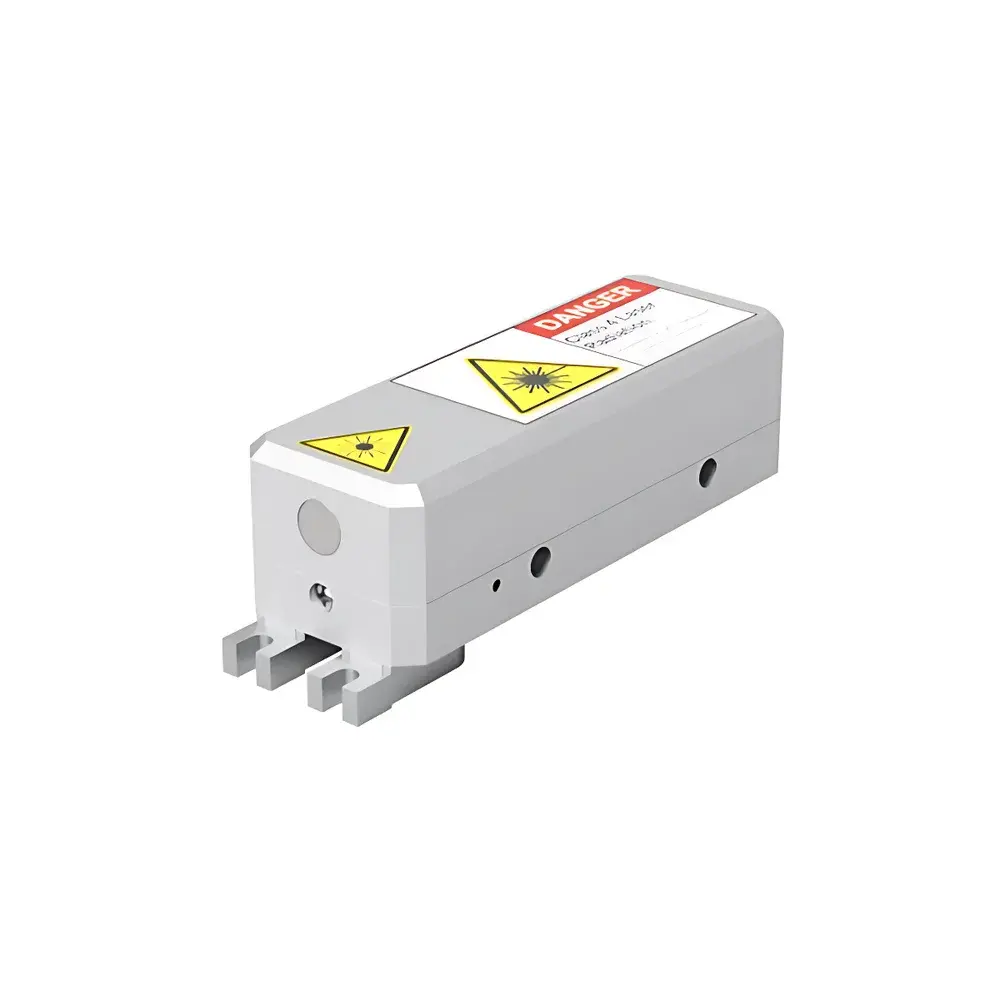
Optogama Kaukas ME-LP Eye-Safe 1540 nm Nanosecond Pulsed Laser
| Brand | Optogama |
|---|---|
| Origin | Lithuania |
| Manufacturer Type | OEM Laser System Developer |
| Product Category | Imported Solid-State Laser Source |
| Model | Kaukas ME-LP |
| Pulse Energy | Up to 1 mJ |
| Repetition Rate | Up to 10 Hz |
| Wavelength | 1540 nm |
| Pulse Width | Nanosecond (ns) |
| Pump Current Requirement | ≤20 A |
| Output Configuration | Free-space, TEM₀₀ |
| Cooling | Air-cooled |
| Compliance | IEC 60825-1:2014 Class 1M / Class 3R (with aperture limitation) |
Overview
The Optogama Kaukas ME-LP is a compact, air-cooled, diode-pumped solid-state (DPSS) nanosecond pulsed laser engineered for reliable operation at the eye-safe wavelength of 1540 nm. Operating on erbium-doped glass (Er:glass) gain medium, it delivers high peak power pulses with nominal pulse widths in the 5–12 ns range—optimized for time-resolved interaction with matter while maintaining intrinsic safety under standard exposure limits defined by IEC 60825-1. Unlike 1064 nm or 532 nm lasers requiring stringent optical enclosure protocols, the 1540 nm emission falls within the retinal hazard zone’s “optical window” where ocular absorption is dominated by water—not melanin or hemoglobin—resulting in significantly reduced risk of photomechanical or photochemical damage to the retina. This enables safer deployment in field-deployable systems, open-beam configurations, and proximity-critical applications such as handheld LIBS analyzers or unattended LIDAR nodes.
Key Features
- Eye-safe 1540 nm output compliant with IEC 60825-1 Class 1M (accessible emission limit < 10 mW average power) and Class 3R under controlled beam apertures
- High pulse energy up to 1 mJ at 10 Hz repetition rate, scalable to lower rep rates for higher per-pulse energy
- Low electrical demand: ≤20 A pump current at 24 V DC input—enabling integration into battery-powered or vehicle-mounted platforms
- Robust monolithic cavity design with passive Q-switching; no moving parts or active alignment mechanisms
- TEM₀₀ spatial mode with M² < 1.3 ensures diffraction-limited focusability for high irradiance applications
- OEM-ready mechanical interface (standardized mounting flange, SMA-style electrical connectors, analog TTL trigger input)
- Integrated thermistor-based temperature monitoring and over-current/over-temperature protection circuitry
Sample Compatibility & Compliance
The Kaukas ME-LP is designed for use with non-contact, optically opaque or semi-transparent samples typical in industrial and scientific spectroscopy. Its 1540 nm output exhibits strong absorption in water, polymers, and biological tissue—making it suitable for ablation of hydrated materials without excessive thermal diffusion. The laser complies with EU RoHS Directive 2011/65/EU and CE marking requirements for electromagnetic compatibility (EN 61326-1) and low-voltage safety (EN 61010-1). For regulated environments—including GLP-compliant analytical labs and ISO/IEC 17025-accredited testing facilities—the unit supports traceable calibration via external energy meter synchronization and provides stable pulse-to-pulse energy stability (< ±3% RMS over 8 hours, measured with calibrated pyroelectric sensor).
Software & Data Management
While the Kaukas ME-LP operates as a standalone hardware module, it interfaces seamlessly with third-party control ecosystems via TTL-compatible trigger input (negative-edge, 5 V logic) and analog monitor output (0–5 V proportional to pulse energy). Users may integrate it into LabVIEW, MATLAB, or Python-based acquisition frameworks using standard DAQ hardware (e.g., National Instruments USB-6009 or Thorlabs Kinesis controllers). Optional firmware upgrades enable programmable burst-mode operation (up to 5 pulses/burst, inter-pulse delay ≥100 µs), supporting time-gated detection schemes required in standoff LIBS or fluorescence lifetime measurements. All operational parameters—including internal temperature, pump current, and cumulative shot count—are accessible via RS-232 serial interface (ASCII protocol) for audit logging and preventive maintenance scheduling.
Applications
- Laser-Induced Breakdown Spectroscopy (LIBS): Enables elemental analysis of soils, alloys, and hazardous materials at safe stand-off distances (1–10 m); 1540 nm minimizes plasma shielding effects observed at shorter wavelengths
- Time-of-Flight LIDAR & Ranging: Supports single-photon or avalanche photodiode (APD)-based receivers with high signal-to-noise ratio due to atmospheric transmission peak near 1550 nm and low solar background interference
- Biophotonic Diagnostics: Used in non-invasive optical coherence elastography (OCE) and photoacoustic imaging where water absorption enhances contrast in soft tissues
- Automated Industrial Inspection: Integrated into robotic vision systems for real-time surface defect mapping, weld seam verification, and coating thickness assessment via laser triangulation or interferometric feedback
- Environmental Monitoring: Deployed in drone-mounted gas sensing platforms leveraging differential absorption LIDAR (DIAL) techniques targeting H₂O, CH₄, and CO₂ absorption lines near 1540–1580 nm
FAQ
Is the Kaukas ME-LP certified for use in FDA-regulated medical devices?
The laser itself meets IEC 60825-1 safety classification requirements and may be incorporated into Class II or Class III medical systems—however, final regulatory clearance rests with the device manufacturer’s quality management system (QMS) per FDA 21 CFR Part 820 and ISO 13485.
Can pulse energy be adjusted without changing repetition rate?
Yes—pulse energy is continuously tunable from ~100 µJ to 1 mJ via analog voltage control (0–5 V input) while maintaining fixed repetition rate and pulse width stability.
What cooling infrastructure is required?
None beyond ambient airflow: the unit is fully air-cooled and rated for continuous operation at ambient temperatures up to +40 °C with ≥0.5 m/s forced convection.
Does Optogama provide OEM documentation packages?
Yes—OEM customers receive full mechanical drawings (STEP/IGES), electrical interface specifications (pinout, timing diagrams), firmware update tools, and a comprehensive safety compliance dossier including test reports from accredited laboratories.
How is long-term pulse energy stability ensured?
Through factory-applied thermal stabilization of the Er:glass rod, precision-matched pump diode current regulation, and closed-loop thermistor feedback controlling internal heatsink temperature to ±0.5 °C.




