
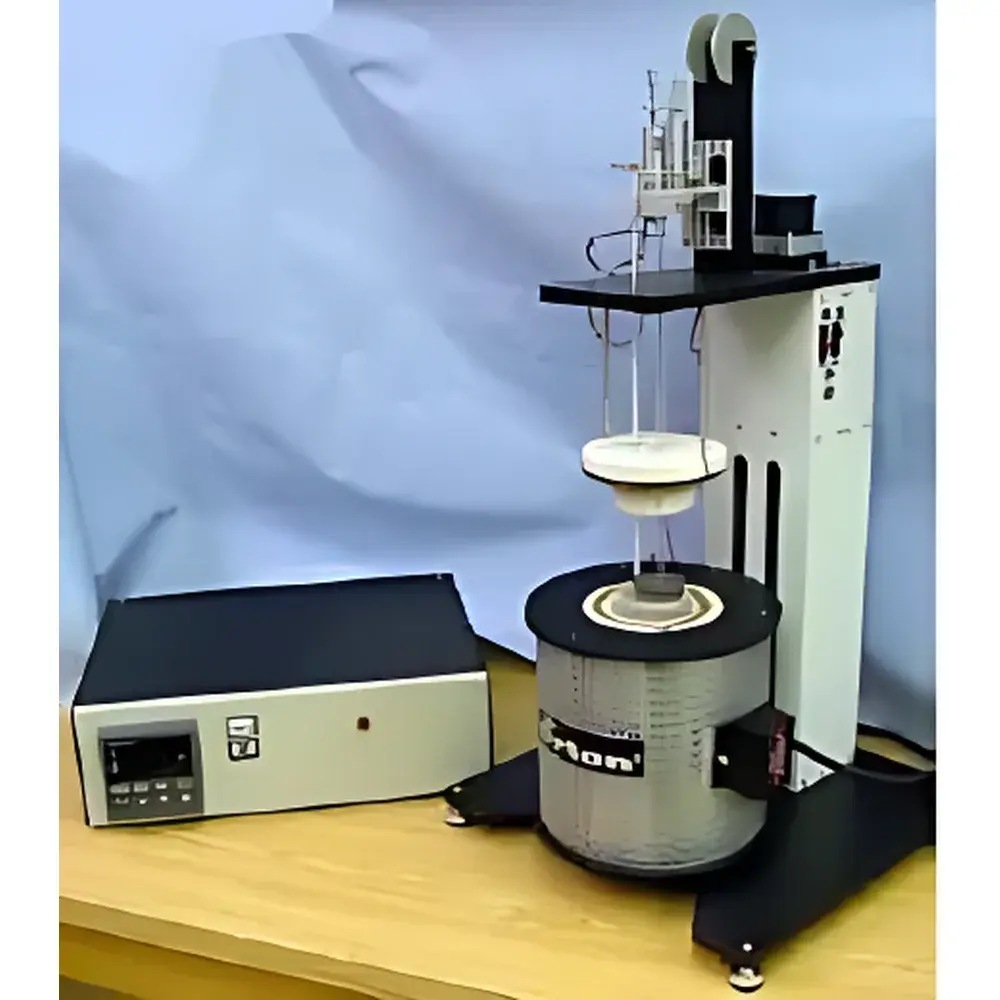
Orton PPV-1000 Series High-Temperature Parallel-Plate Viscometer
| Brand | Orton |
|---|---|
| Origin | USA |
| Model | PPV-1000/1200/1600 Series |
| Max Operating Temperature | 1600 °C |
| Viscosity Range | 10⁵–10⁹ Poise |
| Compliance | ASTM C1351M |
| Control Interface | RS-232 or USB |
| Load Application | Adjustable dead-weight system with triple-mass configuration |
| Displacement Sensing | LVDT (±2.5 mm full scale) |
| Sample Geometry | 44 mm diameter × ~1.5–3 mm thick glass disc |
| Heating System | Vertical tube furnace with sintered alumina or fused quartz support structure |
| Temperature Sensing | “S”-type thermocouple positioned adjacent to sample |
| Sample Fixturing | Dual 44 mm × 6 mm high-temperature alloy plates with 40 mm × 0.001″ platinum foil interlayers |
Overview
The Orton PPV-1000 Series High-Temperature Parallel-Plate Viscometer is a precision-engineered instrument designed for the rheological characterization of inorganic glasses and ceramic melts under controlled thermal conditions. It operates on the principle of uniaxial compression creep deformation, where a cylindrical glass specimen is confined between two parallel, high-temperature-resistant alloy plates and subjected to a constant compressive load while being heated at a defined ramp rate. The resulting axial strain—monitored continuously via a calibrated linear variable differential transformer (LVDT)—is used to calculate viscosity using the standard relationship for Newtonian flow in parallel-plate geometry: η = (F·h)/(A·dh/dt), where F is applied force, h is instantaneous sample thickness, A is contact area, and dh/dt is the time derivative of thickness. This method conforms strictly to ASTM C1351M, the standard test method for determining the viscosity of glass by the parallel-plate technique, and supports viscosity quantification across the critical range of 10⁵ to 10⁹ Poise—spanning the transition region from solid-like rigidity to viscous flow.
Key Features
- Three-tier temperature capability: PPV-1000 (up to 1000 °C), PPV-1200 (up to 1200 °C), and PPV-1600 (up to 1600 °C), each configured with a dedicated vertical tube furnace featuring sintered alumina or fused quartz insulation and optimized thermal uniformity.
- High-fidelity mechanical architecture: Dual 44 mm × 6 mm Inconel® or similar high-temperature alloy platens; ultra-thin (25.4 µm) platinum foils (40 mm diameter) placed between platen and sample to ensure clean interface separation and minimize thermal lag.
- Load application via calibrated dead-weight system with three selectable mass configurations, enabling precise control of nominal stress (e.g., 10–100 kPa range) without hydraulic or servo complexity.
- Real-time displacement resolution: LVDT with ±2.5 mm full-scale range and sub-micron repeatability, integrated with low-drift signal conditioning for robust strain-rate derivation over extended thermal cycles.
- Thermal metrology traceable to NIST standards: “S”-type thermocouple mounted in close proximity (<2 mm) to the sample mid-plane, with compensation for thermal expansion effects using a matched sintered quartz reference rod and high-temperature alloy compensator block (12 mm height).
Sample Compatibility & Compliance
The PPV series accommodates flat, polished glass discs (typically 44 mm diameter, 1.5–3 mm thickness) prepared per ASTM C1351M specifications. Compatible materials include soda-lime, borosilicate, aluminosilicate, phosphate, and chalcogenide glasses—as well as low-viscosity oxide melts and certain refractory slags. All configurations meet the dimensional, thermal, and procedural requirements of ASTM C1351M for reporting viscosity–temperature relationships. The system architecture supports GLP-compliant operation when paired with audit-trail-enabled software settings, timestamped raw data logging, and user-access-controlled parameter locks—facilitating regulatory submissions under FDA 21 CFR Part 11 when deployed in pharmaceutical container glass development or quality assurance environments.
Software & Data Management
Orton PPV Software is a Windows-based application that provides full instrument orchestration via RS-232 or USB. It enables selection of heating profiles (isothermal hold, linear ramp, multi-step programs), real-time plotting of thickness vs. time and viscosity vs. temperature, and automated calculation of activation energy (via Arrhenius fitting). Raw data—including thermocouple voltage, LVDT output, setpoint temperature, and elapsed time—is saved in ASCII tab-delimited format (.txt) with metadata headers for seamless import into MATLAB®, Python (NumPy/Pandas), or statistical analysis platforms. Historical datasets can be overlaid for comparative analysis; batch reports include summary statistics (mean, SD, CV%), pass/fail flags against specification limits, and export-ready graphs in PNG, SVG, or EMF formats. No cloud dependency or subscription model—the software runs locally with full administrative control over calibration constants and algorithm parameters.
Applications
- Determination of glass transition temperature (Tg) and softening point (Ts) via inflection analysis in log(η) vs. T plots.
- Development and validation of composition–viscosity models for optical fiber preform fabrication and flat-panel display glass melting processes.
- Quality control of container glass batches for pharmaceutical vials and syringes, ensuring compliance with USP <660> and ISO 8536-1 mechanical stability criteria.
- Thermomechanical modeling input for finite element simulation of glass forming operations (e.g., press-and-blow, float process).
- High-temperature rheology of nuclear waste vitrification matrices and advanced ceramic precursors.
FAQ
What temperature accuracy is achievable during a viscosity measurement?
Typical thermal uncertainty is ±1 °C at steady state, verified by independent calibration against reference thermocouples traceable to NIST SRM 1750. Drift during ramping is compensated via dynamic correction algorithms embedded in the PID controller firmware.
Can the PPV system measure non-glassy materials such as crystalline ceramics or metallic alloys?
No—it is specifically validated for amorphous or partially devitrified silicate and oxide systems exhibiting time-dependent viscous flow within the 10⁵–10⁹ Poise window. Crystalline solids or metals generally fail the ASTM C1351M geometric and deformation assumptions.
Is the LVDT measurement affected by thermal expansion of the fixture?
Yes—therefore, a passive sintered quartz compensation rod with matched CTE is mechanically coupled to the LVDT coil assembly, nulling out fixture expansion-induced artifacts across the full operating range.
How is data integrity ensured for regulated environments?
Raw sensor outputs are logged at ≥1 Hz with embedded timestamps and hardware-generated checksums. Optional software modules support electronic signatures, change logs, and 21 CFR Part 11 audit trails—including operator ID, parameter modifications, and calibration event records.
What maintenance is required for long-term operational reliability?
Annual verification of thermocouple drift, LVDT linearity, and furnace temperature uniformity is recommended. Platinum foils and alumina support fixtures are consumables with typical service life exceeding 50 cycles per set under standard operating conditions.



