
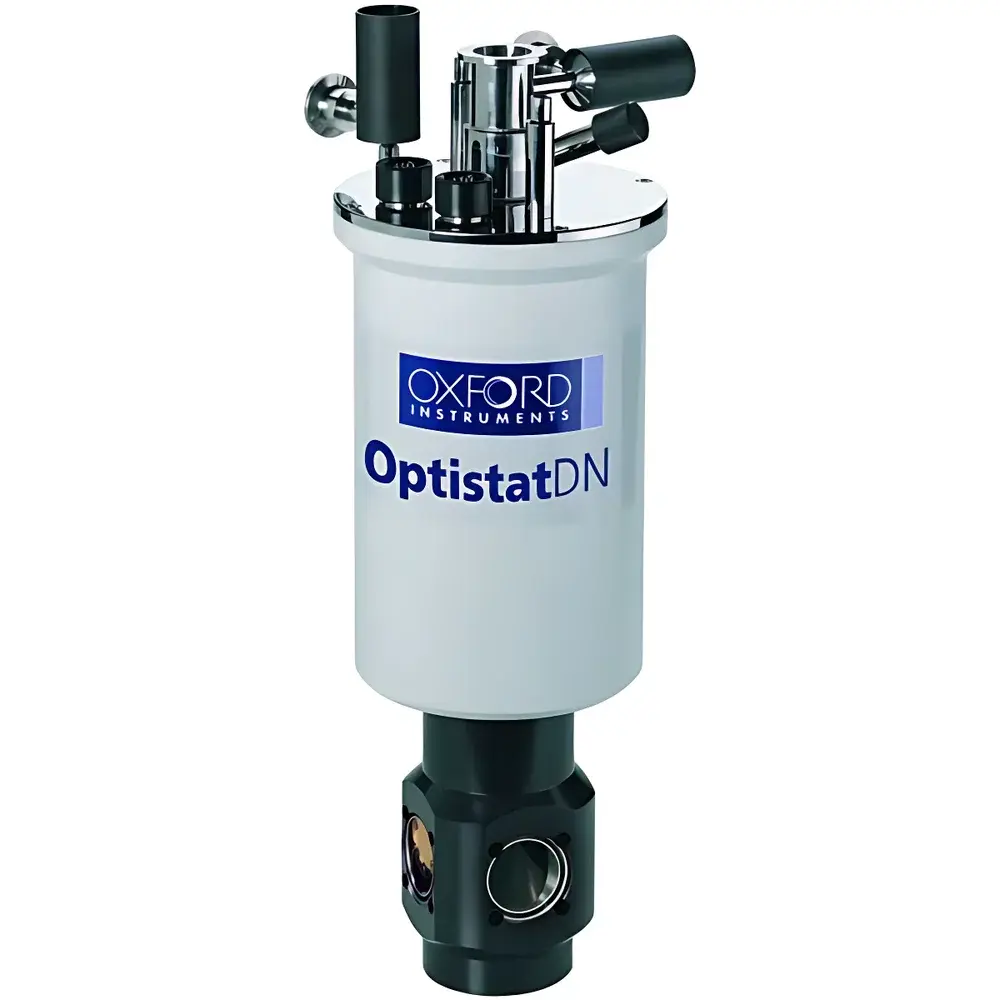
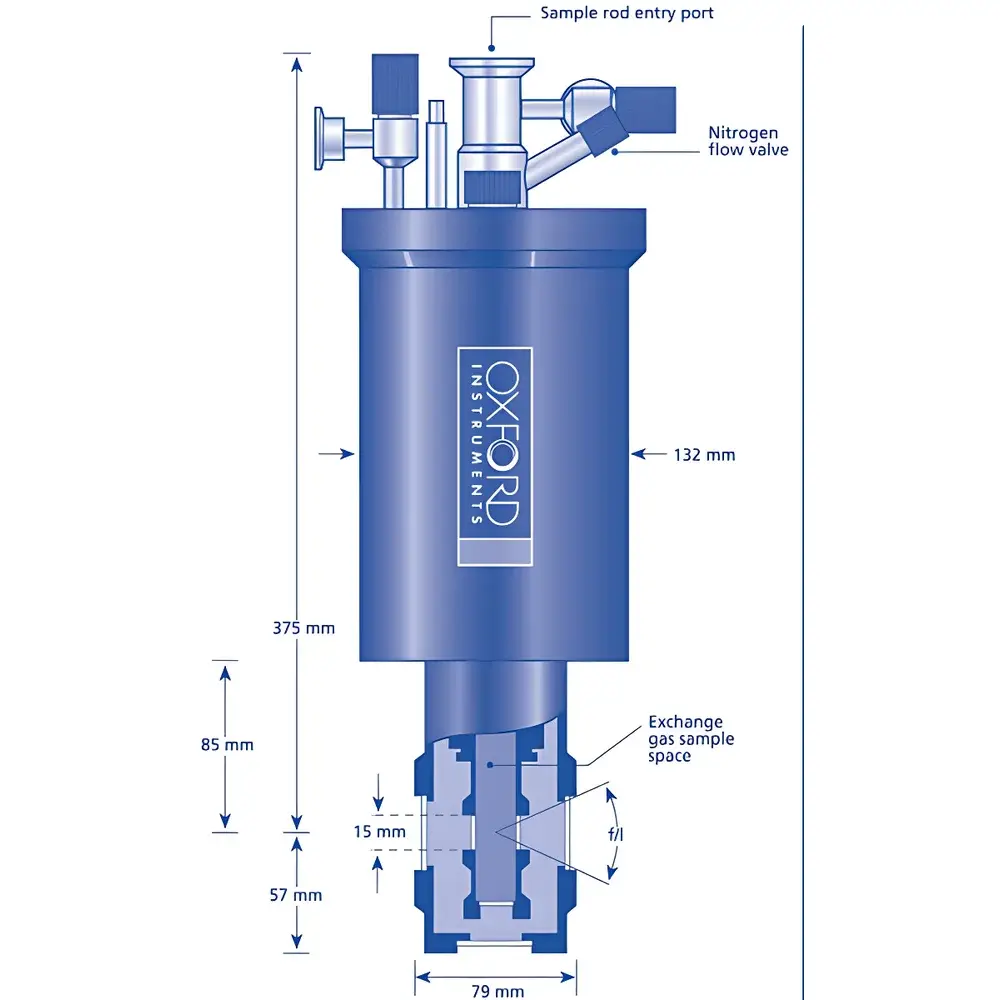
Oxford Instruments OptiStatDN Liquid Nitrogen Cryogenic Thermostat
| Brand | Oxford Instruments |
|---|---|
| Origin | United Kingdom |
| Model | OptiStatDN |
| Temperature Range | 77 K to 300 K (standard) |
| Atmosphere | Controlled nitrogen gas (non-vacuum) |
| Temperature Stability | ±0.1 K |
| Cooling Medium | Liquid nitrogen with adjustable flow rate |
| Standard Optical Access | Four fused silica windows |
| Sample Mounting Options | Liquid cell holder (recommended with monolithic fused silica cuvettes), powder holder, thin-film holder |
| Optional Integration | Electrical transport measurement capability |
| Compatibility | Designed for coupling with UV-Vis, FTIR, THz, photoluminescence, Raman, electroluminescence, ultrafast, and photovoltaic spectroscopy systems |
Overview
The Oxford Instruments OptiStatDN is a purpose-engineered liquid nitrogen cryogenic thermostat designed for high-stability, atmosphere-controlled low-temperature experiments in optical and optoelectronic spectroscopy. Operating within a standard temperature range of 77 K to 300 K—achievable without vacuum pumping—the system maintains sample environment integrity through precise regulation of liquid nitrogen flow and integrated PID temperature control. Unlike conventional cryostats requiring high-vacuum enclosures, the OptiStatDN utilizes a sealed nitrogen-purged chamber, significantly reducing experimental setup complexity and enabling rapid sample exchange while preserving thermal stability. Its core architecture leverages Oxford Instruments’ six-decade heritage in cryogenic system design, incorporating thermally optimized heat sinking, low-drift sensor placement, and mechanical decoupling strategies to minimize vibrational and thermal perturbations during optical measurements. The system is engineered for seamless integration into commercial and custom-built spectrometers, microscopes, and quantum optics platforms where reproducible thermal anchoring and unobstructed optical access are critical.
Key Features
- Non-vacuum operation using purified nitrogen gas atmosphere—eliminates vacuum pump dependency and accelerates sample turnaround time
- Temperature control from 77 K to 300 K via programmable liquid nitrogen flow regulation; extended range up to 500 K available with optional sapphire optical windows
- Thermal stability of ±0.1 K over 1-hour intervals, validated under continuous optical probing conditions
- Four standard high-transmission fused silica optical windows (UV–NIR broadband transmission) positioned at orthogonal and angled ports for multi-directional excitation/detection
- Modular sample stage supporting interchangeable holders: liquid-cell mount (optimized for monolithic fused silica cuvettes), pressed-powder puck holder, and suspended thin-film frame
- Electrical feedthrough compatibility (optional) for concurrent DC/AC transport measurements including resistivity, Hall effect, and photoconductivity
- Compact footprint and standardized flange interfaces (CF-40 or ISO-KF) facilitate retrofitting into existing optical tables and spectrometer enclosures
Sample Compatibility & Compliance
The OptiStatDN accommodates diverse sample geometries and physical states—including bulk crystals, epitaxial thin films, colloidal suspensions, and nanomaterial dispersions—without requiring cryogenic adhesives or epoxy-based mounting. Its nitrogen atmosphere ensures chemical inertness for air-sensitive samples during cooldown and warm-up cycles. All wetted components comply with ISO 8573-1 Class 2 compressed air purity standards when supplied with laboratory-grade nitrogen (99.999% purity). The system meets mechanical safety requirements per EN 61000-6-2 (immunity) and EN 61000-6-3 (emission), and its temperature controller firmware supports audit-trail logging compatible with GLP and GMP workflows. While not certified for medical device use, it conforms to general-purpose laboratory equipment standards referenced in ASTM E2847 (cryogenic system performance verification) and IEC 61000-4 series for electromagnetic compatibility.
Software & Data Management
Temperature setpoint programming, ramp profiling, and real-time monitoring are managed via Oxford Instruments’ Intelligent CryoControl software suite, which operates on Windows-based host PCs. The software provides IEEE-488 (GPIB), USB, and Ethernet (TCP/IP) communication protocols for instrument control and synchronization with external DAQ systems or spectrometer timing controllers. All temperature logs—including sensor readings, LN₂ flow rates, and heater power outputs—are timestamped and exportable in CSV or HDF5 format. Data integrity is preserved through configurable write-protected archive directories and optional integration with enterprise LIMS platforms via OPC UA interface. Firmware updates follow a version-controlled release cycle aligned with Oxford Instruments’ ISO 9001-certified development process.
Applications
- UV-Vis-NIR reflectance and absorption spectroscopy of correlated electron materials and 2D semiconductors
- FTIR transmission studies of molecular vibrations in frozen solutions and protein films
- THz time-domain spectroscopy of topological insulators and superconducting gaps
- Photoluminescence and electroluminescence quantum yield mapping across temperature-dependent phase transitions
- Resonant Raman scattering of phonon modes in transition metal dichalcogenides
- Photoinduced voltage/current transient analysis in perovskite solar cells and organic photodetectors
- Pump-probe ultrafast spectroscopy requiring sub-100 fs laser synchronization and thermal drift suppression
FAQ
What is the minimum achievable base temperature with standard configuration?
The OptiStatDN achieves a stable base temperature of 77 K using liquid nitrogen under atmospheric pressure; no cryocooler or closed-cycle refrigeration is required.
Can the system be used under vacuum if needed?
No—the OptiStatDN is specifically designed for non-vacuum, nitrogen-gas-filled operation. For vacuum-compatible alternatives, consider the OptiStatCF or MicrostatHe series.
Is calibration traceable to national standards?
Yes—each unit ships with a factory calibration certificate traceable to NPL (UK) standards for Pt100 sensor response and temperature controller linearity.
How is temperature uniformity across the sample area characterized?
Spatial uniformity is specified as ±0.3 K over a 10 mm diameter region at the sample plane, measured using calibrated micro-thermocouples under steady-state conditions.
What electrical feedthrough options are available for transport measurements?
Eight-pin hermetic ceramic feedthroughs (rated to 10⁻⁶ mbar equivalent) support four-wire resistance, Hall bar, and gated field-effect configurations; custom wiring harnesses are available upon request.



