
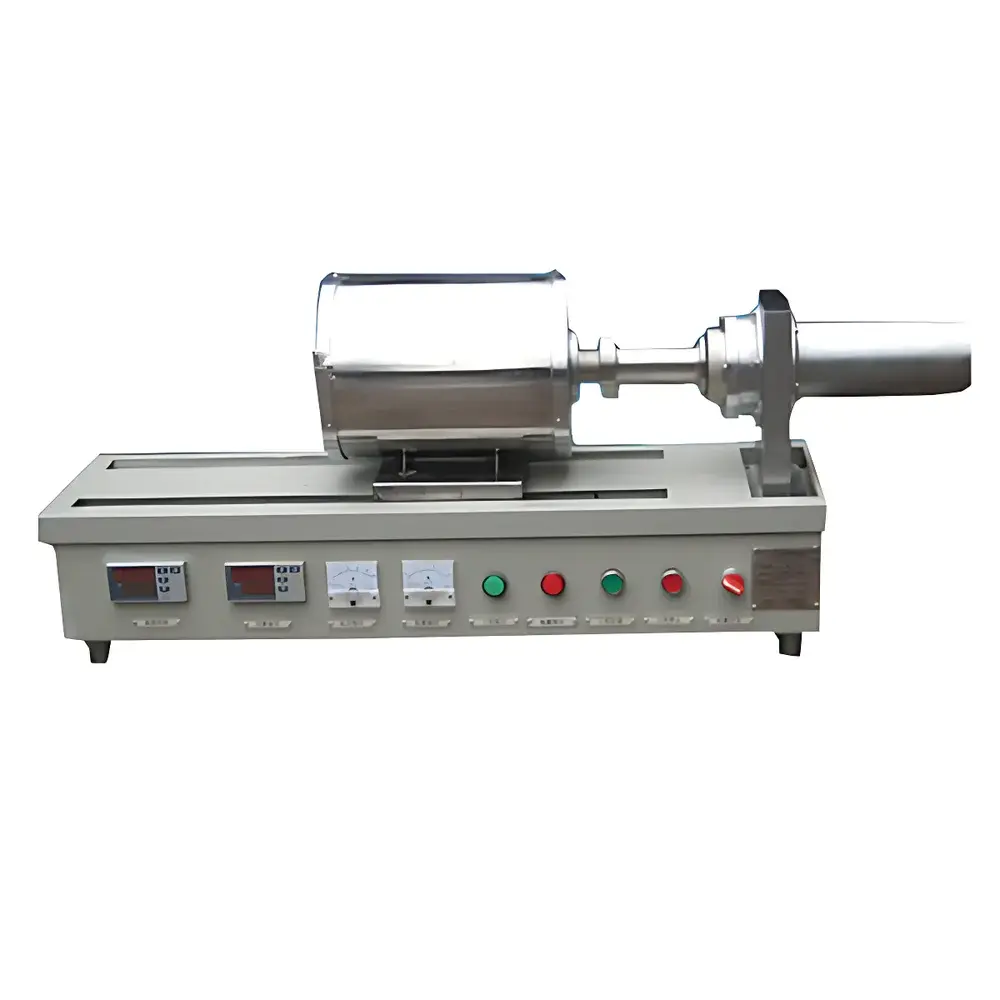
PCY-III-X Horizontal High-Temperature Thermal Dilatometer
| Origin | Hunan, China |
|---|---|
| Manufacturer Type | Authorized Distributor |
| Origin Category | Domestic (China) |
| Model | PCY-III-X |
| Price Range | USD 1,400–7,200 (FOB) |
| Temperature Range (°C) | -30 to 1700 (selectable configurations) |
| Heating Rate (°C/min) | 0.1–20 (standard setpoint: 5) |
| Temperature Accuracy (°C) | ±1 |
| Sample Diameter (mm) | 5–10 |
| Sample Length (mm) | ≤50 |
| Measurement Range | 5 mm |
| Resolution | 1 µm (optional 0.1 µm digitization) |
| Atmosphere Options | Air, Vacuum (down to 10⁻¹ mbar), Static/Dynamic Inert (N₂, Ar), Reactive Gas (customizable) |
Overview
The PCY-III-X Horizontal High-Temperature Thermal Dilatometer is a precision-engineered instrument designed for the quantitative determination of linear thermal expansion behavior in solid materials under controlled temperature environments. Based on the principle of contact-based displacement measurement using high-stability linear variable differential transformer (LVDT) or capacitive transducers, the system detects minute dimensional changes—on the order of micrometers—as samples undergo programmed thermal cycles. Its horizontal furnace architecture ensures uniform axial heat distribution and minimizes gravitational sag or bending effects during high-temperature testing, particularly critical for brittle ceramics, refractories, and sintered compacts. The instrument operates across a broad thermal range—from cryogenic (-30 °C) up to 1700 °C—enabling characterization of phase transitions, sintering kinetics, glass transition (Tg), softening points, and irreversible densification events. It complies with internationally recognized test standards including ASTM E831 (linear thermal expansion of plastics), ASTM D696 (coefficient of linear expansion of plastics), ASTM D3386 (thermal expansion of rigid cellular plastics), and DIN 51045 (dilatometric determination of thermal expansion of solids). CE marking confirms conformity with EU health, safety, and environmental protection directives.
Key Features
- Modular horizontal furnace design with dual-zone heating capability for precise thermal gradient control and enhanced temperature homogeneity across sample length
- High-resolution displacement sensing: standard 1 µm resolution; optional sub-micron (0.1 µm) digitization for ultra-sensitive applications such as low-expansion glass-ceramics or thin-film substrate analysis
- Intelligent dual-mode operation: fully autonomous stand-alone testing via embedded microcontroller-based controller (with real-time display and manual override), or synchronized PC-based automated acquisition and analysis under Windows 7/XP
- Configurable atmosphere handling: integrated vacuum pump interface (base pressure ≤10⁻¹ mbar), mass flow controllers for inert gas purging (N₂, Ar), and optional reactive gas inlet for oxidation/reduction studies
- Thermally stable sample stage with interchangeable holders fabricated from high-purity quartz or alumina—selected per maximum operating temperature and chemical compatibility requirements
- PID-controlled heating with user-adjustable ramp rates (0.1–20 °C/min), dwell time, and multi-step thermal profiles; full parameter logging with timestamped temperature/displacement data
- Integrated calibration routine using certified reference standards (e.g., NIST-traceable fused silica rod) to ensure traceable metrological integrity
Sample Compatibility & Compliance
The PCY-III-X accommodates cylindrical solid specimens (5–10 mm diameter, ≤50 mm length) and powdered samples compacted in custom dies—enabling evaluation of green bodies, pre-sintered compacts, and fully dense ceramics. It supports structural ceramics (alumina, zirconia), refractory linings (magnesia, silicon carbide), investment casting shell materials, metallic alloys, glasses, and cementitious composites. All hardware and firmware are engineered to support GLP-compliant workflows: audit trails for method parameters, operator ID logging, electronic signatures (via optional software module), and raw data immutability—fully aligned with FDA 21 CFR Part 11 requirements when deployed in regulated pharmaceutical packaging or biomedical device material qualification labs. Test reports include ISO/IEC 17025-compatible uncertainty statements where applicable.
Software & Data Management
The included Windows-native software provides intuitive graphical configuration of thermal programs, real-time curve visualization (ΔL vs. T, dL/dT vs. T), automatic CTE calculation across user-defined intervals (e.g., 25–800 °C), and export to CSV, Excel, or PDF formats. Built-in database management allows structured archiving of sample metadata (batch ID, composition, heat treatment history), test conditions, and derived metrics—including instantaneous CTE, average CTE, inflection temperatures, and shrinkage onset points. Raw data files retain full instrument-level timestamps and sensor calibration coefficients, ensuring full traceability. Software updates and firmware patches are delivered via secure vendor portal with version-controlled release notes and validation documentation.
Applications
- Determination of coefficient of linear thermal expansion (CTE) for ceramic matrix composites used in aerospace thermal protection systems
- Sintering profile optimization of technical ceramics via real-time shrinkage monitoring and rate-controlled sintering (RCS)
- Characterization of thermal stability and phase transformation temperatures in battery cathode materials (e.g., LiCoO₂, NMC)
- Quality control of refractory linings in metallurgical furnaces through batch-to-batch CTE consistency verification
- Development of low-expansion sealants and encapsulants for optoelectronic packaging
- Research into thermal mismatch stresses at ceramic–metal interfaces in SOFC (solid oxide fuel cell) stack assemblies
- Evaluation of thermal shock resistance in glazes and architectural tiles via cyclic expansion/contraction hysteresis analysis
FAQ
What temperature ranges are available for the PCY-III-X, and how is furnace configuration selected?
The system offers five factory-configurable upper limits: -30–200 °C (low-temp Peltier), room temperature–1000 °C, 1400 °C, 1600 °C, and 1700 °C. Selection depends on heating element type (Kanthal A1, SiC, MoSi₂, or graphite), insulation grade, and thermocouple class (K, S, B, or C)—all specified at time of order.
Can the instrument operate without a connected PC?
Yes. The embedded single-board controller enables full autonomous operation with local display, keypad input, and internal data storage (up to 10,000 data points). USB export is supported for offline analysis.
Is vacuum tightness verified per ISO 2859-1 sampling plans?
Each unit undergoes helium leak testing at 10⁻¹ mbar; certificate of conformance includes leak rate (<5×10⁻⁸ mbar·L/s) and test duration.
How is thermal calibration performed, and what standards are supported?
Calibration uses certified reference materials traceable to NIST or BAM, including fused silica (CTE ≈ 0.55 × 10⁻⁶/°C), α-quartz, and Invar. Full calibration reports document uncertainty budgets per GUM (Guide to the Expression of Uncertainty in Measurement).
What maintenance is required for long-term measurement stability?
Annual verification of LVDT linearity, thermocouple drift, and furnace temperature uniformity is recommended. Sealing gaskets should be inspected quarterly; replacement kits (Viton, Kalrez, or graphite) are stocked and field-replaceable.



