Peric Customized Sub-Metering Electricity Monitoring & Regulatory Platform
| Brand | Peric |
|---|---|
| Origin | Hebei, China |
| Manufacturer Type | Direct Manufacturer |
| Product Origin | Domestic (China) |
| Model | Customized Sub-Metering Electricity Monitoring & Regulatory Platform |
| Pricing | Available Upon Request |
Overview
The Peric Customized Sub-Metering Electricity Monitoring & Regulatory Platform is an industrial-grade energy intelligence infrastructure designed for regulatory authorities and environmental protection agencies to enforce compliance with pollution control mandates through indirect but highly reliable operational verification. Unlike conventional power meters, this platform implements a distributed sub-metering architecture—deploying multi-parameter acquisition terminals at critical electrical nodes across production lines, pollution control equipment (e.g., scrubbers, RTOs, biofilters), and emission monitoring points. By continuously capturing real-time current, voltage, active/reactive power, cumulative energy consumption (kWh), and waveform harmonics, the system establishes empirical correlations between equipment operational states and verified emissions data from CEMS (Continuous Emission Monitoring Systems) or other EPA-certified analyzers. Its core principle rests on electricity signature analysis: deviations in load profiles, duty cycles, or power factor during scheduled operating hours serve as objective, tamper-resistant proxies for equipment uptime, load rate, and functional integrity—enabling remote validation of whether pollution control systems are energized, loaded, and operated per regulatory requirements (e.g., China’s “Two-Systems Integration” policy and MEP Order No. 38).
Key Features
- Distributed sub-metering topology with DIN-rail–mounted intelligent terminals supporting simultaneous measurement of I, V, P, Q, PF, kWh, and THD up to Class 0.5 accuracy per IEC 62053-21
- Modular platform architecture enabling customizable node mapping: one-to-one, one-to-many, or many-to-one logical binding between production units, pollution control assets, and CEMS data streams
- Rule-based anomaly detection engine with configurable thresholds for runtime deviation, idle-time extension, power profile mismatch, and inter-device correlation drift
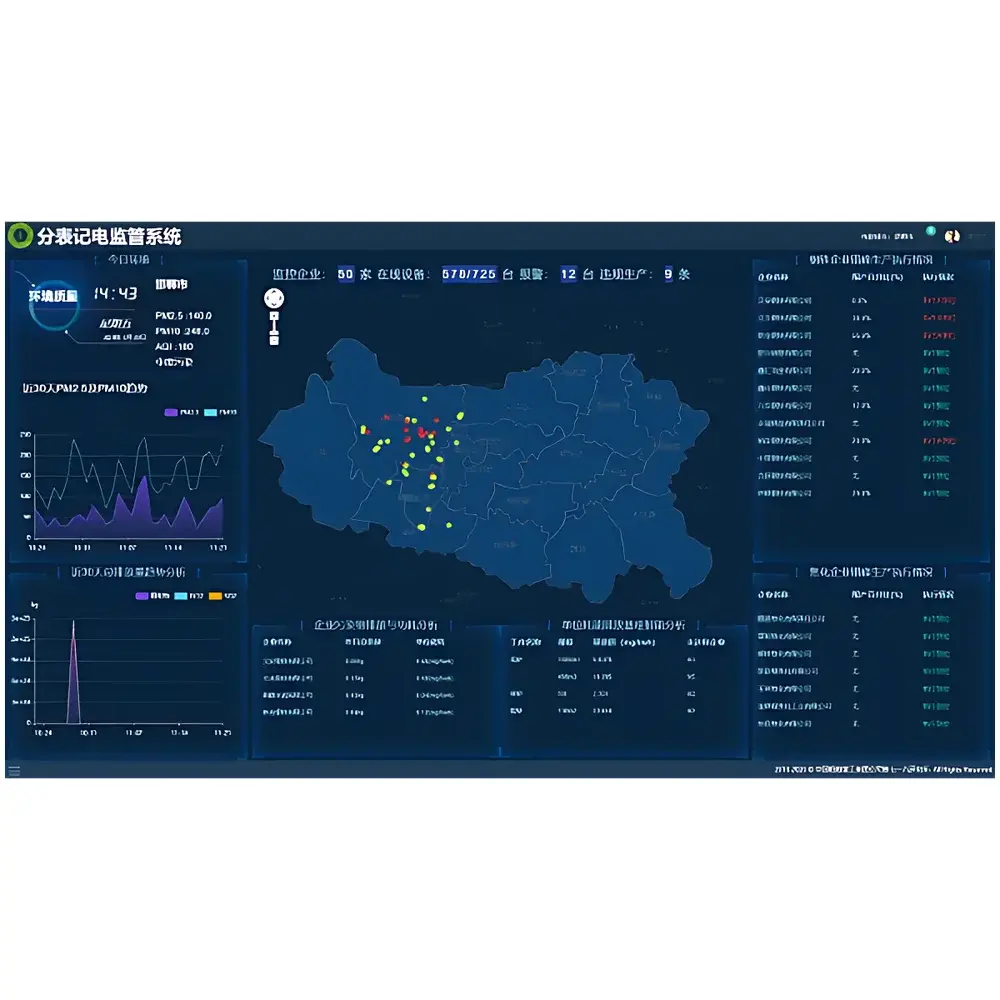
- Role-based web dashboard with GIS-integrated site visualization, historical trend replay, audit trail logging, and automated report generation compliant with GB/T 35273–2020 (Personal Information Security Specification)
- Secure dual-channel data transmission: encrypted MQTT over LTE/4G for field terminals; TLS 1.2 HTTPS + digital certificate authentication for cloud API endpoints
- FDA 21 CFR Part 11–ready audit log module with immutable timestamps, operator ID linkage, and change history for all configuration modifications and alarm acknowledgments
Sample Compatibility & Compliance
The platform is engineered for integration into industrial environments subject to stringent environmental oversight—including electroplating, chemical synthesis, pharmaceutical manufacturing, and thermal power generation facilities. It supports interoperability with third-party CEMS (e.g., Thermo Fisher 42i, Horiba PG-300), DCS/SCADA systems (via Modbus TCP/RTU, OPC UA), and municipal environmental data platforms (e.g., China’s National Environmental Monitoring Platform). Hardware components comply with GB/T 17626 (EMC immunity), GB 4208 (IP65 enclosure rating for terminal units), and RoHS 2011/65/EU. Software design follows GLP/GMP-aligned data integrity principles, including ALCOA+ criteria (Attributable, Legible, Contemporaneous, Original, Accurate, Complete, Consistent, Enduring, Available) for all stored operational records.
Software & Data Management
The regulatory platform runs on a containerized microservices architecture hosted on ISO/IEC 27001–certified infrastructure. Data ingestion pipelines normalize time-series telemetry using ISO 8601 timestamps and UTC synchronization via NTP servers. All raw measurements are retained for ≥18 months with automatic tiered archiving (hot SSD → cold object storage). The analytics layer applies statistical process control (SPC) methods—including X-bar/R charts and cumulative sum (CUSUM) algorithms—to detect subtle operational drift before threshold violations occur. Export modules support CSV, PDF, and XML formats aligned with China’s HJ 212–2017 communication protocol standard. Full system logs—including login attempts, parameter edits, alarm suppressions, and report exports—are retained for ≥36 months to satisfy provincial ecological environment bureau audit requirements.
Applications
- Verification of continuous operation of VOC abatement systems (e.g., activated carbon adsorption units, catalytic oxidizers) against mandated minimum runtime and load conditions
- Correlation analysis between wastewater treatment plant blower motor power draw and online COD/NH3-N sensor outputs to confirm biological treatment efficacy
- Identification of unauthorized production shifts via nighttime electricity consumption spikes inconsistent with approved operating permits
- Automated evidence generation for enforcement actions under Article 99 of China’s Environmental Protection Law (illegal discharge or facility idling)
- Baseline establishment and dynamic benchmarking of energy intensity per unit output across peer facilities within an industrial park
FAQ
Does the platform support integration with existing CEMS or DCS systems?
Yes—native drivers for Modbus RTU/TCP, OPC UA, and HJ 212–2017 protocol stacks are included. Custom API adapters can be developed for proprietary protocols upon request.
How is data security ensured for regulatory-grade deployments?
All communications use TLS 1.2 or higher; terminal firmware is signed and verified at boot; database encryption uses AES-256; and role-based access control (RBAC) enforces separation of duties per GB/T 22239–2019 (Multi-Level Protection Scheme Level 3).
Can the system generate legally admissible evidence for environmental enforcement?
Yes—the platform maintains full chain-of-custody metadata, cryptographic hash integrity checks for all stored records, and timestamped, non-repudiable audit logs required by local ecological environment bureaus for administrative penalty proceedings.
Is hardware calibration traceable to national metrological standards?
Terminal units are factory-calibrated against CNAS-accredited reference standards (certificate included); field recalibration services are available annually per JJF 1248–2010 guidelines.