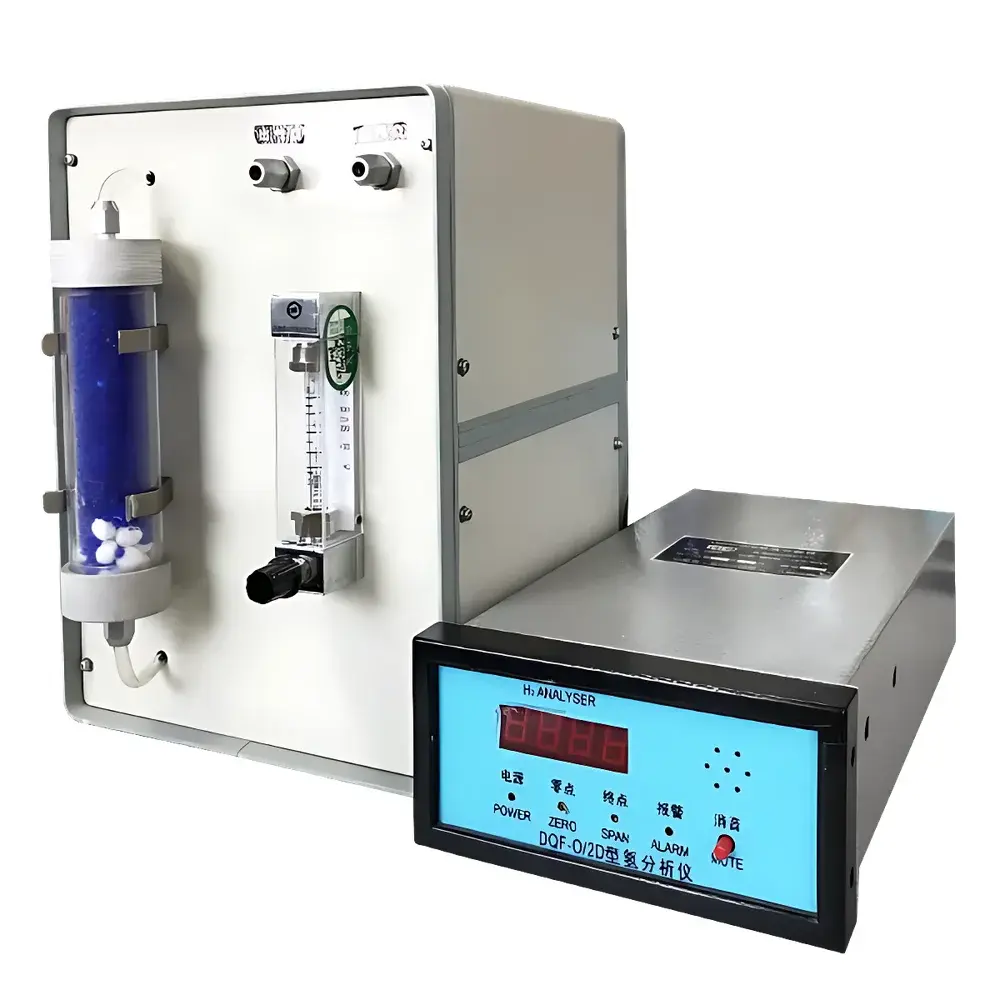
PERIC DQF Fixed-Mount Thermal Conductivity Hydrogen Analyzer
| Brand | PERIC |
|---|---|
| Model | DQF |
| Measurement Principle | Thermal Conductivity |
| Range | 0–1% H₂ (v/v) |
| Response Time | ≤2.5 min |
| Accuracy | ±5% FS |
| Alarm Threshold | >0.75% H₂ |
| Power Supply | AC 220 V |
| Power Consumption | ≤10 W |
| Enclosure Rating | Ex d II CT6 |
| Output Signals | 1–5 V DC & 4–20 mA |
| Display | Digital Panel Meter (H₂ %) |
| Alarm Output | Audible/Visual + Relay Contacts |
| Compliance | GB/T 3836.1–2021 (Explosion-Proof), JJG 915–2008 (Calibration Standard for Thermal Conductivity Gas Analyzers) |
Overview
The PERIC DQF Fixed-Mount Thermal Conductivity Hydrogen Analyzer is an industrial-grade, continuous gas composition analyzer engineered for real-time monitoring of hydrogen concentration in oxygen streams generated by water electrolysis systems. It operates on the fundamental physical principle of thermal conductivity differential—hydrogen exhibits a thermal conductivity approximately seven times greater than that of oxygen at ambient conditions. This property enables highly selective detection of trace H₂ in O₂-rich matrices without chemical reagents or consumables. The instrument employs a dual-sensor, constant-temperature hot-wire configuration housed within a robust stainless-steel detector cell. Sample gas flows continuously through the measurement chamber, where changes in bulk thermal conductivity induce proportional resistance shifts in precision platinum thermistors. These shifts are detected via a balanced Wheatstone bridge circuit, converted to a linear voltage output, and digitized for direct % H₂ readout on an integrated LED panel meter. Designed for unattended operation in harsh industrial environments, the DQF meets Class I, Division 1 explosion-proof requirements (Ex d II CT6) and complies with Chinese national standards for safety, calibration, and performance verification (GB/T 3836.1–2021, JJG 915–2008).
Key Features
- Thermal conductivity-based detection—no catalytic elements, no zero drift from aging, inherently stable for long-term deployment
- Fixed-mount, panel-integrated design optimized for permanent installation in electrolyzer skids, oxygen purification units, and gas compression stations
- Dual-channel thermal sensing architecture with temperature-compensated bridge electronics for improved reproducibility across ambient fluctuations (10–40 °C)
- Integrated alarm system featuring configurable threshold logic (>0.75% H₂), pulsed audible buzzer, high-intensity LED warning light, and dry-contact relay outputs for interlocking with shutdown valves or PLCs
- Standard analog outputs: isolated 4–20 mA current loop and 1–5 V DC voltage signal, both linearly scaled to full-scale 0–1% H₂ range
- Low power consumption (≤10 W) and wide-input AC 220 V supply enable integration into existing plant electrical infrastructure without auxiliary transformers
- Stainless-steel sample inlet manifold with built-in particulate filter and moisture trap port—compatible with conditioned process gas streams per ISO 8573-1 Class 4
Sample Compatibility & Compliance
The DQF analyzer is validated for use with dry, particle-free oxygen streams containing up to 1% hydrogen by volume. It is not suitable for humid, corrosive, or hydrocarbon-laden gas matrices without upstream conditioning (e.g., coalescing filters, desiccant dryers). Interference from helium is minimal due to its distinct thermal conductivity profile; however, helium concentrations exceeding 0.5% v/v require factory recalibration. The instrument conforms to China’s mandatory explosion protection standard GB/T 3836.1–2021 (equivalent to IEC 60079-0) and is certified for use in Zone 1 hazardous areas (Group II C, T6). Calibration traceability follows JJG 915–2008, which specifies verification procedures for thermal conductivity gas analyzers used in industrial safety applications. While not FDA 21 CFR Part 11 compliant out-of-the-box, audit-ready calibration logs and manual intervention records can be maintained in accordance with GLP/GMP-aligned QA protocols.
Software & Data Management
The DQF operates as a standalone hardware analyzer with no embedded firmware or network interface. All signal processing occurs in analog domain; digital display and relay logic are implemented via discrete CMOS circuitry. As such, it does not require software installation, driver updates, or cybersecurity hardening. Process data is accessible exclusively via its native analog outputs, enabling seamless integration into legacy DCS, SCADA, or PLC systems (e.g., Siemens S7, Rockwell ControlLogix, Yokogawa CENTUM VP). For trending and archival, third-party data acquisition modules (e.g., Advantech ADAM-4000 series) may be deployed to digitize the 4–20 mA output at user-defined intervals. Calibration certificates and maintenance logs must be retained manually per ISO/IEC 17025 laboratory management requirements.
Applications
- Real-time hydrogen purity monitoring in PEM and alkaline water electrolysis plants—critical for ensuring oxygen stream integrity prior to compression, storage, or venting
- Safety interlock verification in oxygen generation facilities at power plants, steel mills, and chemical synthesis units
- Quality assurance in meteorological oxygen calibration gas production, where H₂ contamination compromises reference gas stability
- Continuous compliance monitoring in hydrogen–oxygen separation skids used in aerospace ground support equipment
- Export-certified installations in India, Bangladesh, and Iran—validated under local regulatory frameworks for industrial gas safety (e.g., Indian Boilers Regulations, Bangladesh National Building Code Annex E)
FAQ
What gases can interfere with the DQF’s hydrogen measurement?
Helium causes minor positive bias above 0.5% v/v; methane, CO₂, and nitrogen introduce negligible error (<±0.1% H₂) within the 0–1% range. Moisture condensation inside the sensor cell must be avoided.
Is field calibration possible without specialized equipment?
Yes—zero calibration uses certified zero-air or nitrogen; span calibration requires certified 1.0% H₂ in O₂ reference gas. A handheld multimeter and calibrated potentiometer suffice for bridge balance adjustment.
Can the DQF be installed outdoors?
Only when housed in an IP65-rated, temperature-controlled enclosure meeting ambient operating limits (10–40 °C) and protected from direct solar radiation and rain ingress.
Does the analyzer meet international explosion-proof certifications beyond China’s GB/T 3836?
No—its Ex d II CT6 rating is valid only under GB/T 3836.1–2021. For ATEX or IECEx deployment, third-party re-certification is required.
What is the recommended maintenance interval?
Quarterly visual inspection of inlet filter and relay contacts; annual thermistor resistance verification and bridge balance check using reference gases.
Related Products