
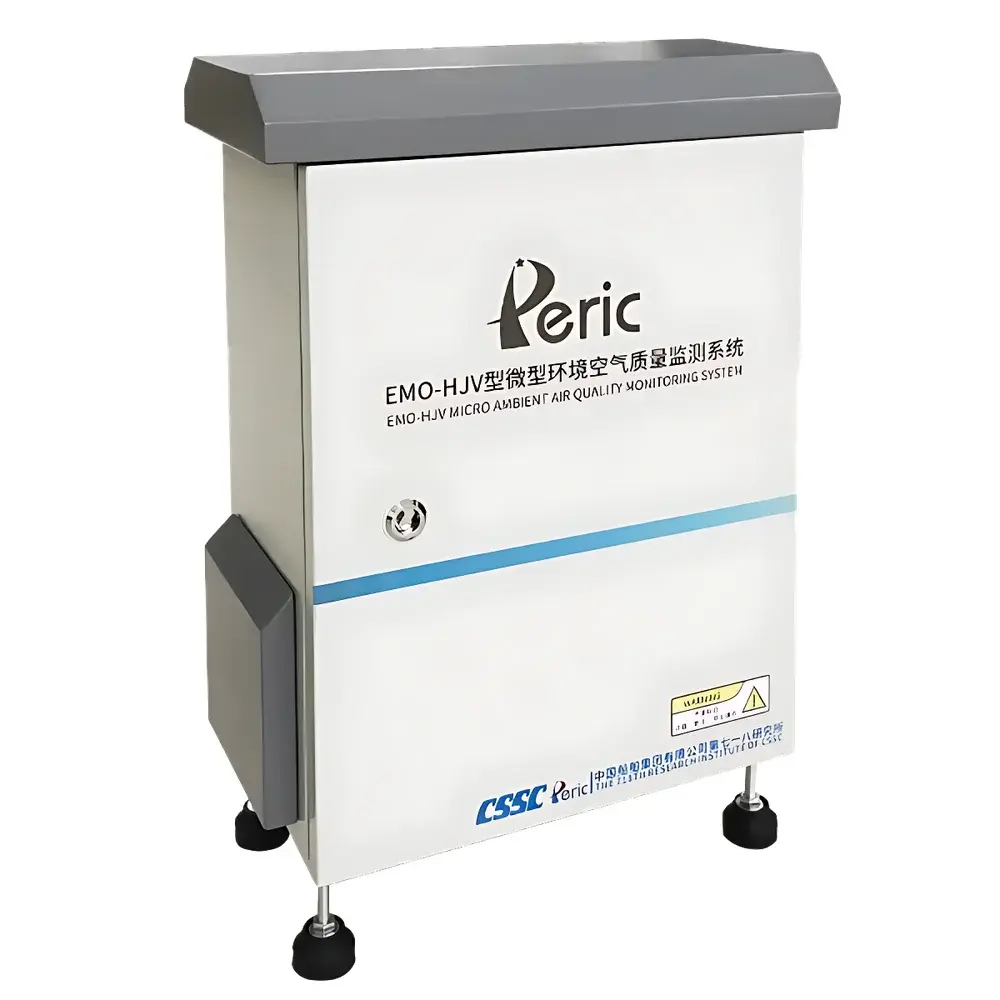
PERIC EMO-HJV Miniature Environmental Air Quality Monitoring System
| Brand | PERIC |
|---|---|
| Model | EMO-HJV |
| Origin | Hebei, China |
| Manufacturer Type | OEM/ODM Producer |
| Country of Origin | China |
| Power Supply | AC 220 V ±10%, with built-in rechargeable battery supporting ≥6 hours operation during power outage |
| Sampling Method | Active pump-driven aspiration with integrated hydrophobic dust/water filter |
| Communication Interfaces | 4G LTE (Cat 1), Ethernet (RJ45), LoRaWAN (optional), RS485 (Modbus RTU) |
| Local Storage | MicroSD card slot (up to 32 GB) |
| Data Upload Protocol | MQTT/HTTP over TLS 1.2 |
| Remote Capabilities | OTA firmware update, remote zero/span calibration, drift compensation algorithm |
| Data Integrity | 断点续传 (Resume-on-Interruption) with local queue buffering |
| Expandability | Optional meteorological module (wind speed/direction, temperature, humidity, pressure, rainfall) |
| Compliance | Designed per IEC 61326-1 (EMC), EN 50270 (gas detection equipment), and aligned with technical requirements of China’s HJ 653–2013 and HJ 93–2013 for ambient air monitoring stations |
| Detection Parameters & Ranges | PM₂.₅ (0–1000 µg/m³, resolution: 1 µg/m³), PM₁₀ (0–1000 µg/m³, resolution: 1 µg/m³), CO (0–12.5 µmol/mol, resolution: 0.01 µmol/mol), SO₂ (0–1000 nmol/mol, resolution: 1 nmol/mol), NO₂ (0–1000 nmol/mol, resolution: 1 nmol/mol), O₃ (0–1000 nmol/mol, resolution: 1 nmol/mol), VOCs (0–50 µmol/mol, resolution: 1 nmol/mol) |
| Sensor Technologies | Optical scattering (PM), electrochemical (CO, SO₂, NO₂, O₃), photoionization detection (PID) for VOCs, NDIR for CO₂ (optional) |
Overview
The PERIC EMO-HJV Miniature Environmental Air Quality Monitoring System is an autonomous, low-footprint ambient air monitoring platform engineered for high-density spatial deployment in urban, industrial, and peri-urban environments. It operates on a multi-sensor fusion architecture—integrating laser scattering photometry for particulate matter (PM₂.₅ and PM₁₀), electrochemical cells for reactive gases (CO, SO₂, NO₂, O₃), and photoionization detection (PID) for volatile organic compounds (VOCs)—to deliver continuous, real-time measurement of up to eight regulated and emerging air pollutants. Unlike traditional reference-grade stations, the EMO-HJV is optimized for networked, grid-scale monitoring where spatial resolution, installation agility, and long-term unattended operation are critical. Its design adheres to the functional architecture defined in ISO 12039 and aligns with data quality objectives outlined in EU Directive 2008/50/EC and China’s Ambient Air Quality Standards (GB 3095–2012). All measurements are traceable to national metrological standards through factory calibration against certified gas mixtures and aerosol generators.
Key Features
- Modular sensor architecture enabling field-replaceable detection units without system downtime
- Active aspiration sampling with dual-stage filtration: hydrophobic membrane (IP65-rated) followed by activated carbon pre-filter to extend sensor lifetime and reduce cross-interference
- Dual-power resilience: primary AC 220 V input with intelligent charge management and backup lithium-iron-phosphate battery supporting ≥6 hours of uninterrupted operation during utility failure
- Multi-protocol telemetry stack supporting secure MQTT/HTTPS transmission to cloud platforms, with configurable QoS levels and TLS 1.2 encryption
- On-device edge processing: real-time baseline correction, temperature/humidity compensation, and sensor drift modeling using embedded Kalman filtering algorithms
- Firmware-over-the-air (FOTA) and remote calibration capability compliant with ISO/IEC 17025:2017 Clause 7.7 for method validation and instrument verification
- Local data persistence via industrial-grade microSD card (32 GB max), with circular buffer logic and CRC-32 integrity checking
Sample Compatibility & Compliance
The EMO-HJV is validated for continuous operation across ambient temperature ranges of −20 °C to +50 °C and relative humidity from 10% to 95% non-condensing. Its sensor suite meets the performance criteria specified in HJ 653–2013 (China’s Technical Specification for Ambient Air Quality Monitoring Stations) and exhibits linearity (R² ≥ 0.995) and repeatability (CV ≤ 5%) under controlled chamber testing per ISO 8518. The electrochemical sensors conform to EN 50270:2015 for electrical safety and electromagnetic compatibility, while the optical PM module satisfies the optical alignment and scattering efficiency requirements of ISO 21501-4. For regulatory reporting, raw sensor outputs are time-stamped with GPS-synchronized UTC and logged with audit-trail metadata—including calibration history, firmware version, and environmental conditions—to support GLP/GMP-aligned data governance frameworks.
Software & Data Management
Data acquisition and management are handled by PERIC’s proprietary EdgeLink™ firmware, which supports both standalone logging and synchronized cloud ingestion. The system generates standardized JSON payloads containing calibrated concentration values, diagnostic flags (e.g., sensor saturation, filter clogging alert), and environmental context (T/RH/pressure). Cloud integration is compatible with AWS IoT Core, Microsoft Azure IoT Hub, and open-source platforms such as ThingsBoard or Grafana via configurable webhooks. All remote operations—including parameter configuration, calibration initiation, and firmware updates—are authenticated via X.509 certificate-based mutual TLS. Audit logs are retained for ≥180 days and comply with FDA 21 CFR Part 11 requirements for electronic records and signatures when deployed in regulated environmental compliance programs.
Applications
- High-resolution air quality mapping for smart city initiatives and neighborhood-level exposure assessment
- Industrial fence-line monitoring to verify compliance with emission limits under EPA 40 CFR Part 63 or China’s GB 16297
- Indoor-outdoor air exchange studies in schools, hospitals, and commercial buildings
- Mobile monitoring on light-duty vehicles or UAV-mounted platforms for dynamic pollution hotspot identification
- Supplemental monitoring networks supporting national reference station data gaps in developing regions
- Research-grade field campaigns requiring scalable, interoperable sensor nodes with traceable metrology
FAQ
Does the EMO-HJV meet regulatory requirements for official air quality reporting?
It is designed for indicative and supplemental monitoring—not certified as a Class I reference analyzer per EU Directive 2008/50/EC Annex VI or US EPA EQOA requirements. However, its data may be used for trend analysis, source attribution, and public information systems when deployed in accordance with QA/QC protocols defined in ISO/IEC 17025.
What maintenance intervals are recommended for sensor modules?
Electrochemical sensors require zero/span verification every 90 days; optical PM modules need annual cleaning and alignment check. Filter elements should be replaced every 3–6 months depending on local dust loading.
Can the system operate without internet connectivity?
Yes. All measurements are stored locally on microSD with timestamped binary logging. Data uploads resume automatically upon network restoration, preserving temporal continuity without gaps.
Is meteorological data integration optional or mandatory?
Meteorological sensing (temperature, RH, wind, pressure) is fully optional and implemented as a plug-and-play module via RS485 Modbus interface. No firmware modification is required.
How is sensor drift compensated during long-term deployment?
The system applies adaptive drift correction using periodic zero-air cycles (via internal solenoid valve) and machine-learning-assisted baseline modeling trained on historical environmental correlations.







