Shimadzu UX Series Animal Balance
| Key | Brand: Shimadzu |
|---|---|
| Origin | Japan |
| Series | UX |
| Max Capacity | 6000 g |
| Readability | 0.01 g (models UX2200H/UX4200H/UX6200H), 0.1 g (models UX4200S/UX8200S) |
| Repeatability | ≤ 0.01 g |
| Calibration | External |
| Animal Mode | Three-tier dynamic stabilization (Inactive / Moderately Active / Highly Active) |
| Pan Dimensions | Ø110 mm (base), Ø200 mm (top), Height 130 mm |
| Power Consumption | ≤12 VA |
| Compliance | Designed for GLP-compliant animal weighing workflows in preclinical research |
Overview
The Shimadzu UX Series Animal Balance is an engineered solution for precise, stable mass measurement of live small-to-medium laboratory animals—designed specifically to mitigate motion-induced instability inherent in conventional analytical and precision balances. Unlike standard balances relying solely on static equilibrium detection, the UX series integrates proprietary Unibloc single-piece electromagnetic force compensation sensor architecture with adaptive digital filtering algorithms. This enables real-time compensation for low-frequency oscillations caused by animal movement, respiration, and limb shifts—without requiring physical restraint or sedation. The balance operates on the principle of electromagnetic force restoration, where displacement of the load pan is detected via high-resolution optical sensing, and a precisely regulated current generates counteracting magnetic force to restore equilibrium. The resulting analog-to-digital conversion delivers high-fidelity mass data even under dynamic loading conditions typical in rodent, rabbit, and juvenile primate studies.
Key Features
- Three-Stage Animal Mode Selection: User-selectable stabilization profiles—“Inactive”, “Moderately Active”, and “Highly Active”—adjust filter bandwidth, sampling rate, and damping coefficients to match subject behavior and experimental requirements.
- Unibloc Sensor Architecture: Monolithic electromagnetic force compensation transducer eliminates mechanical hysteresis and thermal drift, ensuring long-term stability and reproducibility across repeated daily use in vivarium environments.
- Auto-Tare & Continuous Weighing: Supports sustained weighing sessions with automatic tare reset upon cage or transport container placement; ideal for longitudinal weight tracking in chronic dosing or metabolic studies.
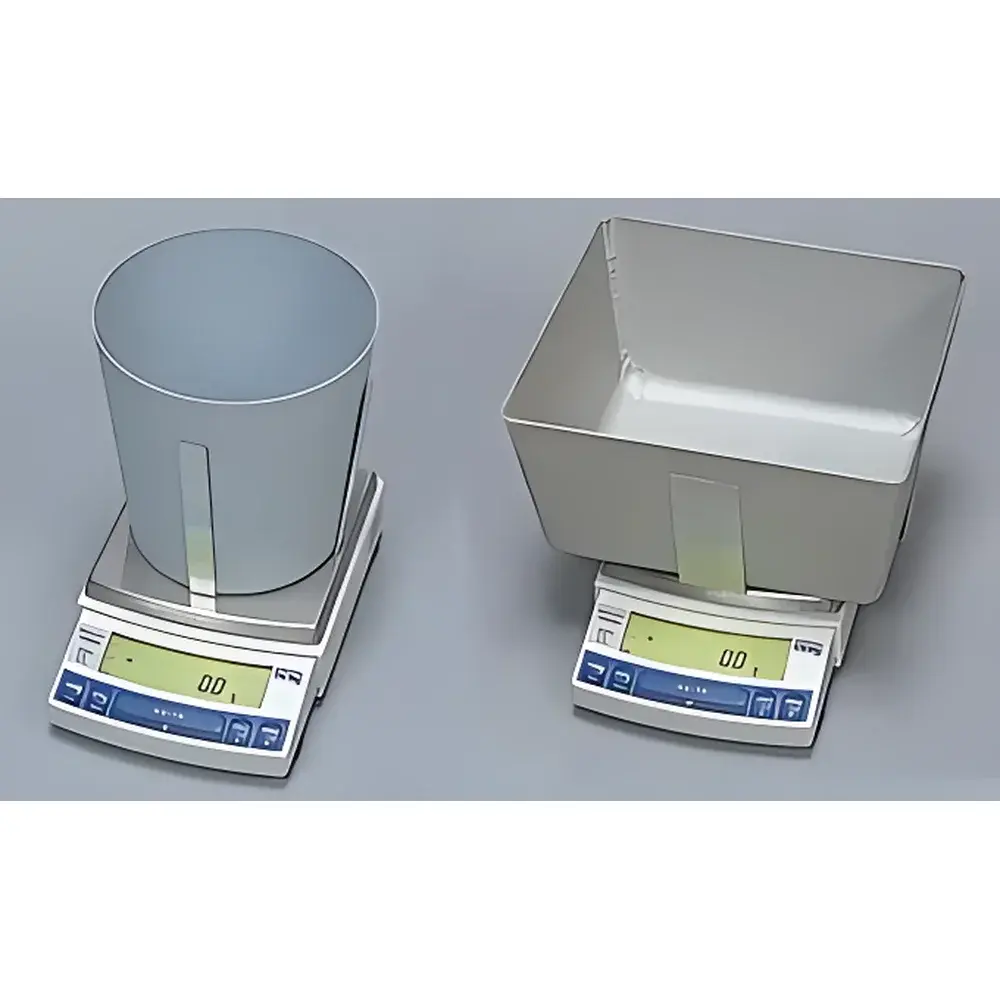
- Ergonomic Animal Pan Assembly (P/N 321-62150): Conical, ventilated acrylic enclosure (Ø110 mm base / Ø200 mm top / 130 mm height) minimizes stress while allowing unobstructed ventilation and visual monitoring—compatible with standard IVC cage transfer protocols.
- GLP-Ready Interface: RS-232 and optional USB output support direct data logging to LIMS or electronic lab notebooks; timestamped readings include mode selection, stability status flag, and operator ID field for audit trail compliance.
Sample Compatibility & Compliance
The UX Series accommodates common laboratory species including mice (15–45 g), rats (100–500 g), guinea pigs (300–1200 g), and rabbits (up to 3 kg), with models rated up to 6200 g capacity supporting larger juveniles or group weighing scenarios. All units are manufactured in Shimadzu’s ISO 9001-certified facilities in Kyoto, Japan, and conform to JIS B 7721 (Japanese Industrial Standard for non-automatic weighing instruments) and OIML R76-1 Class II accuracy requirements for precision balances. The firmware supports configurable pass/fail thresholds and stability confirmation logic aligned with OECD Test Guideline 407 (Repeated Dose 28-Day Oral Toxicity) and FDA Guidance for Industry on “General Considerations for Animal Studies” regarding measurement uncertainty reporting.
Software & Data Management
Shimadzu’s dedicated BalanceLink software (v3.2+) provides secure, password-protected configuration of animal modes, calibration history logging, and PDF report generation with embedded metadata (date/time, model number, serial ID, operator code). Audit trail functionality complies with 21 CFR Part 11 requirements when deployed with Windows-based systems configured for electronic signatures and role-based access control. Raw data export supports CSV and XML formats compatible with SAS, JMP, and GraphPad Prism for downstream statistical analysis. Optional integration with LabArchives ELN and Thermo Fisher SampleManager LIMS is validated per IQ/OQ protocols.
Applications
- Longitudinal body weight monitoring in oncology xenograft, diabetes, and obesity models
- Dosing accuracy verification prior to oral gavage or subcutaneous injection
- Metabolic cage studies requiring frequent, non-stressful weight acquisition
- Pre- and post-surgical assessment in cardiovascular or neurobehavioral models
- Quality control of breeding colony health metrics in SPF facilities
FAQ
What distinguishes the UX series from standard precision balances for animal weighing?
The UX series employs adaptive digital filtering and Unibloc sensor dynamics specifically tuned to dampen biological motion artifacts—whereas standard balances interpret animal movement as noise and either freeze display or reject readings entirely.
Is external calibration required before each use?
External calibration is recommended at startup and after relocation; however, internal temperature compensation and auto-zero tracking maintain ±0.01 g repeatability between calibrations under stable environmental conditions (20–25 °C, <60% RH).
Can the animal pan be autoclaved?
The acrylic pan assembly (P/N 321-62150) is not autoclavable; it is cleaned using 70% ethanol or approved veterinary disinfectants—validated for compatibility with common pathogen decontamination protocols.
Does the UX series support integration with automated cage change systems?
Yes—RS-232 TTL-level output enables hardware-triggered weighing initiation and result capture synchronized with cage handling robotics, provided system-level timing logic is implemented externally.
How is measurement uncertainty reported for regulatory submissions?
Uncertainty budgets follow EURACHEM/CITAC Guide CG4, incorporating contributions from readability, repeatability, eccentricity, and temperature coefficient—documented in Shimadzu’s Certificate of Conformance supplied with each unit.