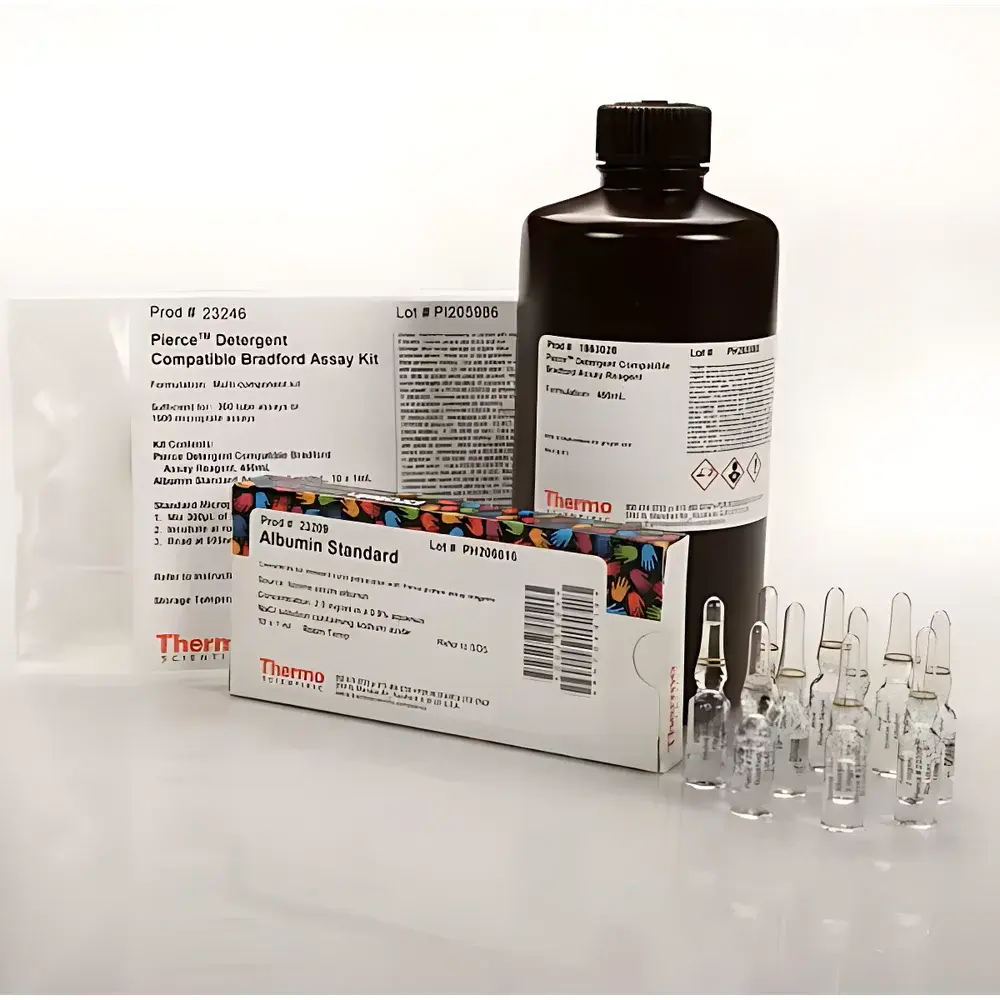
Pierce™ Detergent-Compatible Bradford Assay Kit
| Brand | Thermo Fisher Scientific |
|---|---|
| Origin | USA |
| Model | 23246 |
| Format | Ready-to-use liquid reagent |
| Detection Wavelength | 595 nm |
| Sample Volume | 10 µL (microplate format) |
| Incubation Time | 10 min at room temperature |
| Linear Range | 2–1500 µg/mL (with 1% Triton X-100 or NP-40) |
| Compatibility | Compatible with ≥1% nonionic detergents including Triton X-100, NP-40, Tween-20, and CHAPS |
| Standard Curve Required | Yes (BSA-based, supplied separately or user-prepared) |
| Measurement Platform | UV-Vis spectrophotometer or microplate reader |
Overview
The Pierce™ Detergent-Compatible Bradford Assay Kit is a rigorously optimized, ready-to-use colorimetric assay for total protein quantification in complex biological samples containing high concentrations of nonionic detergents. It is based on the classic Coomassie Brilliant Blue G-250 dye-binding principle, where the dye undergoes a protonation-dependent spectral shift upon binding to basic and aromatic amino acid residues—primarily arginine, lysine, and histidine—in acidic buffer. This interaction results in an immediate and measurable absorbance shift from 465 nm (green unbound form) to 595 nm (blue protein-bound form). Unlike conventional Bradford reagents, this formulation incorporates proprietary stabilizing additives that prevent dye precipitation and signal suppression in the presence of ≥1% (v/v) Triton X-100, NP-40, Tween-20, or CHAPS—commonly used in membrane protein extraction, immunoprecipitation, and native lysis protocols. The assay delivers high reproducibility (CV <5% across replicates) and robust performance under GLP-aligned laboratory conditions.
Key Features
- Direct detergent compatibility: Validated for accurate quantification in samples containing up to 2% (v/v) Triton X-100 or NP-40 without dilution or detergent removal steps.
- Microplate-optimized workflow: Requires only 10 µL sample volume per well, enabling high-throughput analysis with minimal material consumption.
- No reagent preparation: Supplied as a single, stable, pre-formulated liquid reagent—eliminates variability from manual mixing or stock dilution errors.
- Rapid kinetics: Achieves full color development within 10 minutes at ambient temperature (20–25°C), compatible with standard lab incubators or benchtop equilibration.
- Flexible platform integration: Designed for use with both cuvette-based spectrophotometers and 96-/384-well microplate readers equipped with 595 nm filters or monochromators.
- Controlled linearity: Delivers reliable quantification across a dynamic range of 2–1500 µg/mL, with R² >0.995 when calibrated against BSA standards prepared in matching detergent-containing buffers.
Sample Compatibility & Compliance
This assay is validated for use with mammalian cell lysates, bacterial extracts, purified recombinant proteins, and immunoprecipitated complexes solubilized in common nonionic detergents. It is not recommended for samples containing >0.1% SDS, ionic detergents, or reducing agents such as β-mercaptoethanol or DTT above 1 mM, which may interfere with dye binding or cause precipitation. The kit conforms to ISO/IEC 17025:2017 principles for method validation in accredited testing laboratories and supports traceable protein quantification workflows aligned with FDA 21 CFR Part 11 requirements when paired with compliant LIMS or ELN systems featuring audit trail functionality. Certificate of Analysis (CoA) and lot-specific performance data are available upon request.
Software & Data Management
While the assay itself requires no proprietary software, it integrates seamlessly with standard laboratory data acquisition platforms—including Gen5 (BioTek), SparkControl (Tecan), and SoftMax Pro (Molecular Devices)—for automated curve fitting, background subtraction, and concentration interpolation. Users can export raw absorbance data in CSV or Excel-compatible formats for downstream statistical analysis in R, Python (SciPy/Pandas), or GraphPad Prism. To ensure data integrity, we recommend implementing instrument calibration verification prior to each assay run using NIST-traceable neutral density filters and maintaining electronic records of standard curves, blank corrections, and plate layouts in accordance with ALCOA+ (Attributable, Legible, Contemporaneous, Original, Accurate, Complete, Consistent, Enduring, Available) principles.
Applications
- Quantification of total protein in detergent-solubilized membrane preparations prior to SDS-PAGE or native gel electrophoresis.
- Normalization of input material in co-immunoprecipitation (Co-IP) and pull-down experiments.
- Quality control release testing of purified therapeutic proteins in early-stage bioprocess development.
- Monitoring protein yield and stability during refolding or buffer exchange steps.
- Standardization of sample loading in quantitative mass spectrometry workflows requiring precise protein input.
- Validation of lysis efficiency in CRISPR/Cas9-edited cell lines or primary tissue homogenates.
FAQ
Can this assay be used with SDS-containing samples?
No. SDS disrupts dye-protein binding and causes precipitation; samples must be dialyzed or desalted to reduce SDS concentration below 0.05% prior to assay.
Is BSA standard included in the kit?
The kit does not include BSA standard; users must supply their own certified BSA reference material (e.g., Thermo Fisher Cat. No. 23209) or other suitable standard appropriate for their application.
What is the shelf life of the reagent?
When stored at 4°C protected from light, the undiluted reagent remains stable for 12 months from date of manufacture; avoid freeze-thaw cycles.
How should I handle high-absorbance samples near the upper limit?
Dilute samples into fresh assay buffer (not water) to maintain detergent concentration and re-analyze; always include diluted standards in the same buffer matrix.
Does the assay require temperature-controlled incubation?
No—color development is complete within 10 minutes at ambient laboratory temperature (20–25°C); elevated temperatures (>30°C) may accelerate dye degradation and reduce precision.