
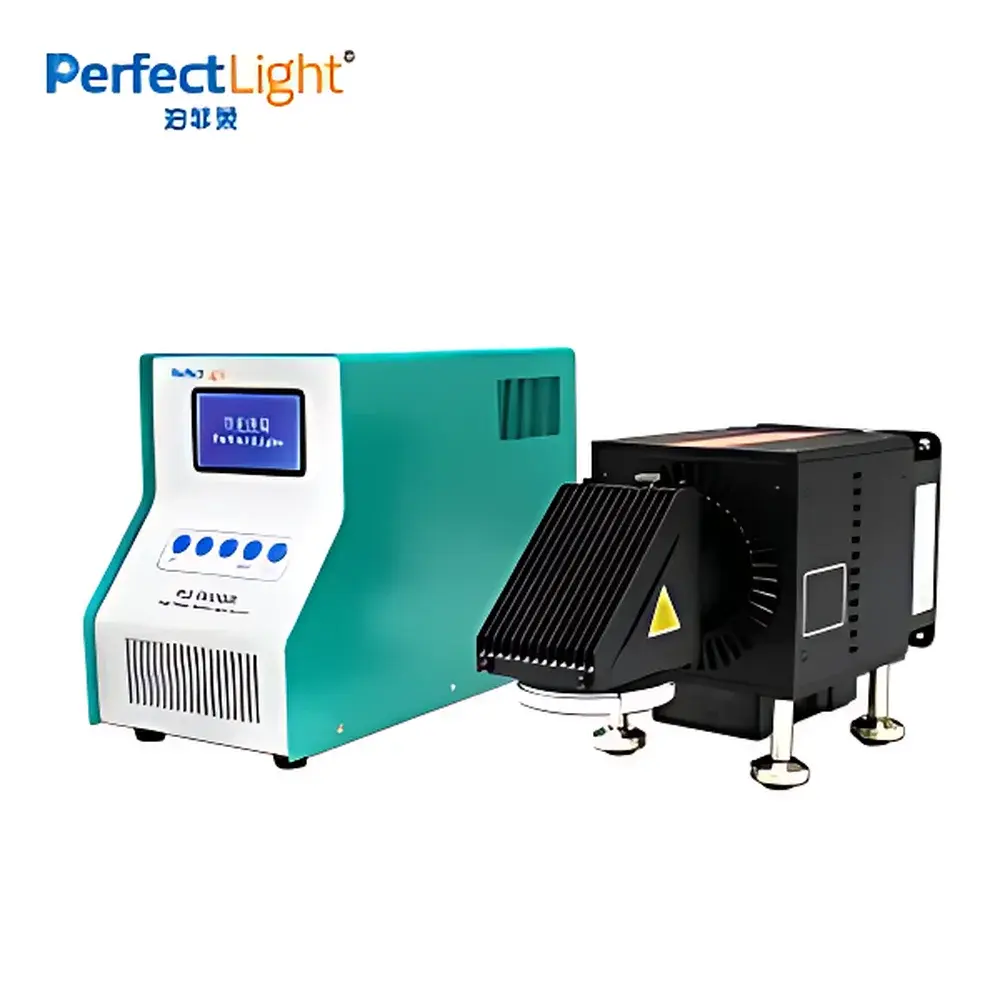
PLS-SXE300E Xenon Light Source
| Brand | PerfectLight (Perfetlight) |
|---|---|
| Origin | Beijing, China |
| Model | PLS-SXE300E |
| Light Source Type | Xenon Arc Lamp |
| Illumination Mode | External Irradiation |
| Lamp Power | 300 W |
| Power Adjustment Range | 150–300 W |
| Power Supply Ripple | 150 mVp-p |
| Load Regulation | ±0.5% |
| Current Display | Digital |
| Control Mode | Programmable / PC Software Interface |
| Current Limit Setting | 21 A |
| Lamp Lifetime | >1000 h (under standard photocatalytic operating conditions) |
| Triggering Method | Integrated High-Voltage Ignition (two-stage, no high-voltage cabling) |
| Total Optical Output Power | 50 W |
| Spectral Range | 320–780 nm (extendable to 320–2500 nm) |
| Beam Divergence | Avg. 6° |
| Spot Diameter | 30–60 mm (distance-dependent) |
| Long-Term Stability | ≤±3% |
| Cooling Architecture | Axial Fan-Based Heat Dissipation (Patent CN201320740323.5) |
| Safety Features | No HV transmission between lamp housing and power supply, fan-fault protection, auto-start on power-up, shutdown delay, overcurrent/overload cutoff |
Overview
The PLS-SXE300E Xenon Light Source is a precision-engineered optical irradiation system designed for reproducible, spectrally broad, and intensity-stable illumination in photochemical and photophysical research laboratories. Built around a 300 W short-arc xenon lamp, it delivers a continuous spectrum spanning 320–780 nm—closely approximating natural solar irradiance—and supports extension into the near-infrared (up to 2500 nm) via optional optical components. Its core architecture employs a microprocessor-controlled digital power supply with <±0.5% load regulation and low 150 mVp-p ripple, ensuring minimal current fluctuation and high temporal stability (<±3% over extended operation). Unlike conventional high-voltage lamp systems, the PLS-SXE300E utilizes an integrated two-stage ignition module that eliminates high-voltage signal transmission along interconnect cables—significantly reducing electromagnetic interference and electrical safety hazards in shared lab environments.
Key Features
- Digitally programmable power supply enabling precise 150–300 W output adjustment with real-time digital current readout and configurable current limiting (up to 21 A)
- Non-metallic lamp housing engineered to mitigate grounding risks and comply with general laboratory electrical safety standards (IEC 61010-1)
- Compact, benchtop form factor (W×D×H ≈ 220 × 280 × 160 mm) optimized for space-constrained optical setups
- ZL-patented axial suction cooling system (Patent No. CN201320740323.5) ensures uniform thermal management of the xenon arc, extending lamp life beyond 1000 hours under validated photocatalytic duty cycles
- Fully isolated control interface supporting RS232/USB communication for integration with LabVIEW, Python, or custom SCADA systems
- Comprehensive hardware-level safety suite: fan-failure detection, automatic pre-ignition self-check, post-shutdown cooling delay, and instantaneous overcurrent/overload cutoff
Sample Compatibility & Compliance
The PLS-SXE300E is compatible with standard quartz reaction vessels (e.g., Pyrex or Suprasil-grade), gas-phase flow reactors, liquid-phase slurry cells, and thin-film photoelectrochemical (PEC) configurations. Its external irradiation geometry allows flexible sample positioning without optical path obstruction. The system meets fundamental requirements for GLP-compliant photochemical experimentation—including traceable power calibration, stable irradiance delivery, and audit-ready operational logs when paired with optional data-acquisition modules. While not certified to IEC 61000-4 EMC immunity levels out-of-the-box, its low-EMI ignition design facilitates integration into ISO/IEC 17025-accredited testing labs conducting ASTM E2583 (photocatalytic VOC degradation) or ISO 22197-1 (NOx decomposition) protocols.
Software & Data Management
The included Windows-based control software provides full remote supervision: lamp ON/OFF sequencing, real-time current/voltage monitoring, programmable ramp-and-hold power profiles, and event-triggered logging (e.g., ignition success/failure, thermal alerts). All operational parameters are timestamped and exportable as CSV for traceability. When used with optional fiber-coupled spectrometers or calibrated photodiode sensors, the software supports closed-loop irradiance stabilization—enabling compliance with USP analytical instrument qualification (AIQ) criteria for light-source performance verification. Audit trails adhere to ALCOA+ principles (Attributable, Legible, Contemporaneous, Original, Accurate, Complete, Consistent, Enduring, Available) when deployed in regulated QC/QA workflows.
Applications
- Photocatalytic water splitting: H₂/O₂ evolution studies under simulated AM1.5G illumination using TiO₂, g-C₃N₄, or perovskite-based catalysts
- CO₂ photoreduction: Quantitative assessment of CH₄, CO, or C₂H₄ yield in gas-phase batch reactors
- VOC abatement kinetics: Formaldehyde, NOₓ, and SOₓ degradation under controlled relative humidity and flow conditions
- Aqueous pollutant mineralization: Rhodamine B, methyl orange, phenol, and benzene-series compound degradation monitored by HPLC or TOC analysis
- Photoelectrochemical characterization: Incident photon-to-current efficiency (IPCE) mapping and transient photocurrent spectroscopy
- Material photostability screening: Accelerated UV–vis exposure testing per ISO 4892-2 (Xenon-arc method)
FAQ
What spectral calibration options are available for quantitative irradiance measurements?
Traceable NIST-calibrated photodiode sensors and fiber-optic spectrometers (200–1100 nm) are supported via optional mounting interfaces and software integration.
Can the PLS-SXE300E be synchronized with pulsed lasers or shutter systems?
Yes—TTL-compatible external trigger input (5 V logic) enables precise timing coordination with mechanical shutters, choppers, or femtosecond laser pump-probe setups.
Is the lamp housing compatible with glovebox integration?
The non-metallic enclosure and low-outgassing materials permit direct installation inside nitrogen- or argon-purged gloveboxes; feedthrough-compatible cable glands are available upon request.
Does the system support automated spectral filtering?
Motorized filter wheels (6-position) and electronically tunable bandpass filters (300–1100 nm) are offered as OEM-integrated accessories with software-defined wavelength selection.
How is lamp aging compensated during long-term experiments?
The digital power supply includes auto-compensation mode: users define target irradiance at 365 nm or 420 nm; the system dynamically adjusts drive current to maintain setpoint intensity over lamp lifetime.




