
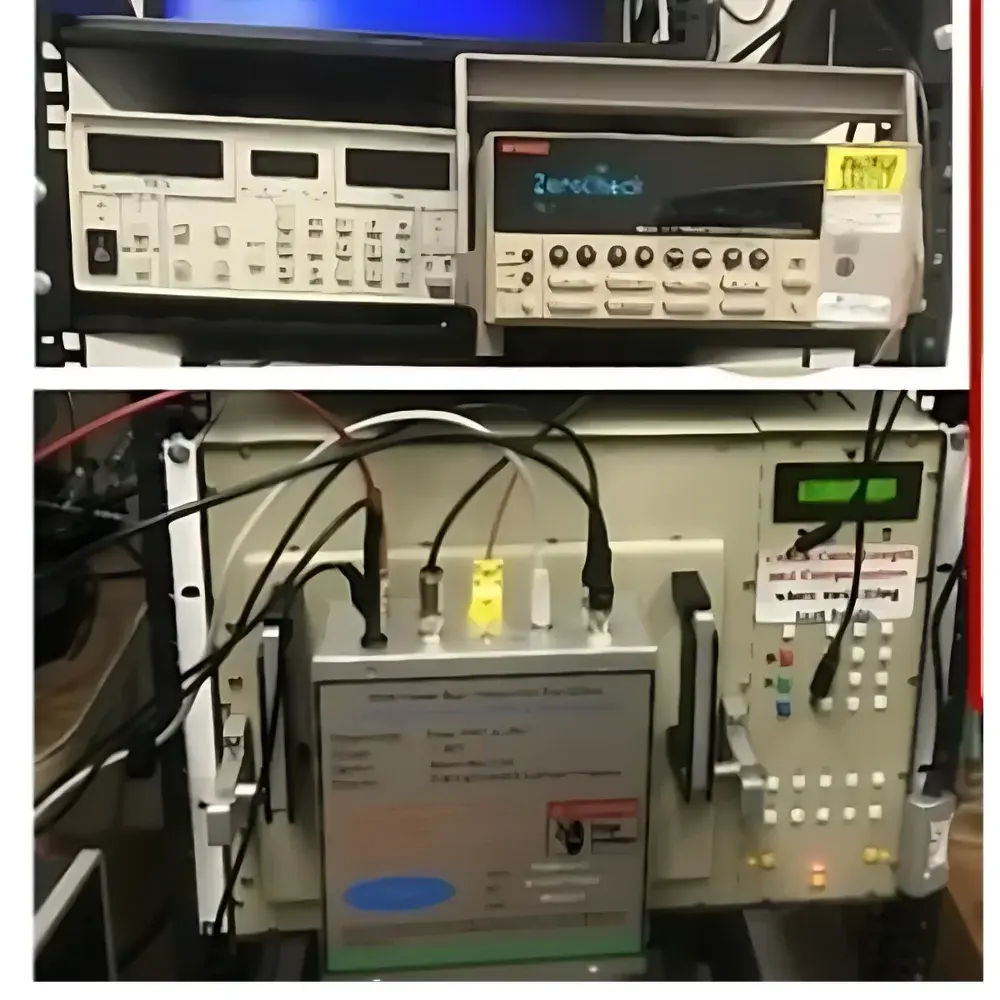
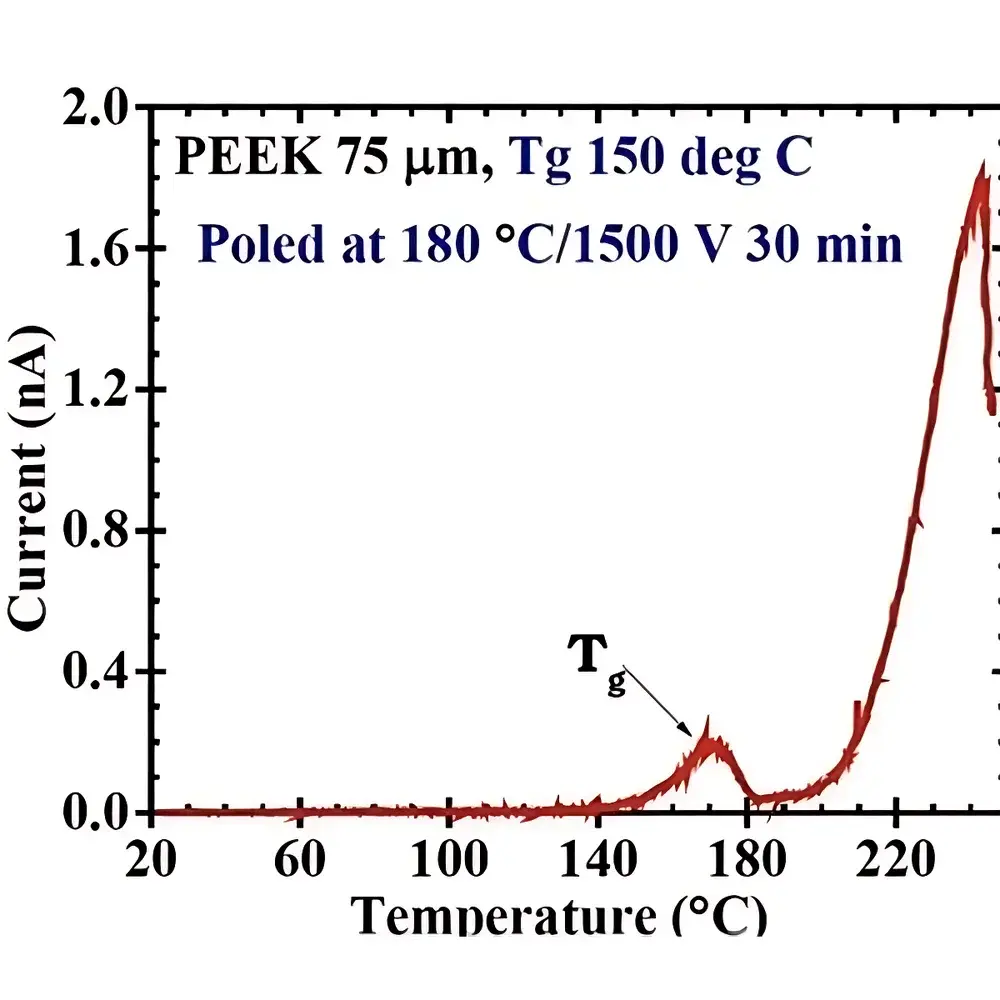
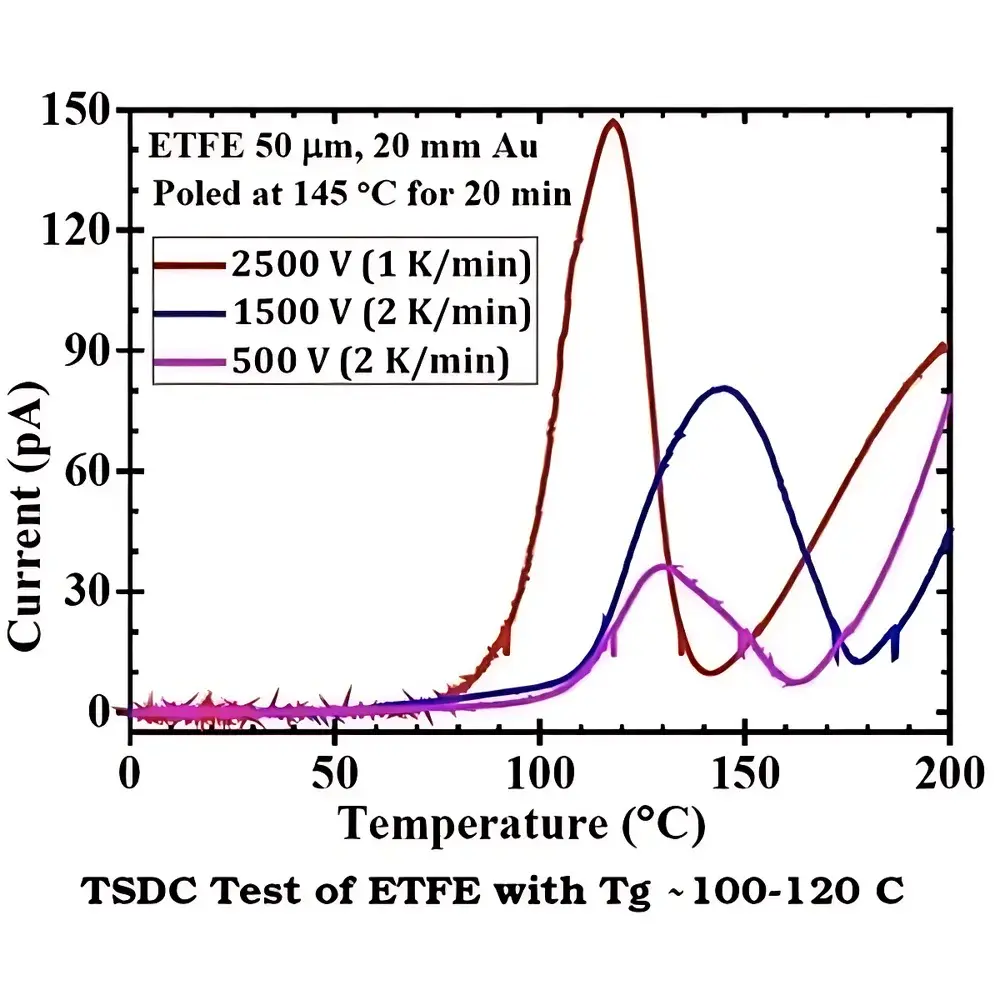
PolyK PK-Pyro600 Thermally Stimulated Depolarization Current (TSDC) Measurement System
| Brand | PolyK Technologies |
|---|---|
| Origin | USA |
| Model | PK-Pyro600 |
| Temperature Range | −184 °C to >300 °C (with liquid nitrogen cooling) |
| Current Measurement Resolution | pA-level (10⁻¹² A) |
| Sample Diameter | up to 8 cm |
| Electric Field Capability | >100 V/µm in air |
| High-Voltage Source | ±10 kV (SRS PS350 or Trek 10 kV) |
| Electrometer | Keithley 6517B (or equivalent) with coaxial shielded cabling |
| Shielding | Fully Faraday-shielded test chamber with insulated interior door mount |
| Electrode Configuration | Spring-loaded spherical electrodes for non-damaging contact on soft polymer films (<10 µm thick) |
| Compliance | ASTM D257, ISO 3001-1, IEC 60243-1, GLP/GMP-ready data logging architecture |
Overview
The PolyK PK-Pyro600 Thermally Stimulated Depolarization Current (TSDC) Measurement System is an engineered solution for quantitative dielectric characterization of thin polymer films under extreme operational conditions—specifically high electric fields (>100 V/µm), elevated temperatures (>300 °C), and ultra-low current regimes (down to sub-picoampere levels). Unlike conventional resistivity testers operating at low fields (20 h), high-field stability critical for reliability assessment.
Key Features
- Ultra-low-current electrometry: Integrated Keithley 6517B (or equivalent) electrometer with guarded coaxial cabling and active shielding, delivering stable pA-level resolution under continuous high-voltage bias.
- High-field compatibility: ±10 kV programmable high-voltage source (SRS PS350 or Trek 10 kV series) with precision voltage ramping and hold capability—engineered for sustained operation at >100 V/µm without arcing or electrode degradation.
- Cryogenic-to-high-temperature range: Full thermal control from −184 °C (liquid nitrogen-cooled cryostat) to >300 °C via resistive heating and PID-regulated thermal stage—enabling TSDC, thermally stimulated conductivity (TSC), and pyroelectric current analysis across broad phase transitions.
- Non-destructive sample interface: Spring-loaded spherical electrodes ensure uniform, low-pressure contact on mechanically fragile polymer films (thickness <10 µm), minimizing indentation, puncture, or local field enhancement.
- Faraday-shielded test chamber: Fully enclosed, grounded copper-shielded enclosure with insulated interior door mounting—providing >120 dB electromagnetic interference (EMI) suppression and eliminating environmental noise coupling during pA measurements.
- Modular architecture: Interchangeable test cavity design supports reconfiguration for complementary dielectric spectroscopy (e.g., impedance gain-phase), DC breakdown testing, and high-voltage endurance validation per IEC 60243-1.
Sample Compatibility & Compliance
The PK-Pyro600 accommodates circular samples up to 8 cm in diameter and thicknesses ranging from 100 nm to 500 µm, including biaxially oriented polypropylene (BOPP), polyethylene naphthalate (PEN), polyimide (PI), and ferroelectric PVDF-based copolymers. Its air-gap configuration eliminates immersion-related artifacts and enables direct correlation with capacitor stack behavior. All measurement protocols align with ASTM D257 (Standard Test Methods for DC Resistance or Conductance of Insulating Materials), ISO 3001-1 (Electrical insulating materials — Determination of resistivity), and IEC 60243-1 (Electric strength of insulating materials — Part 1: Tests at power frequencies). Data acquisition supports audit-ready timestamped logs with full metadata (voltage, temperature, time, ambient humidity), meeting GLP and GMP documentation requirements per FDA 21 CFR Part 11 when paired with validated software configurations.
Software & Data Management
Control and analysis are executed via PolyK’s proprietary PyroSoft Suite—a Windows-based application supporting synchronized multi-parameter acquisition (current, voltage, temperature, time), automated TSDC ramp sequences (e.g., linear heating rate from −100 °C to 200 °C at 1–5 °C/min), and post-processing algorithms for deconvolution of overlapping relaxation peaks using Gaussian, Lorentzian, or Arrhenius-based fitting models. Raw data export is available in CSV, HDF5, and MATLAB-compatible formats. Optional integration with LabVIEW or Python APIs permits custom automation and integration into enterprise LIMS or MES platforms. All user actions—including parameter edits, calibration events, and report generation—are logged with operator ID, timestamp, and digital signature for traceability.
Applications
- Quantification of deep-trap density and activation energy in high-k polymer gate dielectrics for flexible electronics.
- Evaluation of space charge accumulation and dissipation dynamics in DC-link film capacitors for EV inverters and renewable energy systems.
- Correlation of microstructural evolution (crystallinity, phase separation) with dipole mobility in piezoelectric and pyroelectric polymer composites.
- Accelerated aging studies under combined electrical stress and thermal cycling to predict lifetime failure modes in aerospace-grade insulation systems.
- Validation of charge injection barriers at metal–polymer interfaces through field-dependent TSDC peak shift analysis.
FAQ
What is the minimum measurable current resolution of the PK-Pyro600?
The system achieves stable sub-picoampere resolution (≤0.1 pA RMS noise floor) under continuous 10 kV bias, verified via long-term drift testing on <5 µm BOPP films.
Can the system operate under vacuum or inert gas atmospheres?
Yes—the test chamber includes dual-port gas inlet/outlet fittings and optional vacuum flange integration (KF-40), enabling operation under N₂, Ar, or <10⁻³ mbar vacuum to suppress surface conduction and corona discharge.
Is the temperature calibration NIST-traceable?
All thermal sensors (Pt100 RTD, thermocouple inputs) are factory-calibrated against NIST-traceable standards; users may perform on-site verification using certified reference cells.
How is electrode alignment ensured for non-planar or warped samples?
The spring-loaded spherical electrode assembly provides axial compliance (±0.5 mm travel) and self-centering geometry, maintaining consistent contact pressure across curvature deviations up to ±250 µm.
Does the system support simultaneous dielectric spectroscopy (DS) and TSDC?
While DS requires AC excitation incompatible with DC TSDC protocols, the modular cavity allows rapid hardware reconfiguration between the two modes using shared thermal and shielding infrastructure.



