
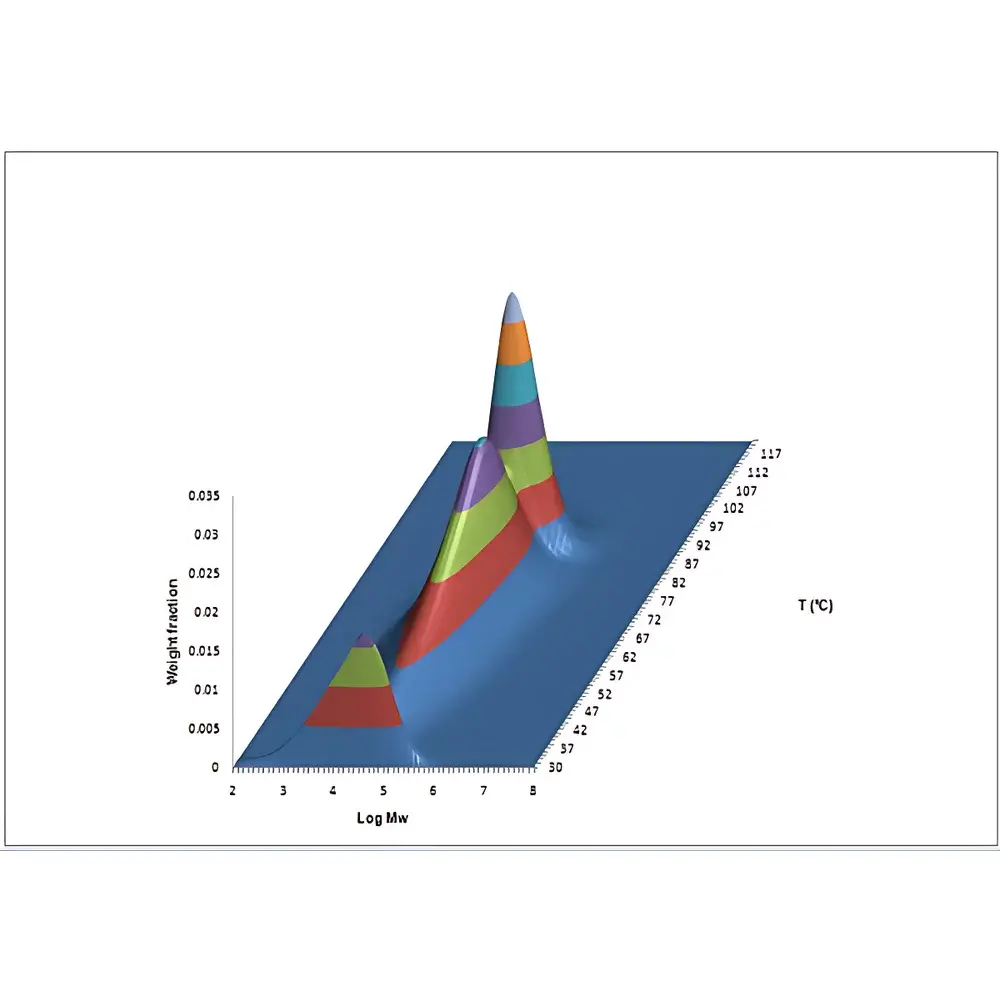
Polymer Char CFC Instrument for Metallocene Catalyst Polymerization Process Optimization Analysis
| Brand | Polymer Char |
|---|---|
| Origin | Spain |
| Manufacturer Type | Authorized Distributor |
| Product Origin | Imported |
| Model | CFC Instrument for Polymerization Process Optimization Analysis |
| Pricing | Available Upon Request |
Overview
The Polymer Char CFC Instrument is a dedicated analytical platform engineered for the systematic optimization of metallocene-catalyzed olefin polymerization processes. It operates on the principle of high-temperature crystallization analysis (HT-CF), coupled with integrated differential scanning calorimetry (DSC) and compositional distribution analysis (CCD), enabling precise quantification of microstructural heterogeneity in polyolefins—including comonomer distribution, short-chain branching (SCB) content, crystallinity gradients, and molecular weight distribution (MWD) correlations. Unlike conventional rheological or spectroscopic screening tools, the CFC instrument delivers process-relevant structural fingerprints directly traceable to catalyst active site behavior and reactor residence time distribution. This enables polymer scientists and process engineers to deconvolute cause–effect relationships between reaction parameters (e.g., temperature, hydrogen concentration, monomer feed ratio, catalyst loading) and final resin architecture—critical for meeting stringent specifications in automotive, medical-grade, and thin-film applications.
Key Features
- Automated high-temperature crystallization fractionation (HT-CF) with programmable cooling ramps from 160 °C to 30 °C at rates as low as 0.1 °C/min, ensuring reproducible separation of polyolefin fractions by crystallizability.
- Integrated DSC module compliant with ASTM D3418 and ISO 11357 standards, providing simultaneous thermal transition data (Tm, Tc, ΔHf) for each eluted fraction.
- Compositional distribution analysis (CCD) via infrared detection (FTIR) calibrated against certified reference materials per ASTM D6645, delivering quantitative ethylene/propylene or higher α-olefin content per fraction.
- Modular design supporting optional integration with GPC/SEC detectors for cross-correlation of composition and molecular weight distributions.
- Robust architecture with inert gas purging (N2 or Ar), corrosion-resistant fluidic paths, and temperature-stabilized column oven (±0.05 °C), ensuring long-term operational stability under routine QC/QA workflows.
Sample Compatibility & Compliance
The CFC instrument accepts standard polyolefin samples (PE, PP, EPDM, plastomers) in solution form (typically 1,2,4-trichlorobenzene at 1–2 mg/mL). Sample preparation follows ASTM D6474 and ISO 16014-2 protocols. All analytical methods are fully compatible with GLP and GMP environments: audit trails, user access levels, electronic signatures, and raw data integrity are supported in accordance with FDA 21 CFR Part 11 requirements when used with Polymer Char’s certified software suite. Method validation documentation—including precision (RSD 0.999), and robustness across laboratories—is available upon request for regulatory submissions.
Software & Data Management
Polymer Char’s proprietary CFC Software v5.x provides full method development, acquisition, and advanced post-processing capabilities. It supports automated peak deconvolution using multivariate curve resolution (MCR), generates compositional distribution curves (CDF), calculates weighted average comonomer content (w-SCB), and exports structured data in ASTM E1482-compliant XML format. All raw thermal and spectral files are stored with immutable metadata (operator ID, timestamp, instrument configuration, calibration history). The software includes built-in reporting templates aligned with internal R&D dashboards and external regulatory dossiers (e.g., ICH M4, USP ).
Applications
- Screening metallocene and post-metallocene catalyst systems for comonomer incorporation efficiency and active site uniformity.
- Mapping reactor temperature and monomer concentration profiles to microstructural outcomes in slurry, gas-phase, and solution processes.
- Supporting DOE (Design of Experiments) studies to identify critical process parameters (CPPs) impacting product quality attributes (CQAs) such as haze, stiffness–toughness balance, and seal initiation temperature.
- Accelerating technology transfer from lab-scale to pilot and commercial reactors through structural benchmarking.
- Resolving batch-to-batch variability in commercial production by correlating CFC-derived compositional heterogeneity with end-use performance metrics.
FAQ
What sample quantity is required for a complete CFC analysis?
Typically 15–20 mg of purified polymer dissolved in 8–10 mL of preheated 1,2,4-trichlorobenzene at 150 °C.
Can the CFC system be validated for use in regulated pharmaceutical packaging development?
Yes—when deployed with documented IQ/OQ/PQ protocols and operated under controlled software permissions, it meets USP analytical instrument qualification criteria for material characterization.
Does the instrument support unattended overnight operation?
Yes—fully automated sequence execution, including solvent purge, column equilibration, injection, fraction collection, and DSC scan, is supported via scheduler functionality.
How does CFC differ from traditional TREF (Temperature Rising Elution Fractionation)?
CFC employs continuous crystallization fractionation with real-time DSC and IR detection, eliminating manual fraction collection and subjective peak assignment inherent in classical TREF.
Is method transfer possible between different CFC instrument installations?
Yes—method portability is ensured through standardized calibration procedures, reference material traceability, and software-based method export/import functionality.






