
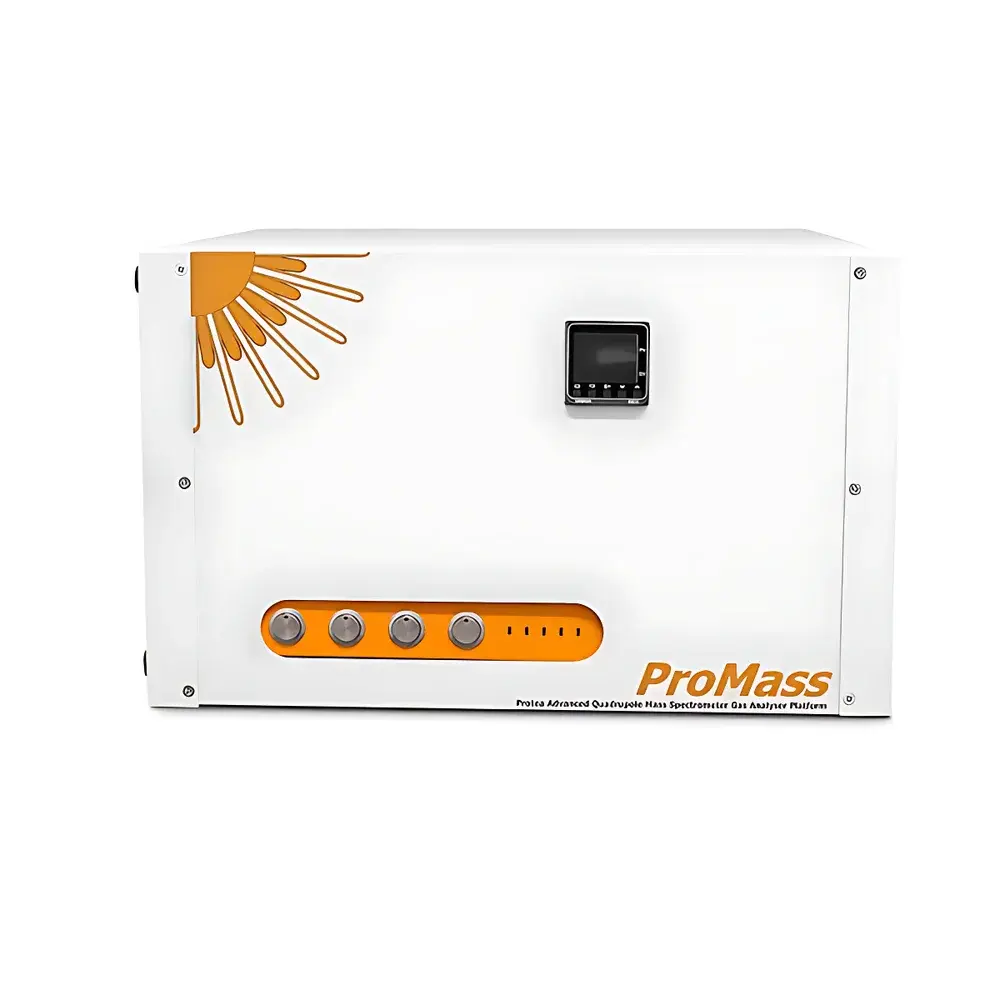
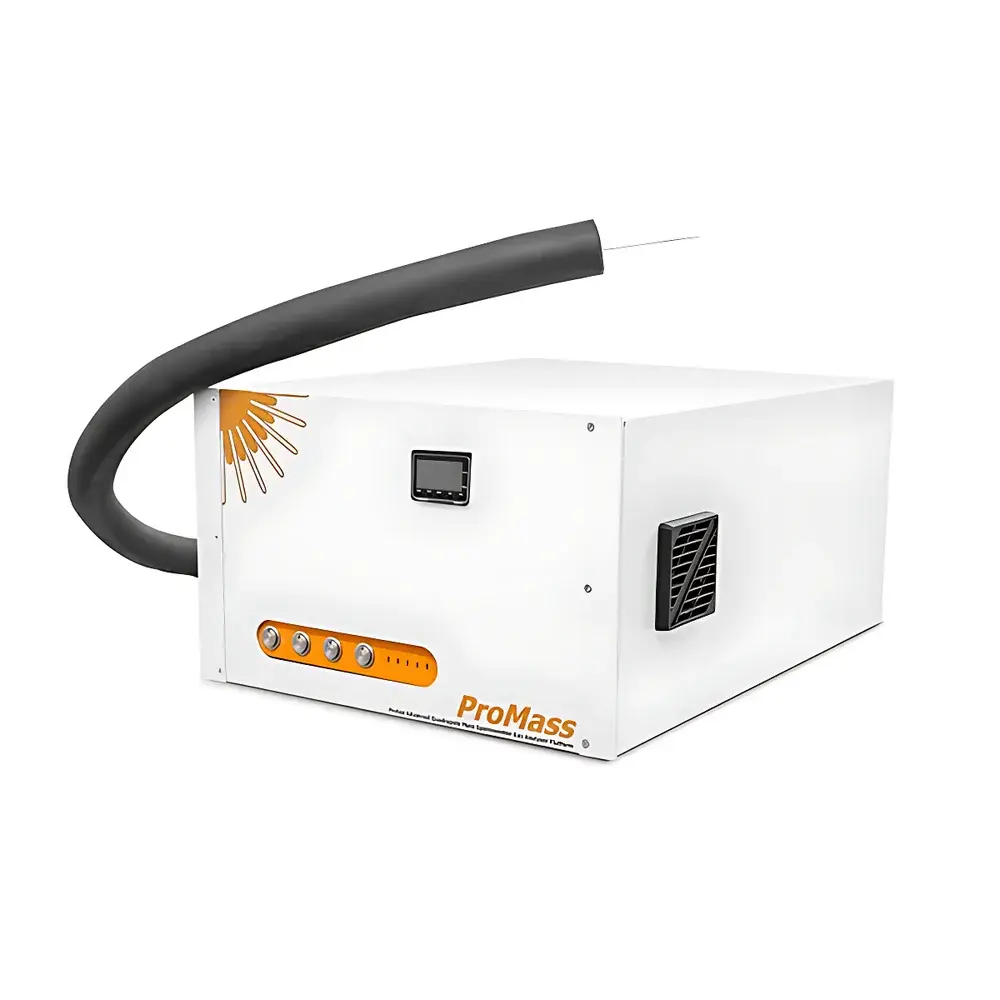
Protea ProMass-D Desktop Quadrupole Mass Spectrometer
| Brand | Protea |
|---|---|
| Origin | United Kingdom |
| Manufacturer Type | Authorized Distributor |
| Origin Category | Imported Instrument |
| Model | ProMass-D |
| Pricing | Available Upon Request |
| Mass Range Options | 0–100 amu, 0–200 amu, or 0–300 amu (configurable) |
| Detection Principle | Quadrupole Mass Filtering (QMS) |
| Ion Detection | Dual-mode—Faraday Cup + Secondary Electron Multiplier (SEM) |
| Sample Inlet | Direct Capillary Inlet |
| Response Time | Millisecond-scale |
| Application Domain | Real-time Gas Phase Analysis in Lab and Process Environments |
Overview
The Protea ProMass-D Desktop Quadrupole Mass Spectrometer is a compact, robust benchtop instrument engineered for high-fidelity gas-phase molecular analysis using quadrupole mass spectrometry (QMS) principles. At its core, the ProMass-D employs a radiofrequency (RF) and direct current (DC) voltage-driven quadrupole mass filter—comprising four precisely aligned parallel rods—to selectively transmit ions based on their mass-to-charge ratio (m/z). Ions generated via electron ionization (EI) at 70 eV are filtered in real time, enabling deterministic separation and detection across configurable mass ranges of 0–100 amu, 0–200 amu, or 0–300 amu. Designed for operational flexibility, the system supports both horizontal and vertical mounting configurations, making it suitable for integration into laboratory workbenches, gloveboxes, or near-process sampling points. Its integrated vacuum architecture—combining a turbomolecular pump with backing pump—maintains stable operating pressure (<1×10⁻⁶ mbar) without external pumping infrastructure, ensuring rapid system stabilization and repeatable analytical performance.
Key Features
- Configurable mass range selection (0–100 / 0–200 / 0–300 amu) optimized for target analytes in gas-phase applications
- Dual detection system: Faraday cup for high-current, stable quantitative measurement and secondary electron multiplier (SEM) for trace-level sensitivity down to sub-ppt levels
- Direct capillary inlet with heated transfer line—enables rapid, contamination-minimized gas introduction without pre-concentration or chromatographic separation
- Millisecond-scale temporal resolution supports dynamic process monitoring, including transient reaction profiling and real-time TGA-MS coupling
- Pre-loaded, application-specific spectral libraries—including H2, CO, CO2, CH4, NH3, NOx, VOCs, and catalyst effluent signatures—facilitate rapid qualitative identification and semi-quantitative screening
- Fully integrated vacuum subsystem with automated pressure regulation and pump health diagnostics, reducing operator dependency and maintenance overhead
Sample Compatibility & Compliance
The ProMass-D accepts gaseous samples directly from ambient air, reactor headspace, fermentation off-gas streams, catalytic test benches, or evolved gas outputs from thermal analyzers (e.g., TGA, DSC). It is compatible with inert carrier gases (He, N2, Ar), reactive species (H2, O2, NH3), and complex mixtures containing condensables when operated with appropriate inlet temperature control (up to 200 °C). The instrument conforms to CE marking requirements under EU Directive 2014/30/EU (EMC) and 2014/35/EU (LVD). Its software architecture supports audit trail generation, user access control, and electronic signature functionality compliant with FDA 21 CFR Part 11 for regulated environments. Routine operation aligns with ISO/IEC 17025 method validation frameworks and ASTM D7169 (for hydrocarbon gas analysis) and ASTM E2789 (for residual gas analysis in vacuum systems).
Software & Data Management
The ProMass-D is controlled via Protea’s proprietary MassSpecLab™ software—a Windows-based platform supporting real-time spectral acquisition, multi-channel time-profile logging, peak integration, background subtraction, and library-assisted compound matching. Data files are saved in vendor-neutral .csv and .mzML formats, ensuring interoperability with third-party chemometric tools (e.g., MATLAB, Python-based SciPy workflows). The software includes built-in calibration wizards for mass axis alignment and sensitivity normalization using reference gases (e.g., perfluorotributylamine, PFTBA). All instrument parameters—including RF/DC voltages, detector gain settings, dwell times, and scan sequences—are fully scriptable via COM API, enabling seamless integration into automated lab systems (e.g., LIMS, PLC-controlled reactors). Raw data archives retain full metadata (timestamp, operator ID, hardware configuration, vacuum status), satisfying GLP/GMP documentation requirements.
Applications
- Hydrogen fuel characterization: Quantification of H2 purity, impurity profiling (O2, H2O, CO, CH4), and leak detection in PEM electrolyzer and fuel cell test stations
- TGA-MS hyphenated analysis: Real-time correlation of mass loss events with evolved gas composition during thermal decomposition, polymer degradation, or battery cathode cycling studies
- Environmental emissions monitoring: Continuous measurement of VOCs, NOx, SO2, and greenhouse gases in stack testing and indoor air quality assessment
- Fermentation bioprocess analytics: Online monitoring of O2 uptake rate (OUR), CO2 evolution rate (CER), and metabolic byproduct formation (e.g., ethanol, acetate) in bioreactors
- Heterogeneous catalysis research: In situ analysis of surface reaction intermediates, adsorption/desorption kinetics, and catalyst deactivation pathways under realistic feed conditions
FAQ
What vacuum level does the ProMass-D require for stable operation?
The system achieves and maintains an operating pressure of ≤1×10⁻⁶ mbar using its integrated turbomolecular pumping station; no external roughing pump is required.
Can the ProMass-D be used with corrosive or condensable gases?
Yes—when equipped with a heated capillary inlet (up to 200 °C) and optional inert-coated quadrupole rods, it accommodates mildly corrosive gases (e.g., HCl, Cl2) and low-volatility organics; extended exposure to aggressive halogens or silanes requires custom inlet conditioning.
Is method transfer possible between different ProMass-D units?
Yes—mass calibration, detector gain tables, and spectral libraries are exportable/importable as encrypted configuration files, ensuring consistent quantitative performance across installations.
Does the software support automated sequence execution?
Yes—MassSpecLab™ supports scheduled acquisition, conditional triggering (e.g., on pressure threshold or external TTL signal), and post-run report generation with customizable templates.
What service and support options are available internationally?
Protea provides remote diagnostics, annual preventive maintenance contracts, on-site calibration services, and application-specific method development support through its global network of certified service engineers and regional application labs.




