
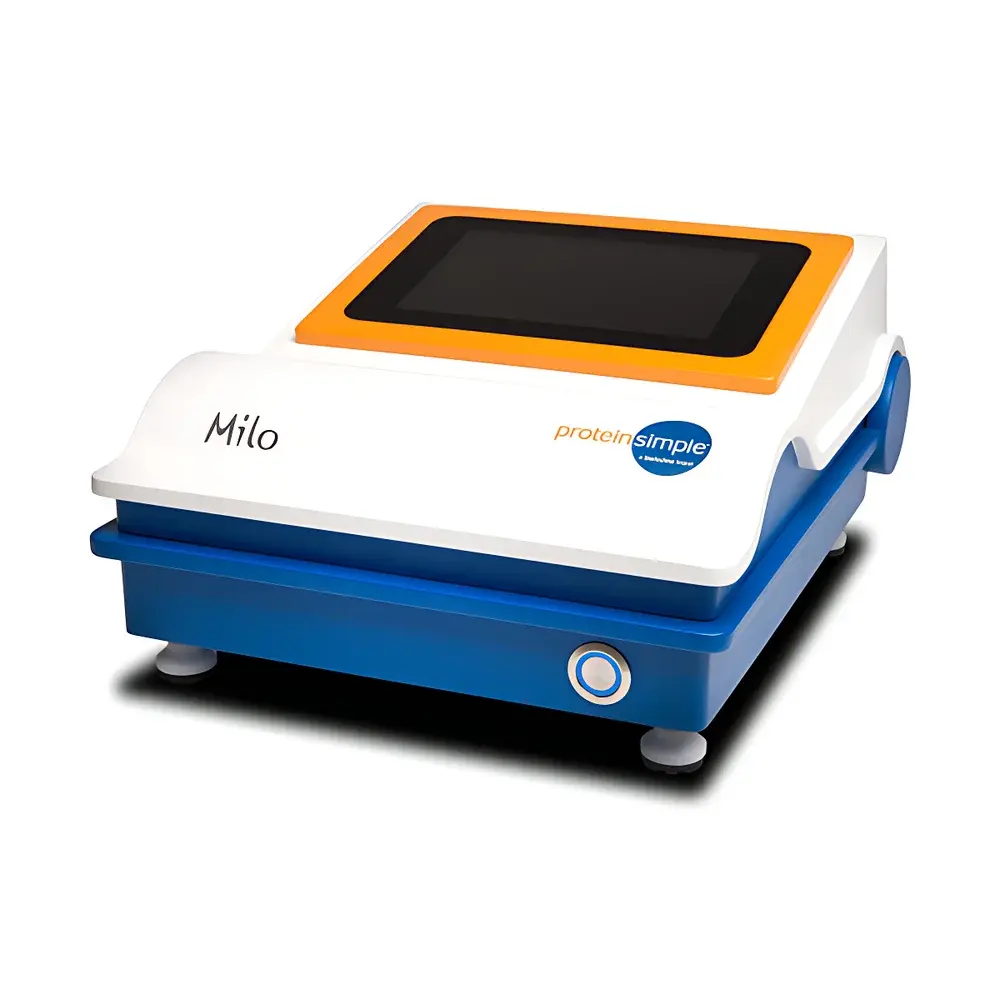
ProteinSimple Milo Single-Cell Western Blotting System
| Brand | ProteinSimple |
|---|---|
| Origin | USA |
| Manufacturer Type | Authorized Distributor |
| Product Category | Imported Instrument |
| Model | Milo |
| Instrument Type | Fully Automated Single-Cell Western Blotting System |
| Automation Level | Fully Automated |
Overview
The ProteinSimple Milo Single-Cell Western Blotting System is an engineered platform for quantitative, single-cell resolution protein expression profiling—grounded in the principle of microfluidic electrophoretic separation followed by on-chip immunodetection. Unlike bulk or ensemble western blotting, Milo performs true single-cell western blotting (scWB) by integrating cell isolation, on-chip lysis, size-based protein separation via SDS-PAGE in nanoliter-scale channels, and antibody-based detection—all within a disposable microfluidic chip. This approach preserves molecular weight information while enabling multiplexed, antibody-validated quantification of intracellular and membrane proteins at the individual cell level. Developed from foundational work published in Nature Methods (2014) and further refined in Nature Protocols (2016), Milo bridges the gap between transcriptomic heterogeneity and functional proteomic output, delivering orthogonal validation to single-cell RNA sequencing data with higher specificity than immunoassays lacking electrophoretic separation.
Key Features
- Microfluidic chip architecture enabling parallel processing of 1,000–2,000 single cells per run, with integrated cell trapping, lysis, electrophoresis, and immunocapture
- On-chip SDS-PAGE separation prior to antibody binding—enhancing specificity by resolving isoforms, post-translational modifications, and degradation products
- Direct compatibility with standard western blot-validated primary antibodies; no requirement for specialized reagents or conjugates
- Simultaneous detection of up to 30 distinct protein targets per cell using sequential fluorescent antibody probing and stripping
- End-to-end automation: sample loading, electrophoresis, immunostaining, washing, and imaging completed in 4–6 hours without manual intervention
- Integrated high-resolution fluorescence scanner with dual-laser excitation (488 nm / 640 nm) and PMT-based detection optimized for low-abundance targets in rare cell populations
Sample Compatibility & Compliance
Milo supports suspension and adherent mammalian cells—including primary isolates, patient-derived xenograft (PDX) cells, circulating tumor cells (CTCs), induced pluripotent stem cells (iPSCs), and immune subsets—with minimal input requirements (as few as 10,000 cells per chip). The system complies with laboratory quality standards for reproducible, traceable data generation: raw image files and analysis metadata are timestamped and stored in audit-trail-enabled formats. While not FDA-cleared for diagnostic use, Milo workflows align with GLP-aligned documentation practices and support 21 CFR Part 11-compliant software configurations when deployed with enterprise Scout software licensing. All protocols adhere to ISO/IEC 17025 principles for method validation in research settings.
Software & Data Management
Scout software—Milo’s native acquisition and analysis suite—provides automated lane alignment, background subtraction, band intensity quantification, and normalization against internal loading controls (e.g., total protein stain or housekeeping proteins). It supports batch processing across multiple chips, hierarchical clustering of single-cell expression profiles, and export of fully annotated .csv and .fcs files compatible with FlowJo, Cytobank, and R/Bioconductor pipelines. Data integrity is reinforced through version-controlled protocol templates, user-access logging, and encrypted local storage options. Scout also enables direct integration with LIMS environments via RESTful API for enterprise-scale deployment in core facilities and contract research organizations.
Applications
- Quantitative dissection of phenotypic heterogeneity in tumor subpopulations during therapy resistance development
- Mapping signaling pathway activation states across rare stem/progenitor cell subsets during differentiation trajectories
- Validating target engagement and downstream modulation in preclinical pharmacodynamic studies
- Profiling immune checkpoint protein co-expression at single-cell resolution in tumor-infiltrating lymphocytes (TILs)
- Correlating proteoform-level changes (e.g., phosphorylation, cleavage) with functional outcomes in primary patient samples where material is limiting
FAQ
What distinguishes Milo from conventional western blotting or digital ELISA platforms?
Milo retains electrophoretic separation—enabling isoform resolution and specificity control—while achieving single-cell throughput unattainable with traditional methods.
Can Milo detect post-translational modifications (PTMs)?
Yes—by preserving molecular weight separation, Milo resolves PTM-induced shifts (e.g., phosphorylation, ubiquitination) and allows antibody-specific interrogation within defined size windows.
Is cell viability required for Milo analysis?
No—Milo accepts fixed or live cells; however, fixation conditions must be empirically optimized to preserve epitope integrity and prevent aggregation during on-chip lysis.
How does Milo handle sample multiplexing across experimental conditions?
Each chip accommodates up to eight independently loaded samples via spatially segregated microchannels, enabling controlled condition comparisons without cross-contamination.
What validation data supports Milo’s quantitative accuracy?
Published benchmarking in Nature Protocols (2016) demonstrates linear dynamic range spanning three orders of magnitude and inter-run CVs <15% for well-characterized phosphoprotein targets under standardized conditions.




