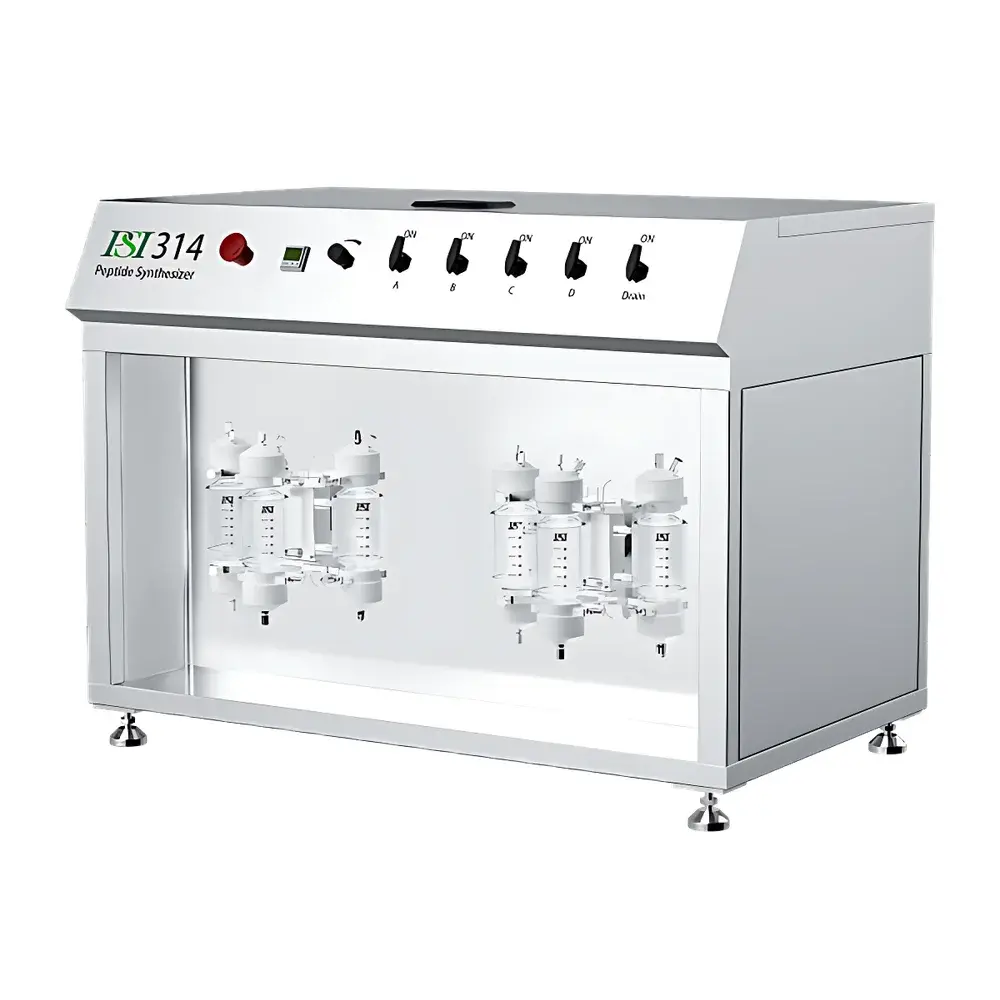
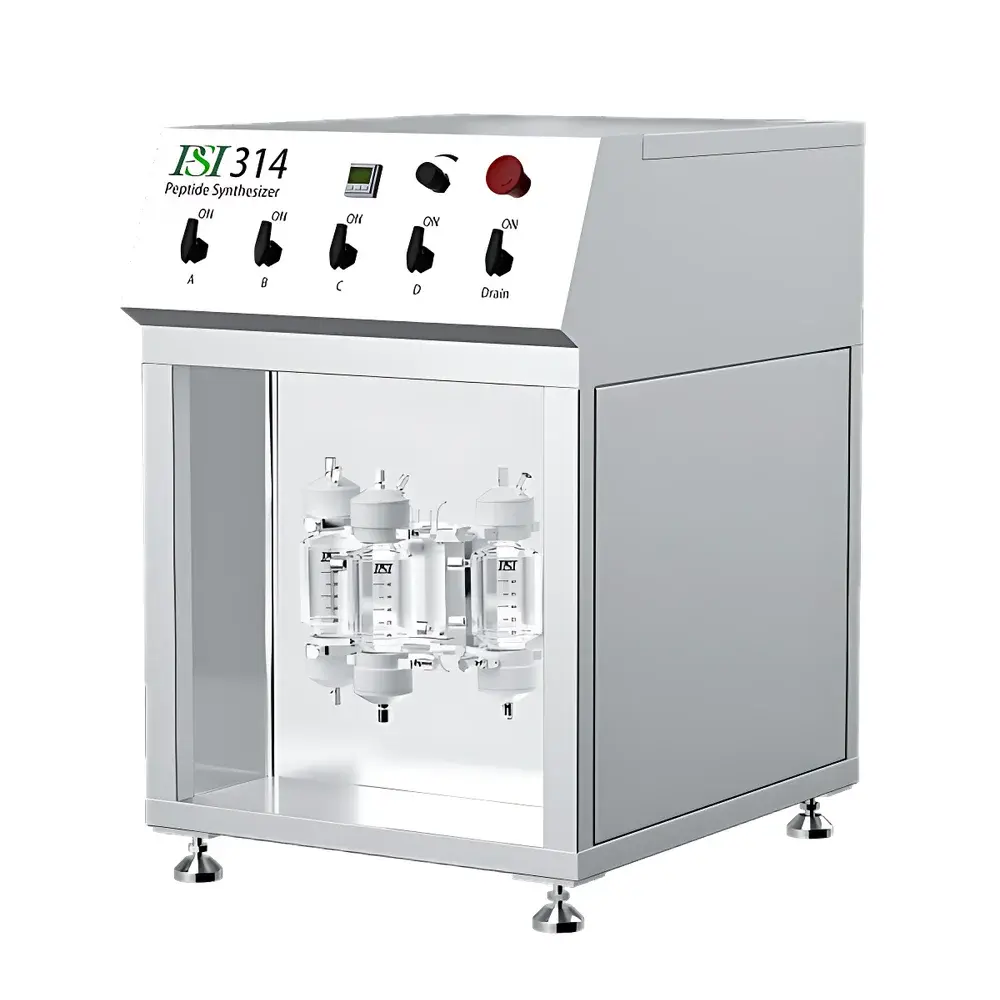
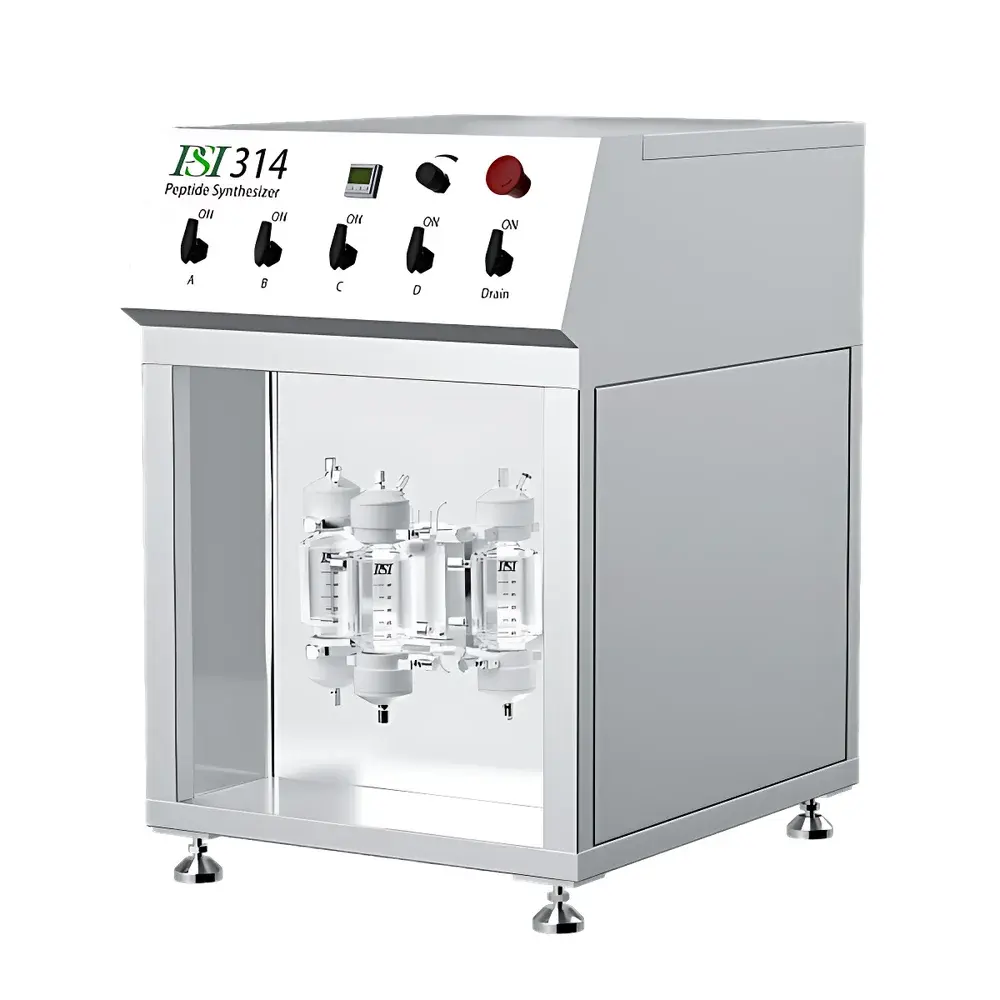
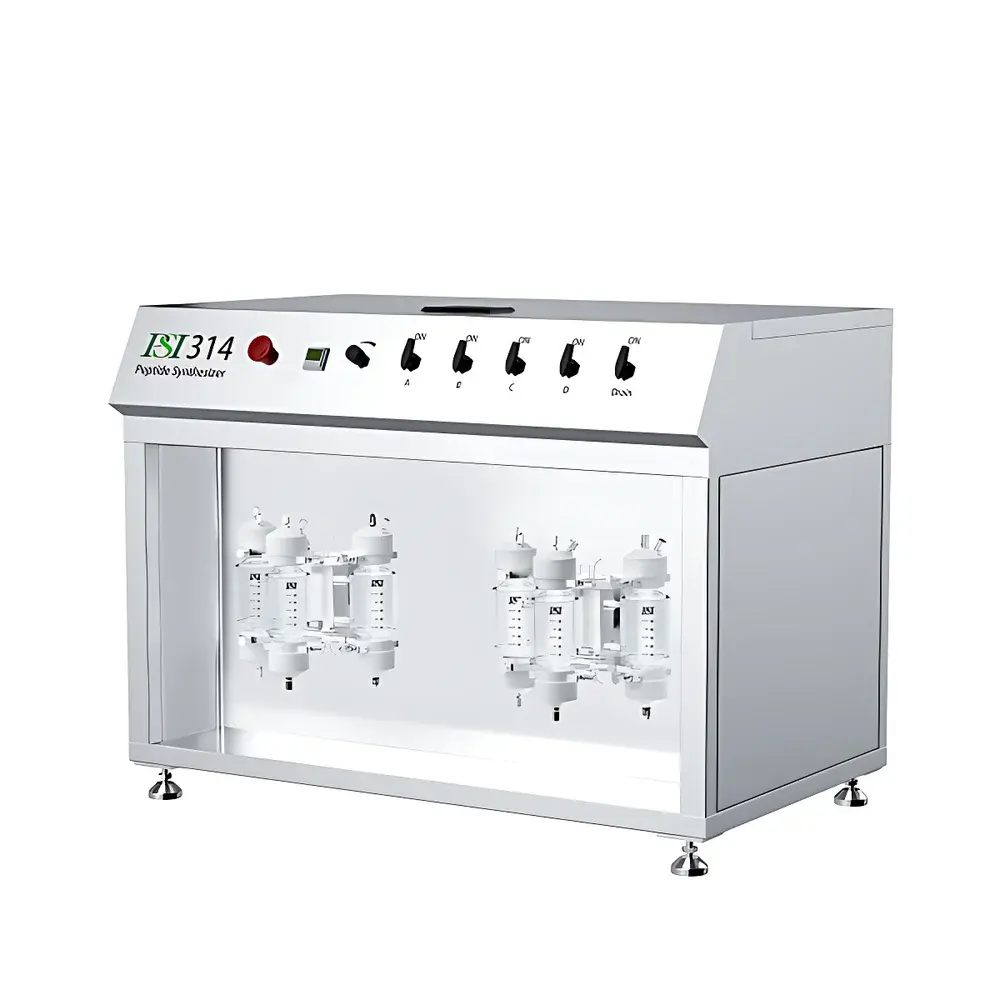
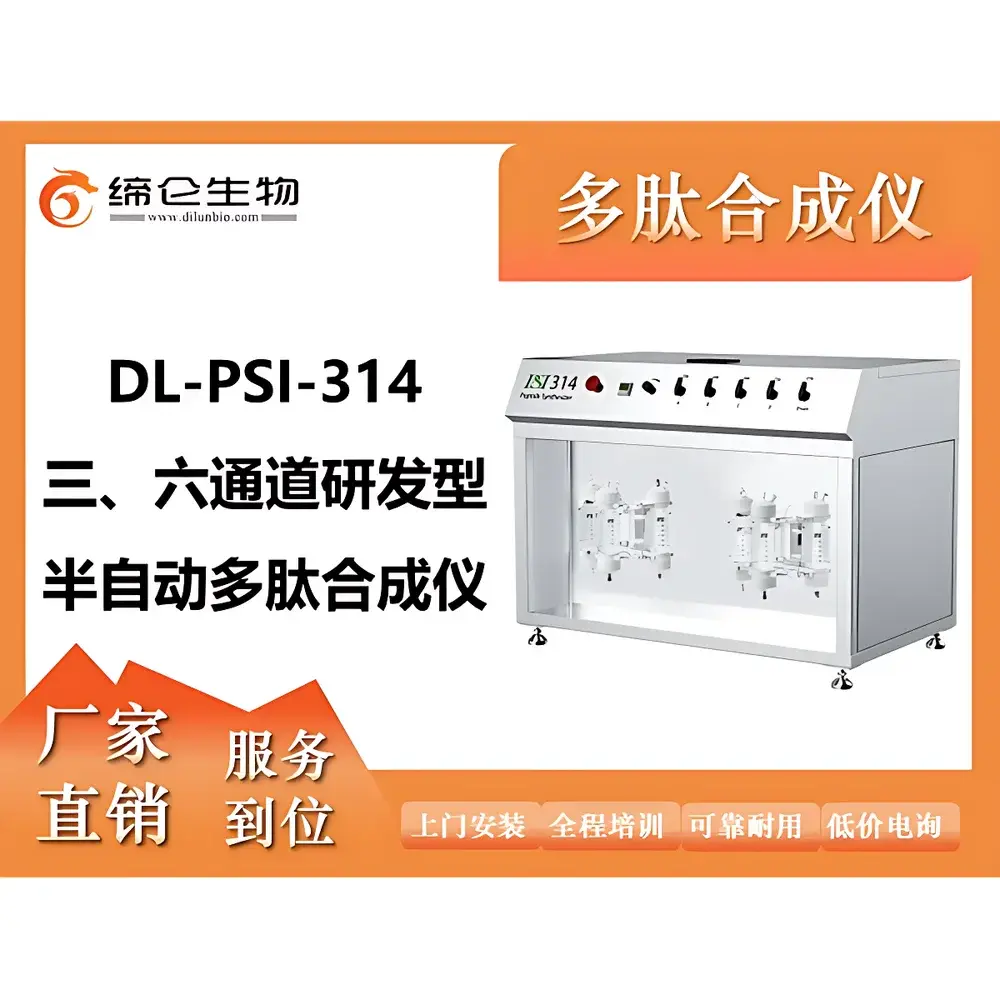
PSI DL-PSI314 Semi-Automatic Multi-Channel Peptide Synthesizer (3- or 6-Channel, Research-Grade)
| Brand | PSI |
|---|---|
| Origin | USA |
| Model | DL-PSI314 |
| Synthesis Scale | 2.5–20 mmol per channel |
| Reactor Count | 3 or 6 |
| Reactor Volume Options | 0.5 L / 1 L / 2 L |
| Syringe Pump Accuracy | ±0.1 mL |
| Synthesis Purity | ≥99.5% |
| Solvent Flow Rate | 200 mL/min |
| Mixing Mode | Dual-axis reactor inversion (stirrer-free) |
| Power Supply | 110/220 V, 50/60 Hz |
| Construction Material | 304 stainless steel frame, borosilicate glass solvent reservoirs (0.5–5 L), 316L stainless steel large-capacity tanks (10–30 L) |
Overview
The PSI DL-PSI314 is a research-grade, semi-automatic multi-channel peptide synthesizer engineered for flexibility, reproducibility, and methodological independence in solid-phase peptide synthesis (SPPS). Unlike fully automated platforms that enforce uniform reaction timing and reagent delivery, the DL-PSI314 implements a dual-configurable architecture—offering either three or six independent synthesis channels—each capable of operating under distinct protocols, coupling cycles, resin loading schedules, and solvent activation sequences. Its core innovation lies in the patented stirrer-free mixing mechanism: instead of mechanical agitation that risks resin fragmentation and compromised coupling efficiency, the system employs precise, programmable vertical inversion of the reaction vessel. This 180° mechanical oscillation induces vigorous yet non-destructive collision between solid-phase resin beads and liquid-phase reagents, achieving coupling efficiencies consistently exceeding 99.5% across diverse amino acid sequences—including sterically hindered residues (e.g., Aib, N-Me-Ala) and long-chain peptides (>100 residues). Designed for academic laboratories, biotech R&D groups, and early-stage CROs, the DL-PSI314 bridges the gap between manual benchtop synthesis and high-throughput automation—retaining full user control over stoichiometric calculations while eliminating manual pipetting errors during repeated wash, deprotection, and coupling steps.
Key Features
- Modular channel configuration: Select between 3-channel (DL-PSI314-3) or 6-channel (DL-PSI314-6) operation—enabling parallel synthesis of up to six unique sequences with independent timing, reagent selection, and cycle parameters.
- Stirrer-free mixing technology: Dual-axis reactor inversion (±90° amplitude, 0–30 rpm programmable) ensures homogeneous resin suspension without bead attrition, preserving pore integrity and minimizing truncated sequence formation.
- Flexible reactor system: Interchangeable jacketed reactors (0.5 L, 1 L, 2 L) support scalable synthesis from 0.25 mmol to 20 mmol per channel; temperature-controlled jackets enable exothermic coupling management (optional chiller integration).
- Semi-automatic workflow: Manual amino acid and reagent vial loading preserves stoichiometric precision—users retain full control over molar equivalents of Fmoc-amino acids, activators (HBTU/HATU), bases (DIEA), and linkers—critical for optimizing difficult couplings.
- Robust fluidic architecture: Four to eight solvent reservoirs (glass: 0.5–5 L; stainless steel: 10–30 L) support sequential or simultaneous delivery of DMF, DCM, piperidine, and wash solvents at regulated flow rates (2–4 mL/s, ±0.1 mL syringe pump accuracy).
- Industrial-grade construction: 304 stainless steel chassis, IP54-rated electronics enclosure, and CE-compliant power system (1 kW, 110/220 V, 50/60 Hz) ensure operational stability in shared lab environments.
Sample Compatibility & Compliance
The DL-PSI314 accommodates standard SPPS resins—including Wang, Rink amide, 2-Cl-Trt, and Sieber amide—and supports both Fmoc- and Boc-based strategies. It is compatible with common coupling reagents (HATU, PyBOP, DIC/Oxyma), scavengers (TIS, EDT), and cleavage cocktails (TFA/water/TIS). The system meets essential laboratory safety and regulatory expectations: solvent handling complies with OSHA 29 CFR 1910.1200 (HCS) labeling requirements; electrical design conforms to IEC 61010-1 for laboratory equipment; and mechanical motion control adheres to ISO 13857 safety distances. While not validated for GMP manufacturing, its audit-ready log generation (timestamped event records, operator ID tagging) supports GLP-aligned documentation practices required by NIH, NSF, and EU Horizon grant-funded research. Full traceability of reagent lot numbers, resin batch IDs, and cycle parameters is achievable via optional CSV export.
Software & Data Management
The DL-PSI314 operates via an embedded Linux-based HMI with a 10.1″ capacitive touchscreen interface. No proprietary software installation is required on host PCs—configuration, method upload, real-time monitoring, and log review are all browser-accessible via HTTPS (Chrome/Firefox/Edge). Each synthesis run generates a structured JSON metadata file containing: start/stop timestamps, reactor temperature profiles, inversion frequency/duration, solvent volume consumed per step, and manual entry confirmations (e.g., “Fmoc-Gly-OH loaded – Lot#G22-891”). Logs are automatically archived to internal 64 GB eMMC storage and optionally mirrored to network-attached storage (NAS) or cloud endpoints (SFTP/HTTPS). Audit trails comply with ALCOA+ principles (Attributable, Legible, Contemporaneous, Original, Accurate) and support 21 CFR Part 11 readiness when paired with institutional digital signature infrastructure.
Applications
- Peptide library screening: Simultaneous synthesis of 3–6 variant sequences (e.g., alanine scans, truncation series, or PTM analogs) under divergent conditions to accelerate structure–activity relationship (SAR) studies.
- Difficult sequence synthesis: High-fidelity assembly of aggregation-prone peptides (e.g., amyloid-β fragments, α-synuclein domains) using optimized inversion kinetics and low-shear mixing.
- Method development: Empirical evaluation of coupling reagents, solvents, and deprotection times across multiple channels without cross-contamination risk.
- Antigen & epitope production: Rapid generation of immunogenic peptide sets for antibody development, ELISA assay validation, and T-cell epitope mapping.
- Process transfer support: Bridging analytical-scale synthesis (≤0.25 mmol) to pilot-scale (≥5 mmol) by maintaining identical mixing dynamics and thermal profiles across reactor volumes.
FAQ
Is the DL-PSI314 compliant with FDA 21 CFR Part 11?
The instrument supports Part 11 readiness through electronic signatures, audit trail logging, and role-based access control—but formal validation must be performed by the end-user per their internal SOPs and quality system requirements.
Can I use custom resin types or non-standard solvents?
Yes. The system accepts any commercially available SPPS resin and solvent compatible with glass or 316L stainless steel wetted materials—no firmware restrictions apply.
What maintenance is required for the inversion mechanism?
The dual-axis servo drive system requires no routine lubrication; annual verification of mechanical alignment and encoder calibration is recommended.
Does the system support overnight unattended operation?
Yes. All synthesis cycles include automatic solvent refill detection, pressure fault shutdown, and emergency stop circuitry—enabling safe 24-hour runs with proper lab supervision protocols.
Are spare parts and technical documentation available globally?
Original PSI-manufactured components (reactors, pumps, valves, HMI modules) are stocked in North America and EU distribution hubs; English-language service manuals and schematics are provided with each unit.