
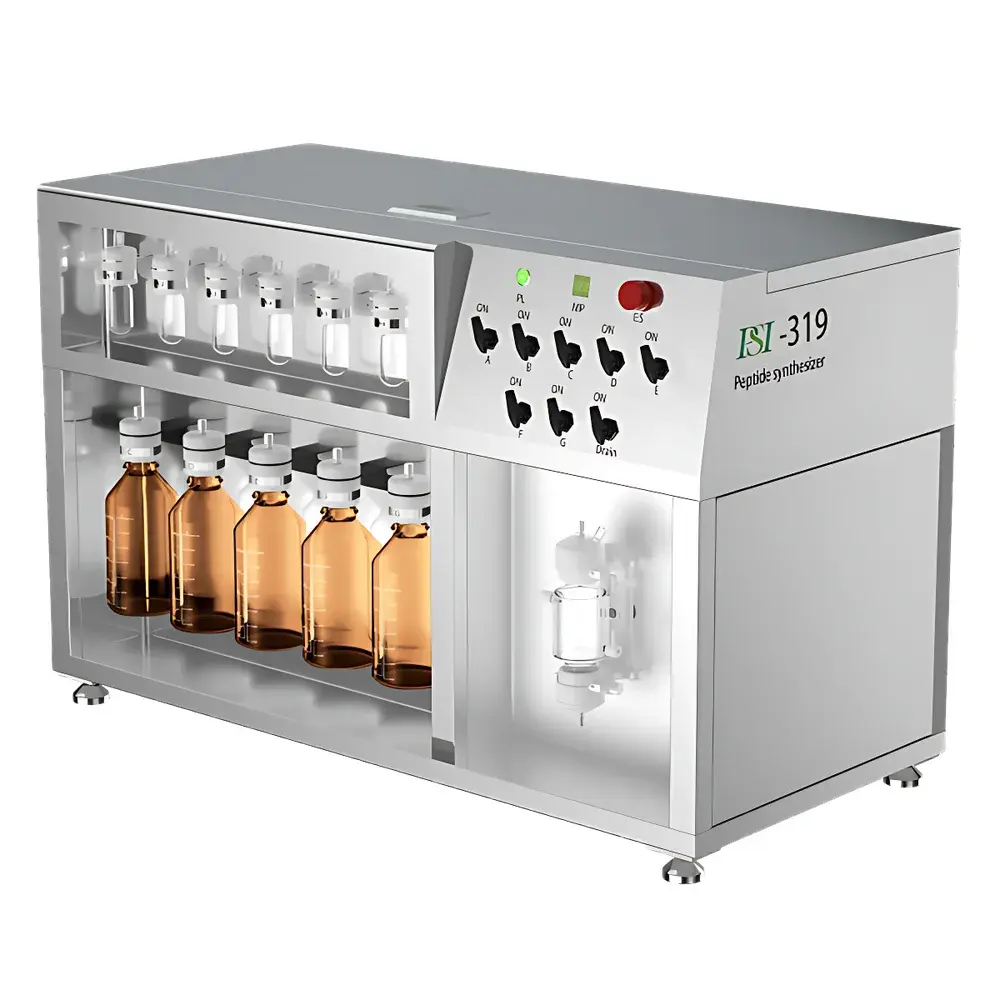
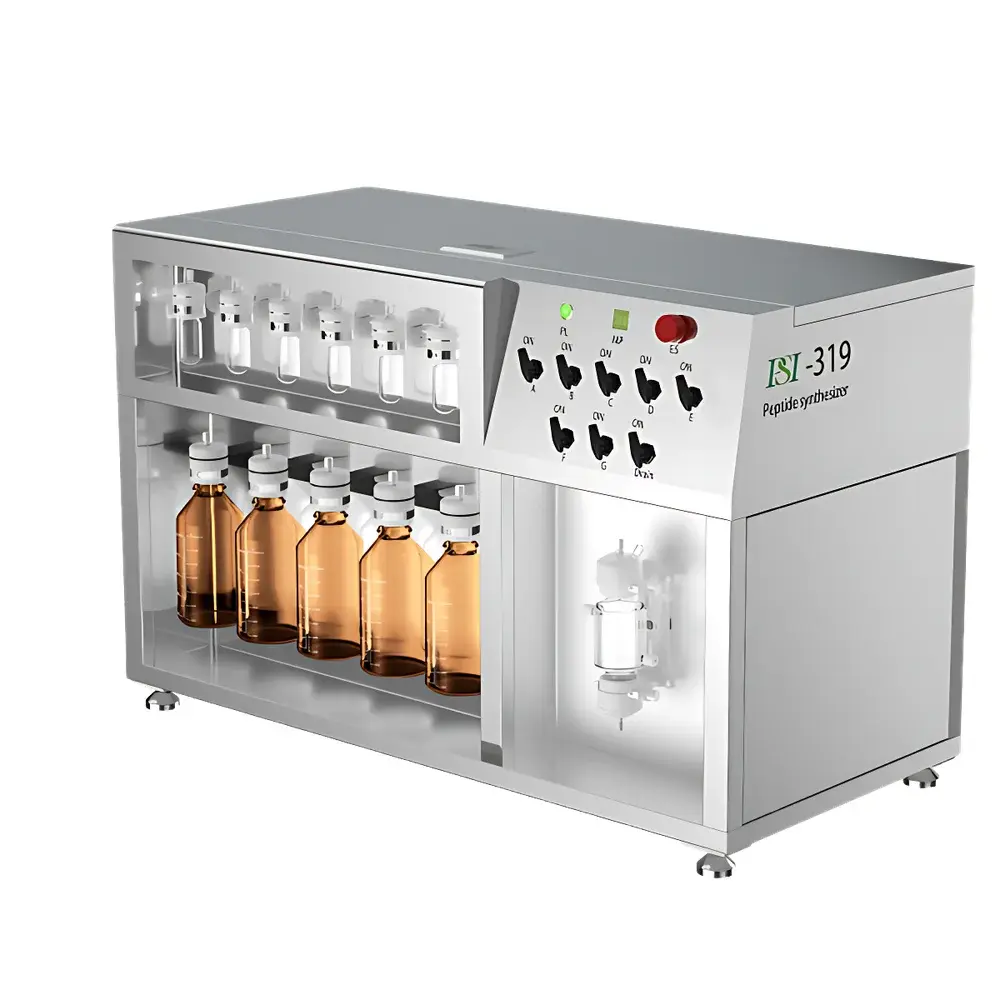
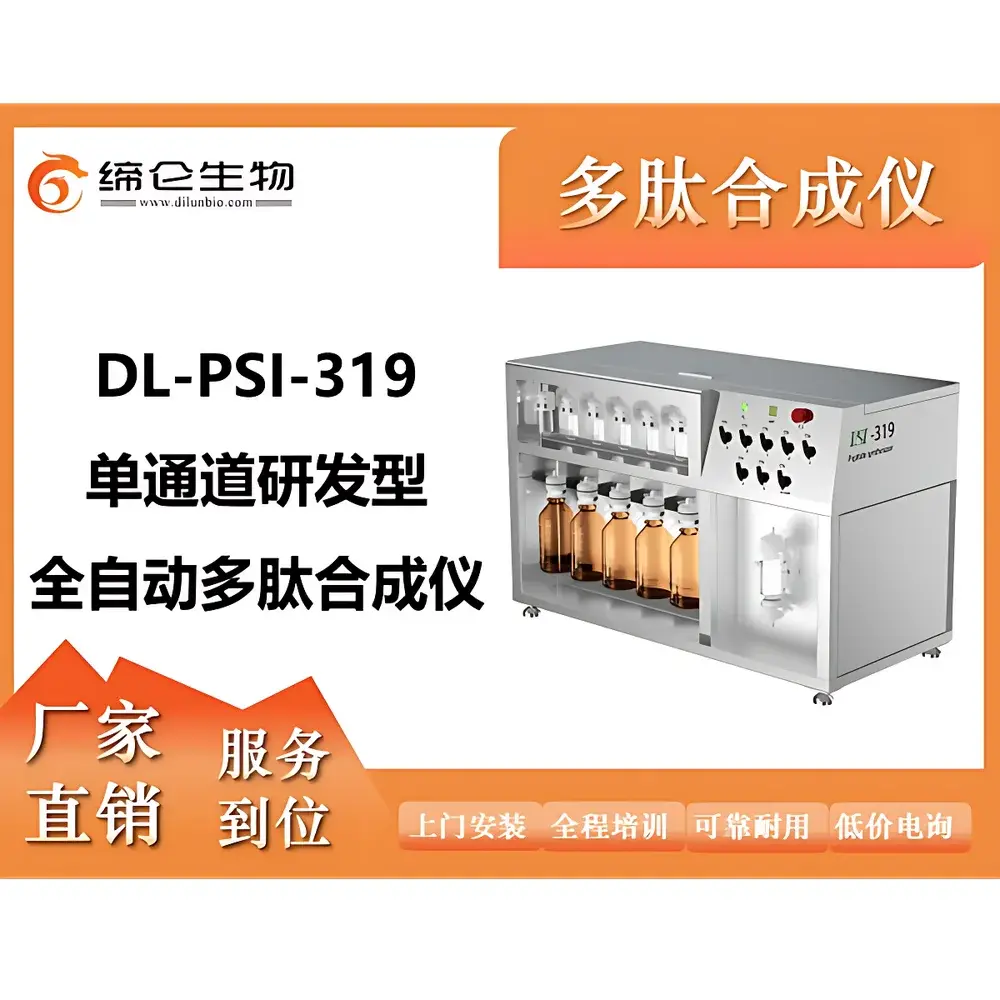
PSI DL-PSI319 Single-Channel Research-Grade Fully Automated Peptide Synthesizer
| Brand | PSI |
|---|---|
| Origin | USA |
| Model | DL-PSI319 |
| Amino Acid Delivery | Automated |
| Reagent Delivery | Automated |
| Synthesis Scale | 0.25–3 mmol per channel |
| Reactor Count | 1 |
| Reactor Volumes | 50 mL, 100 mL, 200 mL (jacketed) |
| Syringe Pump Accuracy | ±0.1 mL |
| Synthesis Purity | ≥99.5% |
| Solvent Flow Rate | 2–4 mL/sec |
Overview
The PSI DL-PSI319 is a single-channel, research-grade fully automated peptide synthesizer engineered for high-fidelity synthesis of long and challenging peptide sequences—particularly those exceeding 50 amino acid residues. Unlike multi-channel parallel synthesizers optimized for screening or library generation, the DL-PSI319 prioritizes coupling efficiency, resin integrity, and process reproducibility in deep-sequence optimization. Its core innovation lies in the patented 180° mechanical inversion mixing mode, first validated by Dr. John Ye in 1995 at Peptide Scientific Inc. This method eliminates rotating impellers entirely, thereby preventing mechanical shear-induced resin fragmentation—a well-documented cause of reduced coupling yield and clogged frits in conventional stirred reactors. Instead, the jacketed reactor rotates end-over-end along its horizontal axis, inducing vigorous yet controlled tumbling of solid-phase resin beads within the solvent–reagent matrix. This results in uniform mass transfer, minimized aggregation, and consistent deprotection/coupling kinetics across extended synthesis cycles.
Key Features
- Single-channel architecture with modular reactor compatibility: interchangeable 50 mL, 100 mL, and 200 mL jacketed glass reactors—enabling precise scale-up studies from analytical to preparative synthesis.
- 180° mechanical inversion mixing driven by a precision electronic servo motor, offering infinitely variable rotation speed (0–30 rpm) and programmable dwell time per step.
- Automated amino acid and reagent delivery via high-accuracy syringe pumps (±0.1 mL volumetric tolerance), ensuring stoichiometric control critical for difficult couplings (e.g., sterically hindered or N-methylated residues).
- Jacketed reactor design supports active temperature control (–20 °C to +60 °C) using external circulators—essential for suppressing aspartimide formation, minimizing diketopiperazine side reactions, and improving coupling kinetics in low-solubility sequences.
- Full system construction from electropolished 304 stainless steel; solvent reservoirs available in borosilicate glass (0.5–5 L) or 316L stainless steel (10–30 L) to meet compatibility requirements for aggressive reagents (e.g., HF, TFMSA, or anhydrous DMF).
- Integrated solvent flow monitoring with real-time pressure sensing and automatic fault detection—ensuring consistent delivery across all synthesis steps (deprotection, washing, coupling, capping).
Sample Compatibility & Compliance
The DL-PSI319 accommodates standard Wang, Rink amide, 2-chlorotrityl, and Sieber resins, as well as specialty supports including PEG-based and chemically cleavable linkers. It is compatible with Fmoc- and Boc-based chemistries, including orthogonal protection schemes involving Alloc, ivDde, or Mmt groups. The system meets fundamental engineering requirements for GLP-compliant environments: full audit trail logging (user actions, timestamps, parameter changes), password-protected method editing, and electronic signature support per FDA 21 CFR Part 11 when integrated with compliant LIMS or ELN platforms. All fluidic pathways are chemically inert and validated for residual carryover ≤0.01% (measured via UV trace analysis post-cleaning protocol).
Software & Data Management
The synthesizer operates under PSI SynthOS v4.x—a deterministic, event-driven control platform with dual-mode operation: fully automated batch execution or step-by-step manual override with real-time sensor feedback (pressure, temperature, volume dispensed). Each synthesis run generates a structured XML log containing cycle-by-cycle metrics: coupling time, reagent volume consumed, observed pressure transients, and user-annotated deviations. Raw data exports are natively compatible with CSV, JSON, and ASTM E1384-compliant formats. Optional integration with laboratory informatics systems enables automatic synchronization of synthesis metadata—including sequence, resin lot, amino acid batch IDs, and environmental conditions—to centralized databases for traceability and regulatory submission readiness.
Applications
- Synthesis of ultra-long peptides (>75 aa) for structural biology (e.g., NMR sample preparation, cryo-EM targets).
- Optimization of coupling protocols for problematic sequences containing polyproline stretches, β-branched residues (Val, Ile), or consecutive glycines.
- Development and validation of novel resin-linker combinations under controlled thermal and mechanical stress profiles.
- Process characterization studies supporting IND-enabling CMC documentation, including robustness testing across resin swelling ratios, solvent aging effects, and reagent stoichiometry gradients.
- Preparative-scale synthesis of immunogenic epitopes for vaccine development—where purity >99.5% and endotoxin-free handling are mandatory.
FAQ
What distinguishes the DL-PSI319 from multi-channel synthesizers like the PSI-286 or PSI-386?
The DL-PSI319 is purpose-built for deep-sequence optimization—not throughput. Its single-channel, inversion-mixing architecture delivers superior coupling homogeneity and resin preservation over extended cycles, making it ideal for sequences where failure propagation is unacceptable.
Can the system be validated for GMP manufacturing use?
While classified as a research instrument, the DL-PSI319’s hardware architecture, software audit trail, and material certifications support IQ/OQ protocols. Full GMP qualification requires site-specific PQ and integration with validated data management infrastructure.
Is remote monitoring and control supported?
Yes—via secure TLS-encrypted Ethernet connection. Operators can initiate runs, pause/resume cycles, view live sensor feeds, and download logs remotely using browser-based SynthOS Web Console.
What maintenance intervals are recommended for long-term reliability?
Daily: visual inspection of frit integrity and solvent line clarity. Quarterly: calibration of syringe pump displacement and verification of reactor seal torque. Annually: full fluidic path cleaning, servo motor encoder verification, and pressure transducer recalibration.
Does the system support custom amino acid derivatives not listed in the standard library?
Yes—users may define non-standard monomers with custom molecular weight, solubility profile, activation chemistry, and coupling duration parameters directly in SynthOS method editor.




