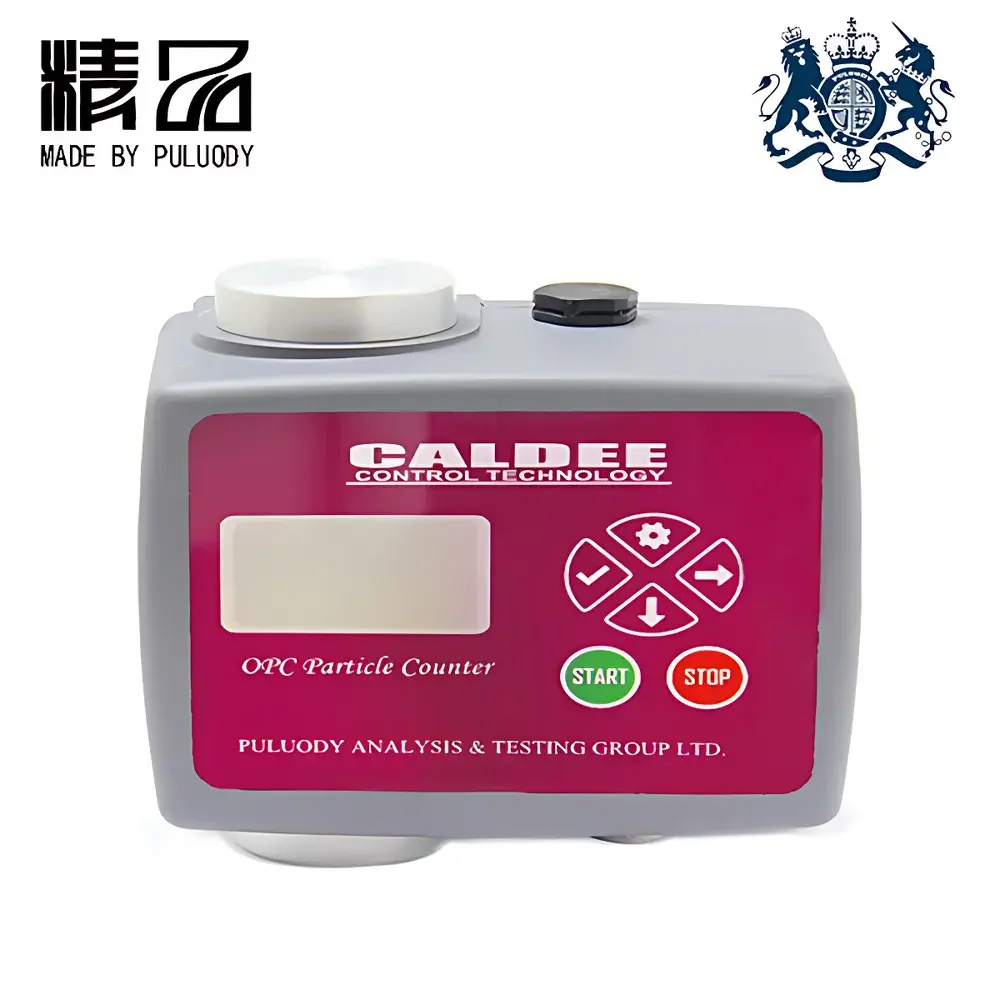
PULUODY OPC Online Oil Particle Counter
| Brand | PULUODY |
|---|---|
| Model | OPC |
| Origin | Shaanxi, China |
| Detection Principle | Light Obscuration (LO) with Dual-Laser Narrow-Beam Technology |
| Measurement Range | 1–150 µm |
| Calibration Standards Supported | ISO 4406, NAS 1638, SAE AS4059, ISO 11171, MIL-STD-1246C, GB/T 14039, DL/T 432, GJB/T 420A/B, GB/T 18854 |
| Operating Pressure | 0–0.6 MPa (standard), up to 31.5 MPa (with integrated pressure regulator) |
| Sample Flow Rate | 6–500 mL/min |
| Fluid Temperature Range | −10 °C to +80 °C |
| Viscosity Limit | ≤500 cSt (online mode) |
| Output Interfaces | 4–20 mA analog, RS232 serial, optional alarm relay |
| Power Supply | 9–30 VDC |
| Compliance | Designed for industrial process monitoring per ISO 21501-4, ASTM D6786, and IEC 61508 SIL2-ready architecture |
| Enclosure Rating | IP65 (standard), optional IP67 |
| Software | Integrated firmware with configurable reporting (particles/mL + contamination code) |
Overview
The PULUODY OPC Online Oil Particle Counter is an industrial-grade, real-time fluid contamination monitoring system engineered for continuous in-line measurement of particulate contamination in hydraulic oils, turbine oils, lubricants, and other mineral- and synthetic-based fluids. Based on the seventh-generation dual-laser narrow-beam light obscuration (LO) principle, the OPC delivers high-reproducibility particle counting under dynamic flow conditions without sample dilution or offline handling. Unlike laboratory-based particle counters, this instrument integrates directly into pressurized hydraulic circuits—enabling continuous, unattended monitoring of particle concentration (per mL) and automatic classification according to internationally recognized cleanliness standards. Its robust optical design minimizes signal drift and photodetector saturation, ensuring stable performance across wide viscosity ranges (up to 500 cSt) and temperature gradients (−10 °C to +80 °C). The OPC is not a portable or benchtop analyzer; it is a permanently installed process sensor designed for integration into SCADA, DCS, or PLC-controlled infrastructure.
Key Features
- Dual-laser narrow-beam optical detection architecture—optimized for high signal-to-noise ratio and minimal coincidence error at elevated particle concentrations
- Real-time, continuous sampling at adjustable flow rates (6–500 mL/min) with integrated flow control and pressure regulation (0–31.5 MPa support with built-in reducer)
- Multi-standard compliance engine: automatic conversion and reporting per ISO 4406:2017, NAS 1638, SAE AS4059F, MIL-STD-1246C, and Chinese national standards (GB/T 14039, DL/T 432, etc.)
- Industrial-grade analog (4–20 mA) and digital (RS232) outputs—fully compatible with legacy control systems and modern IIoT gateways
- Configurable alarm thresholds with dry-contact relay output for immediate machine protection response
- IP65-rated stainless-steel housing with high-temperature elastomer seals—certified for operation in harsh environments including offshore platforms, foundries, and mobile hydraulic equipment
- Firmware-upgradable embedded controller with non-volatile data logging (≥30 days at 1-min intervals)
Sample Compatibility & Compliance
The OPC is validated for use with mineral oils, phosphate esters, polyalphaolefins (PAO), and water-glycol fluids commonly found in aviation hydraulics, power generation turbines, marine propulsion systems, and heavy-duty mobile equipment. It meets the optical calibration traceability requirements defined in ISO 21501-4 and supports verification using NIST-traceable latex sphere suspensions (ISO 11171:2010 compliant reference materials). All reported contamination codes are generated in accordance with ISO 4406:2017 Annex A algorithms, ensuring audit readiness for ISO 9001, API Q1, and AS9100-certified maintenance programs. While not FDA 21 CFR Part 11 compliant by default (as it lacks electronic signature capability), its data export format (CSV/ASCII) enables full traceability when paired with validated LIMS or CMMS platforms operating under GLP/GMP frameworks.
Software & Data Management
The OPC operates with embedded firmware—not PC-dependent software—ensuring deterministic response time and immunity to host OS vulnerabilities. Configuration, threshold setting, and report generation are performed via ASCII command set over RS232 or through optional web-based HMI (via external gateway). Raw particle count histograms (binned by 1–150 µm channels) and cumulative contamination codes are stored locally and exportable on demand. Data files include timestamp (UTC), flow rate, temperature, pressure, and operator-defined metadata tags—supporting root-cause analysis during failure investigations. For enterprise-level integration, OPC UA and Modbus TCP protocol adapters are available as field-installable modules (sold separately).
Applications
- Proactive condition monitoring of critical hydraulic systems in wind turbine pitch controls and gearboxes
- Real-time filter performance validation on offline kidney-loop filtration units and mobile refueling skids
- Wear debris trending in marine diesel engine lubrication circuits aboard offshore drilling rigs
- Contamination control during commissioning and flushing of new hydraulic installations (per ISO 4406 Class targets)
- Validation of cleanroom-compatible fluid transfer lines in semiconductor manufacturing tooling
- Supporting predictive maintenance programs aligned with ISO 55001 asset management standards
FAQ
Does the OPC require annual recalibration by an accredited lab?
Yes—while factory-calibrated per ISO 11171, users must perform annual verification using certified reference materials. The device supports on-site calibration verification via its internal reference channel; full recalibration requires return to an ISO/IEC 17025-accredited service center.
Can the OPC measure particles in water-based coolants?
It is validated for oil-based fluids only. Water-glycol mixtures may be measured if conductivity remains below 10 µS/cm and free water content is <0.1%; consult technical documentation for fluid compatibility matrix.
Is explosion-proof (ATEX/IECEx) certification available?
Not standard. ATEX Zone 2 / IECEx nA version is available upon special order with modified enclosure and intrinsically safe power interface.
What is the minimum detectable particle size under high-flow conditions?
At 500 mL/min, the lower detection limit remains 1 µm per ISO 21501-4, provided optical alignment is maintained and fluid turbidity is <0.5 NTU.
How is data integrity ensured during power interruption?
All configuration parameters and logged counts are stored in EEPROM with battery-backed SRAM cache—no data loss occurs during brief (<5 s) outages. Extended blackouts trigger automatic cold-start recovery without firmware corruption.