
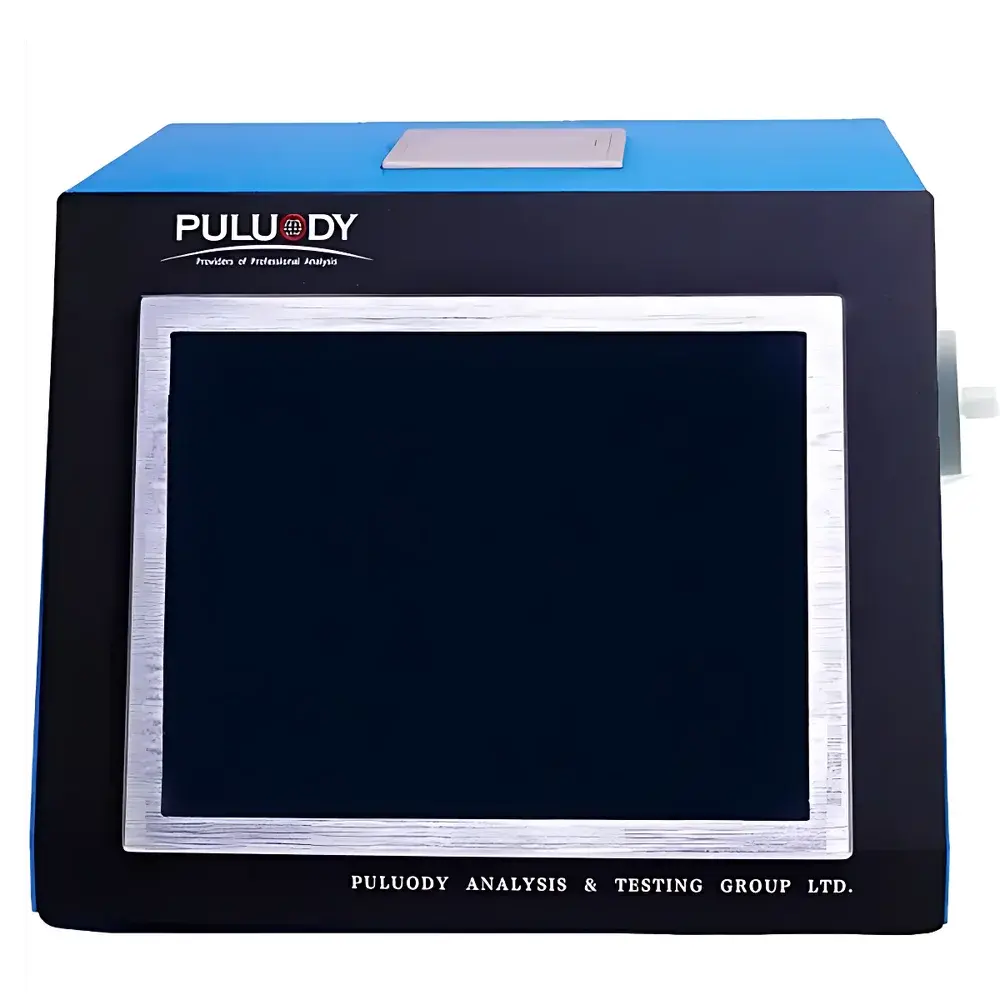
PULUODY PDM-301A Portable Digital Density Analyzer
| Brand | PULUODY |
|---|---|
| Model | PDM-301A |
| Measurement Principle | Oscillating U-tube |
| Density Range | 0–3.0000 g/cm³ |
| Resolution | ±0.0001 g/cm³ |
| Repeatability | ±0.0002 g/cm³ |
| Temperature Control Accuracy | ±0.1 °C |
| Thermostatic Range | 15–30 °C |
| Power Supply | 220 V ±10%, 50 Hz |
| Sample Volume | 2–3 mL |
| Data Storage Capacity | >20,000 records |
| Display | LCD |
| Dimensions | 206 × 205 × 200 mm |
| Compliance | GB/T 29617–2013, GB/T 2013–2010, SH/T 0604–2000, SN/T 2383–2009, ASTM D4052–11, ASTM D5002–13, ASTM D3505–12e1, ISO 12185:1996, IP 559–2008, JJG 1058–2010 |
Overview
The PULUODY PDM-301A Portable Digital Density Analyzer is an intelligent, microprocessor-controlled density measurement instrument engineered for precision and portability in laboratory, field, and quality control environments. It operates on the internationally standardized oscillating U-tube principle: when a sample fills the dual-U-shaped borosilicate glass sensor tube, the resonant frequency of the tube shifts in direct proportion to the sample’s mass per unit volume. This physical relationship—governed by the fundamental equation f ∝ 1/√ρ—is digitally resolved via high-stability quartz oscillation circuitry and real-time temperature compensation. Integrated with a high-accuracy Pt100 temperature sensor embedded directly within the measurement cell, the system maintains thermal equilibrium at user-selectable setpoints (15–30 °C) with ±0.1 °C stability—critical for trace-level density quantification where thermal expansion effects dominate uncertainty budgets. Unlike hydrometer or pycnometer methods, the PDM-301A eliminates operator-dependent variables, delivering direct, repeatable digital output without manual interpolation or calibration curve fitting.
Key Features
- True portable architecture: compact footprint (206 × 205 × 200 mm), integrated peristaltic sampling pump, and self-contained thermostatic module enable deployment beyond fixed lab benches—including QC stations, production lines, and mobile testing units.
- Dual-U-tube sensor design fabricated from low-thermal-expansion borosilicate glass ensures long-term mechanical stability and chemical resistance to organic solvents, acids, bases, and hydrocarbons.
- Real-time temperature-compensated density calculation: simultaneous acquisition of oscillation frequency and cell temperature enables dynamic correction using NIST-traceable polynomial models embedded in firmware.
- High-resolution density readout: 0.0001 g/cm³ resolution over full 0–3.0000 g/cm³ range, validated per ASTM D4052 repeatability criteria (±0.0002 g/cm³).
- Onboard data management: stores >20,000 measurement records with timestamp, temperature, density, and user ID fields; exportable via USB to CSV-compatible spreadsheets.
- Compliance-ready operation: firmware supports audit trail logging, electronic signature prompts, and configurable user access levels—aligned with GLP/GMP documentation requirements under FDA 21 CFR Part 11 guidelines.
Sample Compatibility & Compliance
The PDM-301A accommodates a broad spectrum of Newtonian and near-Newtonian liquids, including petroleum distillates (gasoline, diesel, kerosene), lubricants, transformer oils, glycols, alcohols, aqueous salt solutions, pharmaceutical syrups, food-grade oils, and electronic cleaning agents. Its 2–3 mL sample requirement minimizes waste and enables rapid turnover—particularly advantageous for high-throughput QC labs. All measurement protocols adhere to globally harmonized standards: ISO 12185 (oscillating U-tube method for crude and refined products), ASTM D4052 (digital density meters), ASTM D5002 (crude oil analysis), and Chinese national standards GB/T 29617 and SH/T 0604. Instrument verification follows JJG 1058–2010 metrological verification procedures, ensuring traceability to national primary standards through certified reference materials (e.g., water, n-decane, bromobenzene).
Software & Data Management
The analyzer operates autonomously via its embedded LCD interface but integrates seamlessly with optional PC-based software for advanced data handling. The software suite provides automated concentration conversion tables (e.g., % w/w ethanol in water, API gravity, Baume scale), statistical process control (SPC) charting, batch reporting templates compliant with ISO/IEC 17025, and raw data export in .csv or .xlsx formats. Audit trails record all parameter changes, calibration events, and result modifications—including timestamps, operator IDs, and justification notes—to satisfy regulatory review requirements. Software configuration supports multi-language UI (English, Spanish, German, Simplified Chinese) and customizable report headers for enterprise LIMS integration.
Applications
This analyzer serves as a primary density measurement tool across regulated and industrial sectors. In petroleum refining, it verifies batch conformity to ASTM D1298 specifications and calculates API gravity for custody transfer. In pharmaceutical manufacturing, it validates excipient density for formulation consistency and supports USP density testing of liquid dosage forms. In food & beverage labs, it monitors sugar content in soft drinks (via Brix–density correlation) and detects adulteration in olive oil or honey. Electronics manufacturers rely on it for precise density verification of fluxes and solder paste carriers. Academic and research institutions use it for teaching fluid property fundamentals and validating thermophysical models. Its robustness and portability also support environmental field testing—for example, measuring brine density in groundwater monitoring wells or antifreeze concentration in HVAC systems.
FAQ
What is the minimum sample volume required for accurate measurement?
The PDM-301A requires only 2–3 mL of sample, minimizing consumables cost and enabling analysis of limited or expensive materials.
Does the instrument require external PC connectivity to operate?
No—the device functions fully standalone with on-device display, controls, and internal storage; PC connection is optional for advanced reporting and database synchronization.
How is temperature control achieved during measurement?
An integrated Peltier-based thermostatic module and high-precision Pt100 sensor maintain the oscillation cell at user-defined setpoints (15–30 °C) with ±0.1 °C accuracy, eliminating ambient drift.
Is the instrument suitable for non-Newtonian fluids such as polymer solutions or suspensions?
It is optimized for Newtonian liquids; highly viscous or particulate-laden samples may dampen oscillation amplitude and affect frequency stability—viscosity screening (<500 mPa·s) is recommended prior to use.
Can the PDM-301A be calibrated using certified reference standards?
Yes—calibration is performed using NIST-traceable density standards (e.g., air-saturated water at 20 °C = 0.998203 g/cm³); the instrument supports multi-point calibration routines per JJG 1058–2010.





