
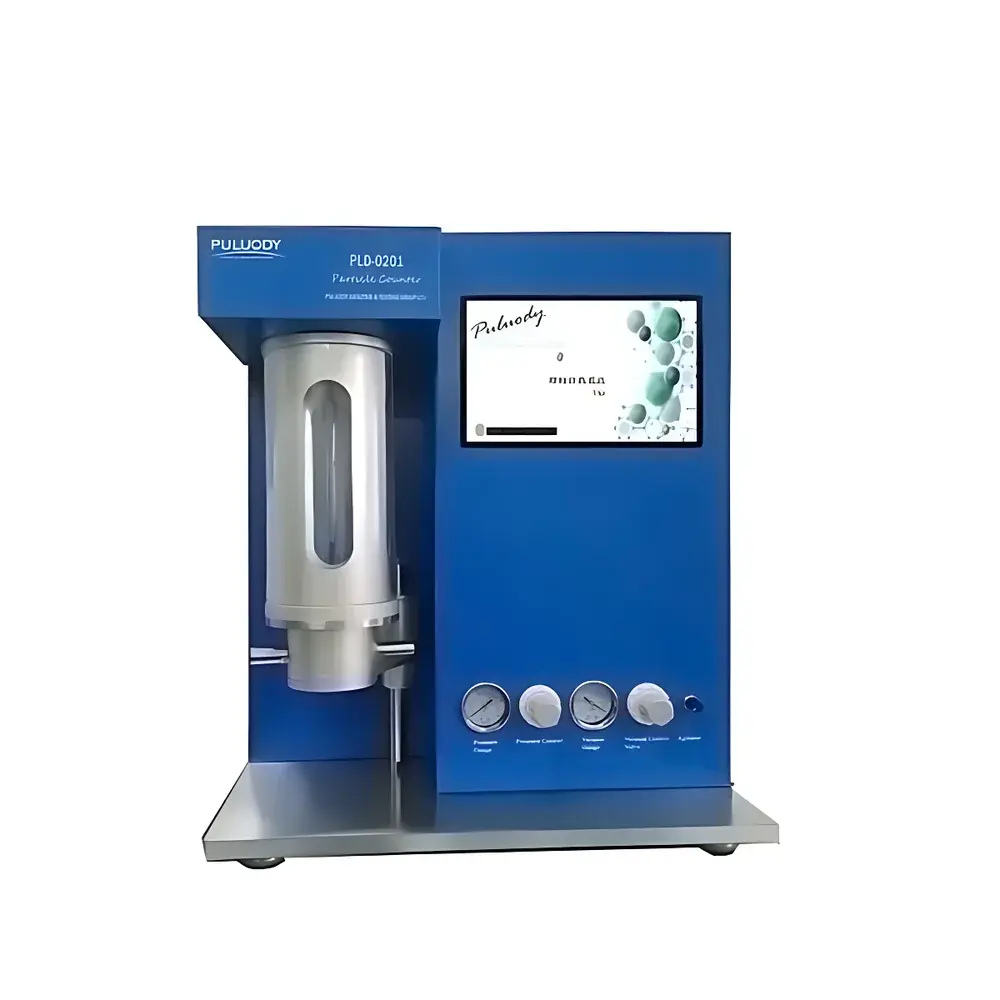
PULUODY PLD-0201-008 Optical Hydraulic Oil Particle Counter
| Brand | PULUODY |
|---|---|
| Origin | Shaanxi, China |
| Model | PLD-0201-008 |
| Instrument Type | Optical Particle Counter |
| Detection Principle | Light Obscuration (LO) |
| Measurement Range | 0.01 µm to 1000 µm (sensor-dependent) |
| Channel Resolution | Up to 1000 user-configurable size channels |
| Sensitivity | 1 µm (per ISO 4402) or 4 µm(c) (per ISO 11171 / GB/T 18854) |
| Sample Volume Accuracy | ±1% |
| Flow Control | Precision piston pump + electromagnetic flow regulation (5–60 mL/min) |
| Viscosity Handling | ≤450 mm²/s |
| Operating Temperature | Ambient to 65 °C |
| Pressure Range | −0.08 to 0.8 MPa |
| Compliance Standards | ISO 4406, NAS 1638, ISO 11171, ISO 4402, GB/T 14039, DL/T 432, GJB 420A/B, ASTM D2276, MIL-STD-1246, USP <788>, and 510+ global particle contamination standards |
Overview
The PULUODY PLD-0201-008 Optical Hydraulic Oil Particle Counter is an industrial-grade, light obscuration (LO)-based instrument engineered for precise, repeatable quantification of solid particulate contamination in hydraulic fluids, lubricants, insulating oils, turbine oils, and other organic liquid media. It operates on the fundamental principle of single-particle optical sensing: as particles suspended in a flowing fluid pass through a focused laser beam, they generate transient reductions in transmitted light intensity—proportional to their cross-sectional area—enabling real-time sizing and counting across up to 1000 programmable detection channels. Designed for compliance-critical environments—including aerospace, power generation, and defense—the system adheres to internationally recognized calibration and reporting frameworks, including ISO 11171 (for sensor calibration traceability), ISO 4402 (for coarse particle verification), and NAS 1638 (for military-grade fluid cleanliness classification). Its dual-pressure (positive/negative) sample conditioning module ensures reliable analysis of viscous, aerated, or sediment-prone samples without manual pretreatment.
Key Features
- 8th-generation dual-laser narrow-beam sensor architecture delivering enhanced signal stability, reduced noise floor, and improved sub-micron resolution down to 0.01 µm.
- Modular sensor configuration: Select from 13 interchangeable optical detectors (A–N), each optimized for specific size ranges—from nanoparticulates (0.03–0.10 µm) to coarse debris (40–1000 µm)—with channel counts ranging from 4 to 1000.
- Integrated sample handling system featuring precision piston pumping, electromagnetic flow control, vacuum-assisted degassing, and magnetic stirring—enabling uniform dispersion and accurate aspiration of high-viscosity oils (≤450 mm²/s).
- Onboard industrial control computer with 7-inch color touchscreen interface; supports dual-input operation (touch + keypad), embedded thermal printer, and local storage of ≥3,000 test records.
- Full compliance with ISO 11171 calibration protocols; optional certified calibration reports available from CNAS-accredited national metrology institutes, including the Aviation Industry Particle Metrology Center and Northwest National Metrology Center.
- RS232 serial interface for external data logging; compatible with P6.4 Analysis Software (PC version) for advanced histogram generation, trend analysis, multi-sample comparison, and automated ISO/NAS grade assignment.
Sample Compatibility & Compliance
The PLD-0201-008 accommodates a broad spectrum of liquid matrices: mineral- and synthetic-based hydraulic oils, aviation turbine fuels (Jet A-1, JP-8), transformer insulating oils, gear oils, engine oils, water-glycol fluids, and polymer solutions. It meets regulatory and quality assurance requirements across multiple sectors: ASTM D2276 for aviation fuel particulate testing; MIL-STD-1246 for spacecraft fluid cleanliness; GJB 420B for Chinese military hydraulic systems; and USP for pharmaceutical-grade non-volatile residue assessment. All measurements are traceable to NIST-traceable reference materials (GBW series), and the instrument supports audit-ready data integrity features—including electronic signatures, time-stamped test logs, and configurable user access levels—aligned with GLP and FDA 21 CFR Part 11 expectations where interfaced with validated PC software.
Software & Data Management
P6.4 Analysis Software provides comprehensive post-acquisition processing, including customizable channel binning, differential/cumulative distribution plots, time-series contamination trending, and automated report generation per ISO 4406, NAS 1638, or user-defined grading schemes. Data export formats include CSV, PDF, and XML, facilitating integration into LIMS and enterprise QA databases. The embedded OS enables direct printing of compliance reports showing particle counts per milliliter, contamination code (e.g., ISO 4406:22/19/15), and statistical confidence intervals. Internal memory retains full measurement metadata—flow rate, temperature, pressure, sensor ID, calibration date—and supports firmware updates via USB.
Applications
This particle counter serves as a primary tool for predictive maintenance and fluid life extension in critical rotating equipment. It is routinely deployed for: monitoring hydraulic system health in aircraft landing gear and flight control actuators; verifying cleanliness of turbine lube oil prior to commissioning; validating filtration efficiency in power plant EH oil systems; assessing wear debris accumulation in wind turbine gearboxes; certifying particulate content in semiconductor process coolants; and conducting routine surveillance of transformer oil per IEC 60296 and DL/T 1096. Its adaptability extends to R&D labs evaluating additive package stability, emulsion breakdown, or nanoparticle dispersion homogeneity in functional fluids.
FAQ
What calibration standards does the PLD-0201-008 support?
It complies with ISO 11171 (primary calibration), ISO 4402 (verification standard), GB/T 18854, and JJG/T 066. Certified calibration services are available through national metrology institutes.
Can it analyze high-viscosity oils without dilution?
Yes—its integrated positive/negative pressure system and magnetic stirrer enable direct analysis of oils up to 450 mm²/s at 40 °C without preheating or solvent dilution.
Is the instrument suitable for cleanroom or Class 100 environment use?
While not rated for ISO Class 5 environments, its sealed optical path, HEPA-filtered purge air option, and low particulate shedding design make it appropriate for controlled laboratory settings supporting ISO 14644-1 Class 8 operations.
How is data integrity ensured during long-term deployment?
All measurements include embedded timestamps, operator IDs, sensor calibration status, and environmental parameters. When used with P6.4 PC software under validated conditions, the system supports 21 CFR Part 11-compliant audit trails and electronic signatures.
Does it support custom particle counting protocols beyond published standards?
Yes—users may define arbitrary size thresholds, channel groupings, and pass/fail logic via the P6.4 platform, enabling proprietary contamination control limits aligned with internal OEM specifications.



