
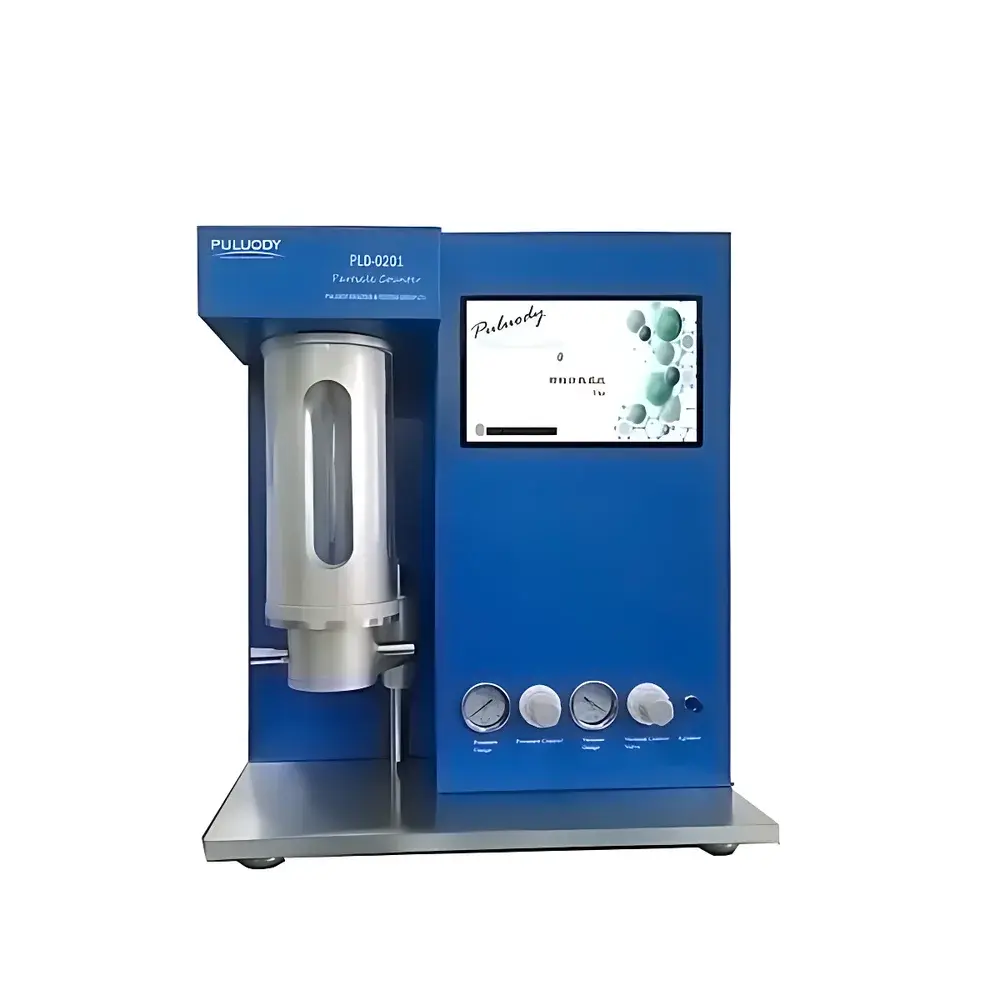
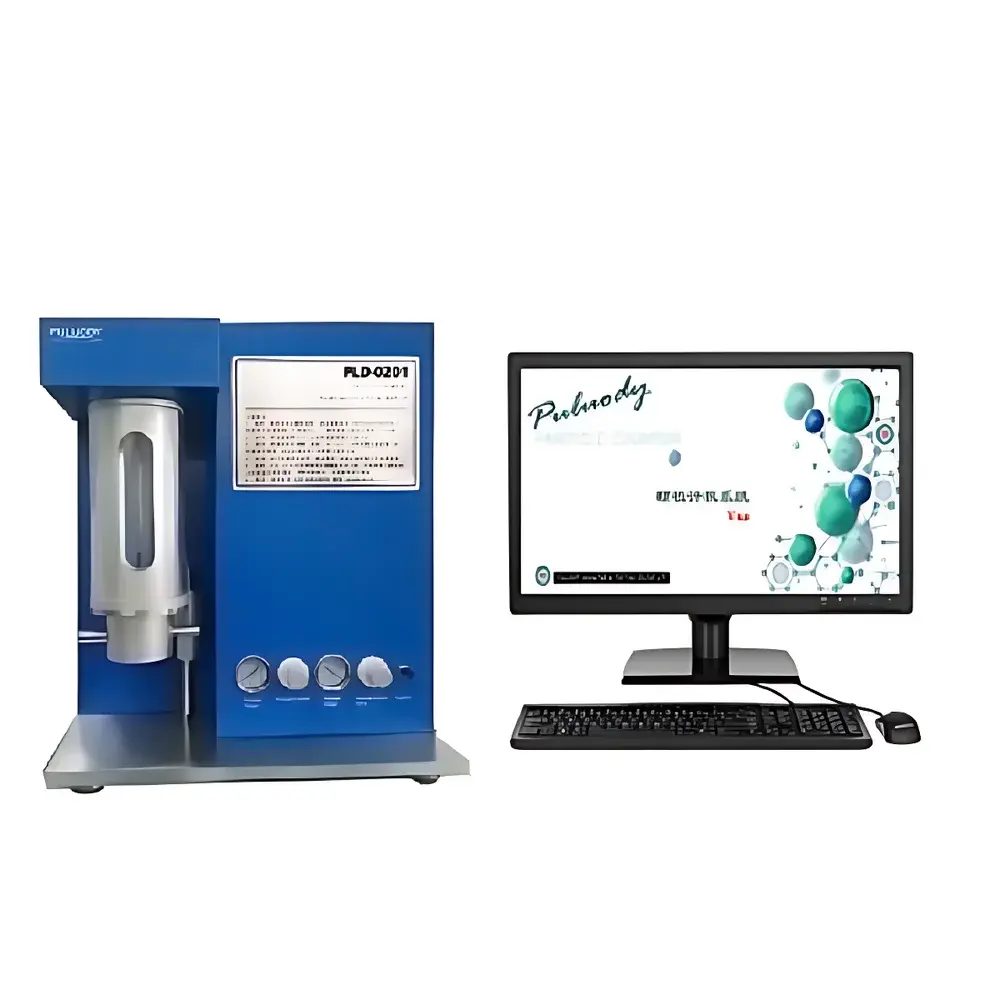
PULUODY PLD-0201-3 Optical Oil Particle Counter for Power Plant Applications
| Brand | PULUODY |
|---|---|
| Origin | Shaanxi, China |
| Model | PLD-0201-3 |
| Instrument Type | Optical Particle Counter |
| Measurement Principle | Light Obscuration (LO) / Photometric Blockage |
| Calibration Standards | ISO 11171, ISO 4406, NAS 1638, GB/T 18854, JJG/T 066 |
| Detection Channels | 1000 adjustable size bins |
| Flow Control | Precision piston pump + ultra-precise electromagnetic flow regulation |
| Sample Volume Range | 1 mL to unlimited (user-defined) |
| Display | Color LCD touchscreen with dual input (touch + keypad) |
| Data Output | RS232 serial interface, built-in thermal printer, iPad-compatible data acquisition |
| Software | PULL 8.1 multi-language platform (English, Chinese, Japanese, Korean, etc.), GLP-compliant audit trail, 3000-test local storage |
| Compliance | Supports FDA 21 CFR Part 11-ready configuration (via optional software module), ISO/IEC 17025 traceable calibration protocols |
Overview
The PULUODY PLD-0201-3 Optical Oil Particle Counter is an industrial-grade, light obscuration (LO)-based particle measurement system engineered for continuous and periodic monitoring of hydraulic and lubricating oil cleanliness in power generation facilities. Designed specifically for high-reliability environments—including turbine control systems, boiler feed pumps, and generator bearing circuits—the instrument quantifies suspended particulate contamination across a user-definable 1000-channel size spectrum (e.g., ≥4 µm(c), ≥6 µm(c), ≥14 µm(c), ≥21 µm(c), ≥38 µm(c), ≥70 µm(c)). Its eighth-generation dual-laser collimated optical sensor delivers enhanced signal-to-noise ratio and long-term photometric stability, minimizing drift during extended unattended operation—a critical requirement for predictive maintenance programs mandated under ISO 4406:2017 and IEC 60306-3. The system operates on the principle of single-particle optical sensing: as particles pass through a precisely defined laser beam, they generate transient light blockage pulses proportional to their equivalent spherical diameter. Pulse amplitude and frequency are digitally processed to produce statistically robust particle counts per unit volume (particles/mL), enabling direct classification against international cleanliness codes.
Key Features
- Eighth-generation dual-laser narrow-beam optical sensor with integrated temperature-compensated photodiode array for improved detection repeatability and sensor lifetime
- Dual-mode flow control architecture: precision metering piston pump ensures volumetric accuracy (±0.5% full scale), while closed-loop electromagnetic flow regulation maintains constant sample velocity (0.5–60 mL/min) independent of viscosity or backpressure
- Integrated pre-conditioning chamber supporting positive/negative pressure sampling, magnetic stirring, and vacuum-assisted degassing—enabling reliable analysis of high-viscosity oils (up to ISO VG 680) and water-based coolants
- 1000 programmable detection channels with user-configurable threshold settings; supports simultaneous reporting per ISO 4406, NAS 1638, SAE AS4059, and custom grading schemes
- Self-contained industrial PC with 10.1″ color capacitive touchscreen, dual-input interface (touch + physical keypad), and embedded thermal printer—operable without external computing resources
- RS232 serial port compliant with Modbus RTU protocol for integration into SCADA and CMMS platforms; optional Wi-Fi/Ethernet module available for remote diagnostics and firmware updates
Sample Compatibility & Compliance
The PLD-0201-3 accommodates a broad range of fluid matrices relevant to thermal and nuclear power plants: mineral and synthetic turbine oils, phosphate ester fire-resistant fluids (e.g., Fyrquel, Hydrex), compressor lubricants, hydraulic servo-oils (e.g., MIL-PRF-5606, MIL-PRF-83282), aqueous glycol coolants, and demineralized water used in stator cooling circuits. It complies with ISO 11171:2016 for sensor calibration using NIST-traceable ACFTD and MTD reference materials, and supports validation per ASTM D6786 (for aviation turbine fuels) and IEC 60422 (for insulating oils). Calibration verification may be performed using certified reference standards from the China National Aviation Industry Particle Measurement Station or Northwest National Metrology Center (CNAS-accredited). Optional GLP/GMP configuration includes electronic signatures, audit trail logging, and 21 CFR Part 11–compliant user access controls.
Software & Data Management
PULL 8.1 analytical software provides a modular, multi-language environment (English, Chinese, Japanese, Korean, German, French, Spanish, Russian, Arabic, Portuguese) with three operational layers: real-time acquisition, post-test analysis, and metrological calibration—all functionally isolated to prevent cross-contamination of raw data. Each test record stores full pulse-height distribution, flow rate history, temperature logs, and operator metadata. Local storage capacity exceeds 3,000 complete reports with searchable indexing by date, sample ID, or cleanliness code. Data export supports CSV, PDF, and XML formats compatible with LIMS and enterprise asset management (EAM) systems. Optional cloud synchronization enables centralized fleet-wide trend analysis across multiple plant sites.
Applications
- Condition-based monitoring of turbine lube oil reservoirs per ISO 4406:2017 and DL/T 432–2018 (Chinese power industry standard)
- Verification of filter performance in offline kidney-loop filtration systems
- Wear debris analysis during component break-in and post-maintenance commissioning
- Acceptance testing of new oil deliveries against OEM specifications (e.g., GEK 32568, Siemens TLV 9000)
- Contamination control in electro-hydraulic control (EHC) systems for steam and gas turbines
- Monitoring of stator cooling water purity per IEEE C50.12 and IEC 60034-1
FAQ
Does the PLD-0201-3 support automated calibration verification?
Yes—built-in calibration check routines allow daily verification using certified reference suspensions; full recalibration follows ISO 11171:2016 procedures with traceable ACFTD/MTD standards.
Can it analyze water-glycol coolants without dilution?
Yes—the integrated degassing and stirring module enables stable measurement of aqueous solutions with up to 50% glycol content, eliminating manual preparation steps.
Is remote firmware update supported?
Yes—via optional Ethernet/Wi-Fi module; updates preserve all user configurations and historical databases.
What is the minimum detectable particle size?
The optical system achieves consistent detection down to 4 µm(c) under ISO 11171-compliant conditions, with signal resolution verified using NIST SRM 2806a.
How is data integrity ensured during long-term deployment?
All measurements include time-stamped flow rate, temperature, and sensor health diagnostics; raw pulse data is archived alongside summary reports to support root-cause investigation and regulatory audits.
Related Products



