
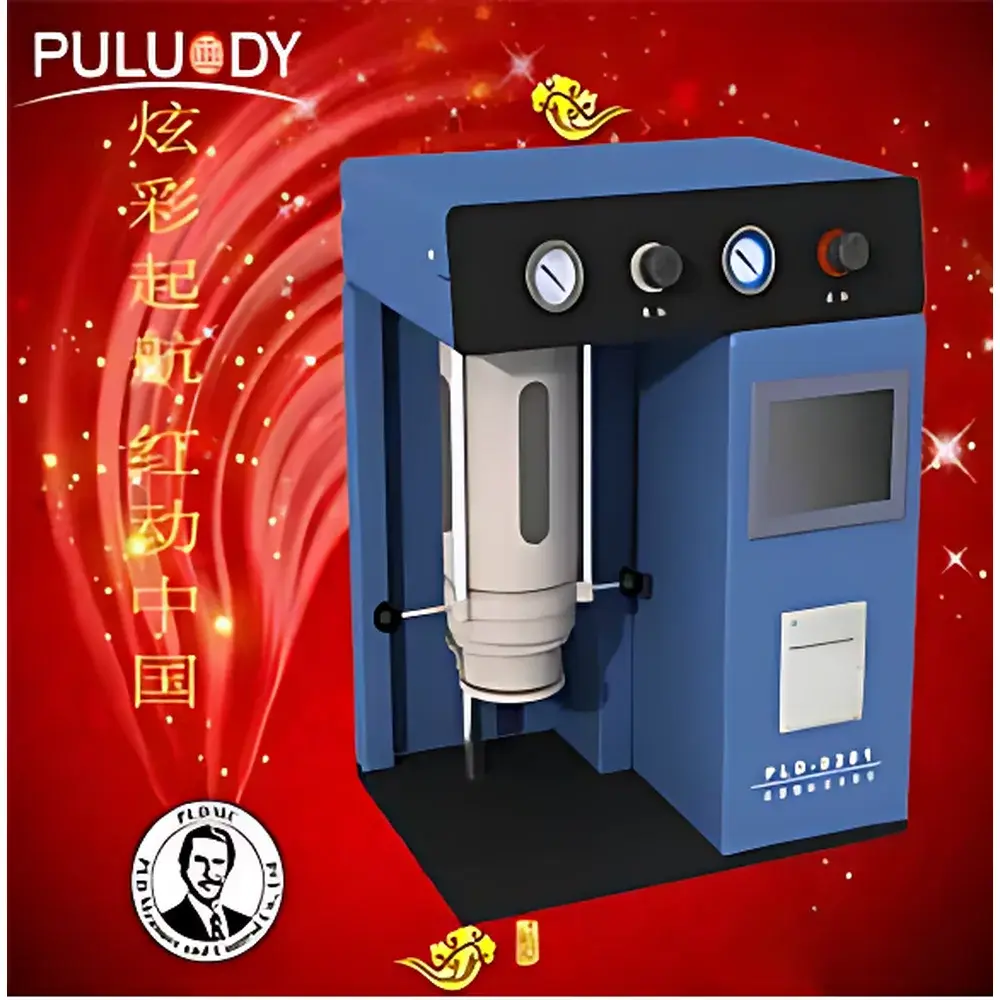
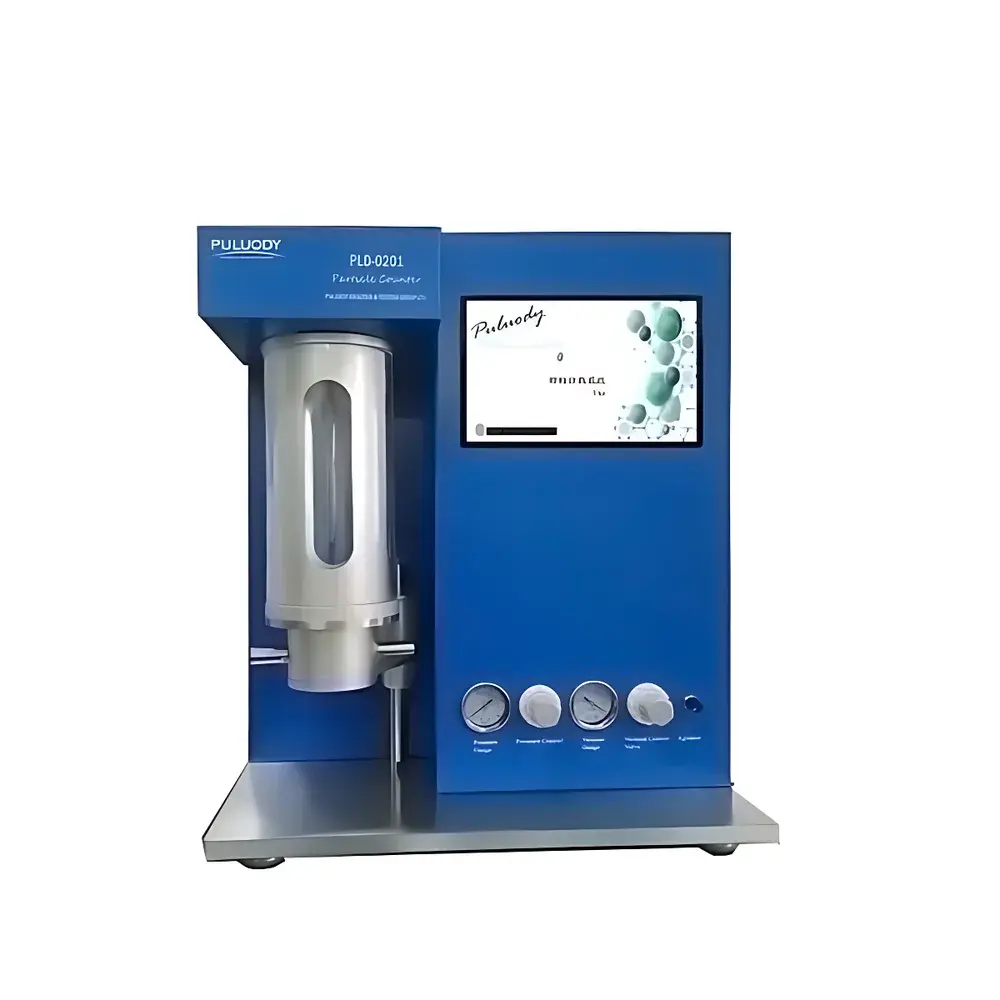
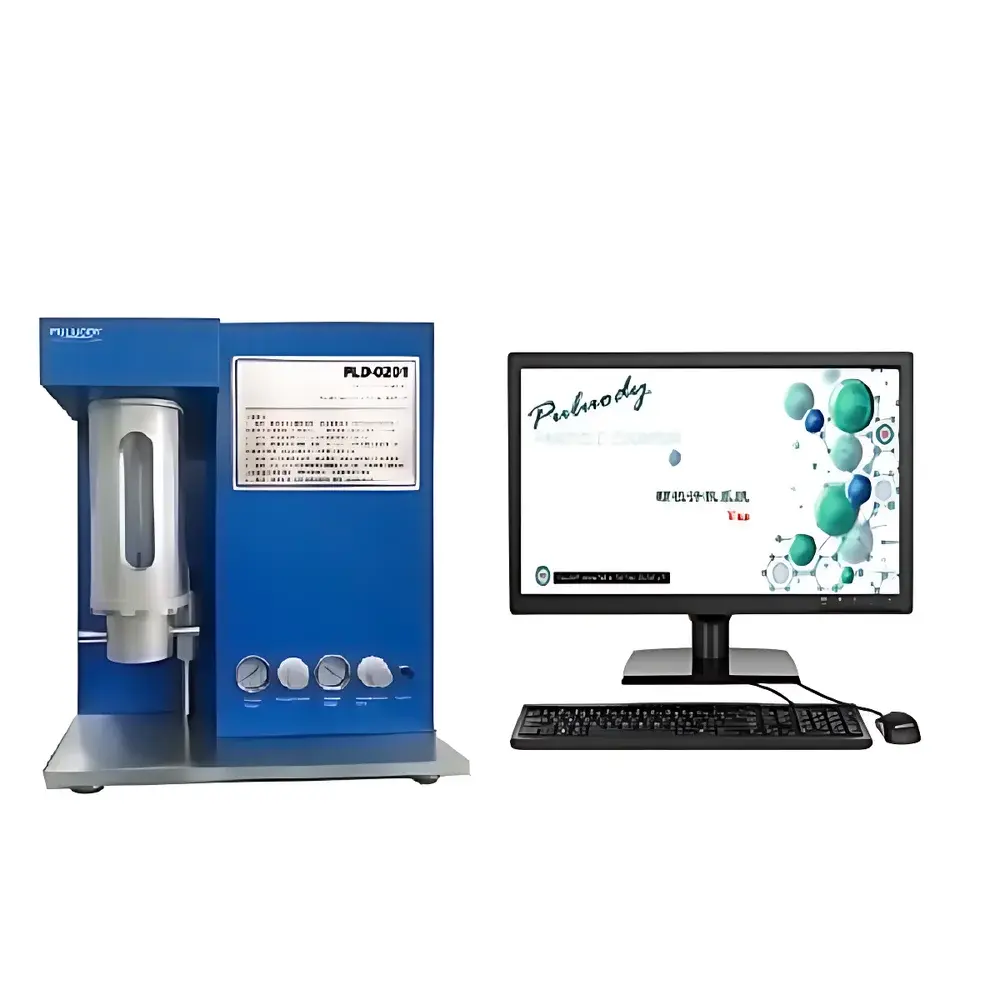
PULUODY PLD-0201 Laboratory Oil Particle Counter
| Brand | PULUODY |
|---|---|
| Origin | Shaanxi, China |
| Manufacturer Type | Direct Manufacturer |
| Instrument Type | Optical Particle Counter |
| Detection Principle | Light Obscuration (LO) |
| Standard Compliance | ISO 4406, ISO 11171, NAS 1638, GB/T 18854, JJG/T 066, GJB 420B, DL/T 432 |
| Measurement Range | 0.01 µm – 1000 µm (sensor-dependent) |
| Channel Capacity | Up to 1000 adjustable size channels |
| Sensitivity | 1 µm (per ISO 4402), 4 µm(c) (per ISO 11171 & GB/T 18854) |
| Sample Flow Control | Dual-mode precision piston pump + electromagnetic flow regulation |
| Viscosity Handling | ≤ 450 mm²/s |
| Operating Temperature | Ambient to 65 °C |
| Pressure Range | −0.08 MPa to +0.8 MPa |
| Sampling Volume Accuracy | ±1% |
| Test Duration | Configurable (standardized at 20 s per ISO 11500) |
| Data Storage | 3000 onboard tests |
| Interface | RS232, touchscreen GUI, integrated thermal printer |
| Software | PULL 8.1 multi-language platform (English, Chinese, Japanese, Korean, etc.), FDA 21 CFR Part 11–ready audit trail mode optional |
Overview
The PULUODY PLD-0201 Laboratory Oil Particle Counter is an optical particle counter engineered for high-precision, trace-level contamination analysis of liquid media in critical industrial and regulatory environments. It operates on the internationally standardized light obscuration (LO) principle—where particles suspended in a flowing liquid stream pass through a focused laser beam, generating transient reductions in transmitted light intensity proportional to their cross-sectional area. This signal is converted into pulse amplitude and digitally resolved across up to 1000 user-definable size channels, enabling quantitative assessment of particle concentration per unit volume (e.g., particles/mL) and classification according to ISO 4406, NAS 1638, GJB 420B, or custom grading schemes. Designed for use with hydraulic fluids, lubricants, transformer oils, turbine oils, aviation fuels, aqueous solutions, and polymer solvents, the PLD-0201 supports both routine QC screening and R&D-grade particulate characterization under GLP/GMP-aligned workflows.
Key Features
- Eighth-generation dual-laser narrow-beam sensor architecture ensures enhanced signal stability, reduced noise floor, and extended operational lifetime compared to conventional single-source LO detectors.
- Integrated sample conditioning module featuring programmable positive/negative pressure control, magnetic stirring, and vacuum-assisted degassing—enabling reliable measurement of viscous, aerated, or heterogeneous samples without manual pretreatment.
- Dual-flow regulation system combining a calibrated precision piston pump with closed-loop electromagnetic flow monitoring guarantees volumetric accuracy better than ±1% across the full sampling range (1 mL to unrestricted volume).
- Configurable channel mapping supports simultaneous evaluation across multiple standard-compliant bin sets—including ISO 4406 (4 µm(c)/6 µm(c)/14 µm(c)), NAS 1638 (5 µm/10 µm/15 µm/25 µm/50 µm), and custom thresholds from 0.01 µm upward.
- Industrial-grade embedded controller with 10.1-inch color capacitive touchscreen, dual-input support (touch + physical keypad), and real-time graphical display of histogram distributions, cumulative counts, and contamination grade assignment.
- Onboard thermal printer and RS232 interface allow stand-alone operation or seamless integration into laboratory information management systems (LIMS) and centralized data archives.
Sample Compatibility & Compliance
The PLD-0201 accommodates a broad spectrum of liquid matrices: mineral and synthetic oils (hydraulic, lubricating, insulating, turbine), water-glycol and phosphate ester fire-resistant fluids, deionized water, ultrapure water (UPW), pharmaceutical buffers, and organic solvent systems. Its fluidic path is chemically inert (316L stainless steel, fluoropolymer wetted components), supporting compatibility with mildly corrosive media. Regulatory alignment includes full traceability to ISO 11171:2010 (calibration using NIST-traceable ACFTD and MTD reference materials), ISO 4402:1991 (for legacy reporting), and national standards such as GB/T 18854–2002 and JJG/T 066. Optional validation packages include calibration certificates issued by the China National Aviation Industry Particle Measurement Station or Northwest National Metrology Center, compliant with ISO/IEC 17025 requirements.
Software & Data Management
PULL 8.1 software serves as the unified analytical engine—available in 12 language variants and structured to separate calibration routines from routine testing operations, eliminating cross-interference during concurrent execution. The platform implements hierarchical user access control, electronic signature capability, and optional 21 CFR Part 11 compliance modules (audit trail, electronic records, role-based permissions). Data output includes raw pulse histograms, differential/cumulative distribution curves, ISO/NAS grade tables, and customizable PDF reports. Local storage retains 3,000 test records; external PC synchronization enables unlimited archival, statistical trending (e.g., SPC charts), and batch comparison across instruments or timepoints. All datasets are exportable in CSV, XML, or proprietary .PLD formats for third-party analytics integration.
Applications
This instrument is deployed across aerospace OEMs and MRO facilities for hydraulic system cleanliness verification per MIL-STD-1246C and SAE AS4059F; in power generation for transformer oil particulate monitoring aligned with IEC 60296 and DL/T 1096; within semiconductor fabs for UPW and chemical delivery system qualification; and in automotive R&D labs evaluating wear debris evolution in engine and transmission oils per ASTM D7619 and ISO 11500. It further supports pharmaceutical manufacturing for USP particulate matter testing in injectables when configured with appropriate filtration and rinse protocols, and fulfills ISO 8573-4 requirements for compressed air condensate analysis.
FAQ
What calibration standards does the PLD-0201 support?
It accepts both ACFTD and MTD reference materials per ISO 11171:2010, and supports calibration verification against GBW certified reference particles per GB/T 18854.
Can the instrument measure sub-micron particles?
Yes—when equipped with optional nanoparticle sensors (e.g., 0.01–0.1 µm range), it delivers resolution down to 10 nm under optimized flow and detection conditions.
Is offline testing possible without a connected PC?
Absolutely—the embedded industrial PC enables full autonomous operation, including measurement, grading, histogram generation, and direct thermal printing.
How is sample viscosity managed during analysis?
The dual-mode pressure system automatically adjusts aspiration force and flow rate to maintain laminar flow integrity across viscosities up to 450 mm²/s at 40 °C.
Does the software support automated report generation for regulatory submissions?
Yes—PULL 8.1 includes configurable templates aligned with ISO, ASTM, and military reporting structures, with metadata tagging and digital signature support for validated environments.



