
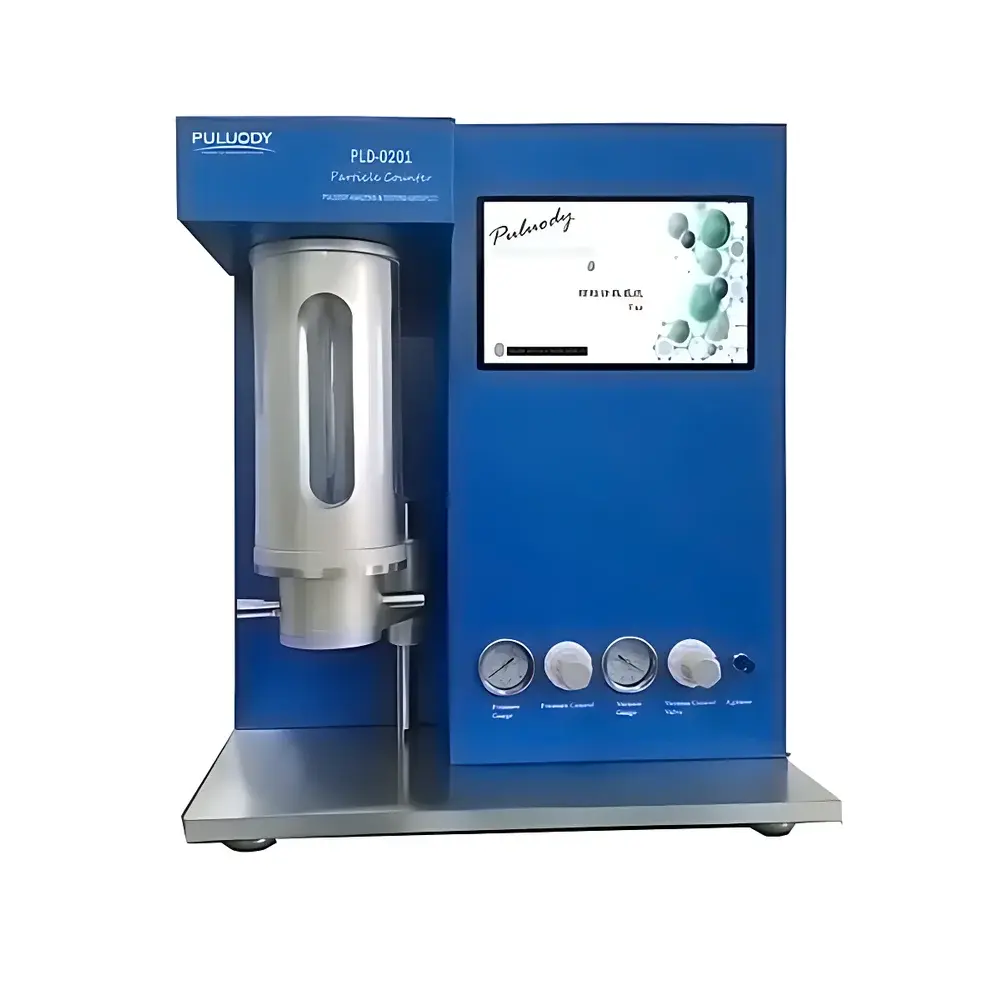
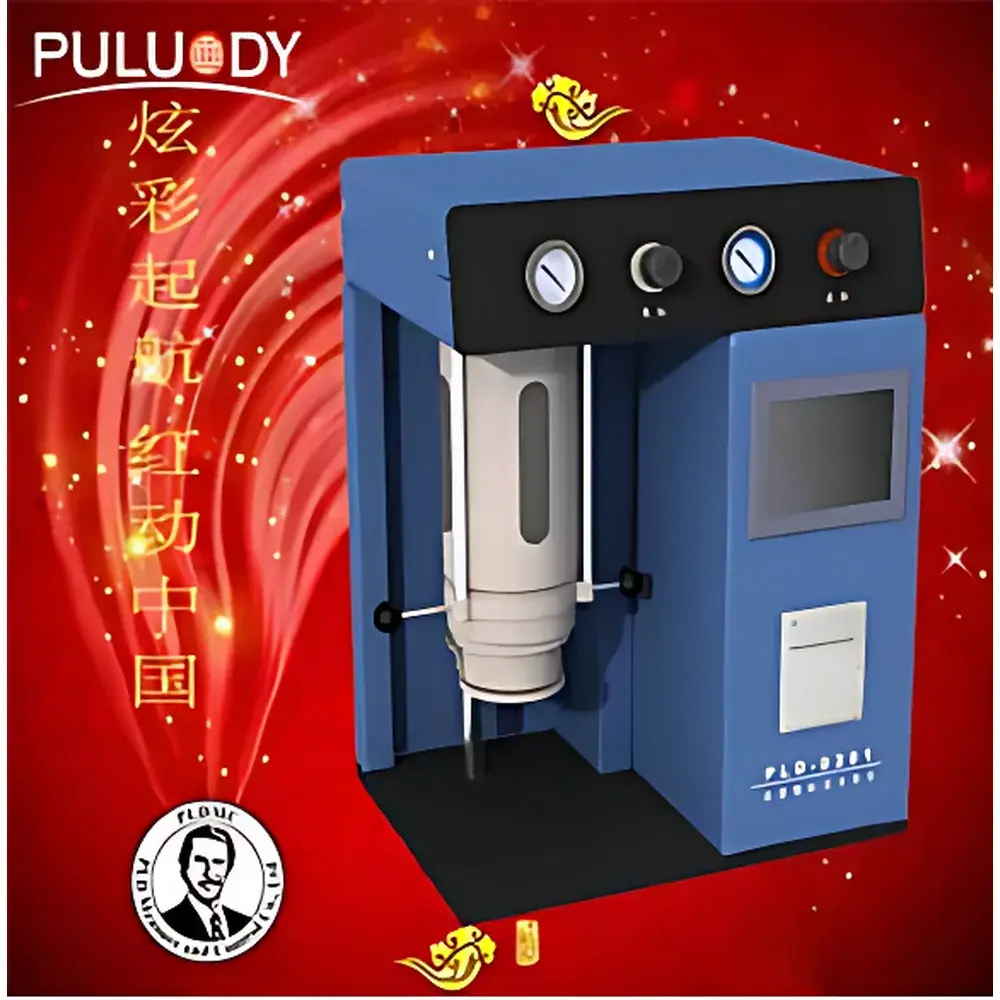
PULUODY PLD-0201 Transformer Oil Particle Contamination Analyzer
| Brand | PULUODY |
|---|---|
| Origin | Shaanxi, China |
| Manufacturer Type | OEM Manufacturer |
| Regional Category | Domestic (China) |
| Model | PLD-0201 |
| Price | USD 45,800 (FOB Shanghai) |
| Detection Principle | Light Obscuration (LO) with Dual-Laser Narrow-Beam Sensor |
| Calibration Standards | ISO 11171:2016, ISO 4402:1991, GB/T 18854–2002, JJG/T 066, NAS 1638, ISO 4406:2021 |
| Measurement Range | 0.01 µm – 1000 µm (configurable sensor modules) |
| Channel Resolution | Up to 1000 user-definable size channels |
| Sensitivity | 1 µm (per ISO 4402), 4 µm(c) (per ISO 11171 & GB/T 18854) |
| Sample Volume Accuracy | ±1% |
| Flow Control | Precision Piston Pump + Electromagnetic Flow Regulation |
| Max. Viscosity Handling | ≤450 mm²/s |
| Operating Temp. | 20–65 °C (sample), 0–50 °C (ambient) |
| Pressure Range | –0.08 to 0.8 MPa |
| Data Storage | 3000+ tests onboard |
| Output Interface | RS232, touchscreen GUI, integrated thermal printer |
| Software | PULL 8.1 Multi-Language Platform (EN/CN/JP/KO/DE/FR/ES/IT/RU/AR) |
| Compliance Support | ASTM D6786, USP <788>, ISO 21501-4, GLP/GMP audit trail (optional), FDA 21 CFR Part 11 compliant mode (with optional license) |
Overview
The PULUODY PLD-0201 Transformer Oil Particle Contamination Analyzer is a high-precision, dual-laser light obscuration (LO) instrument engineered for quantitative measurement of insoluble particulate contamination in insulating oils—primarily transformer oil (mineral and synthetic ester-based), but also applicable to turbine oil, hydraulic fluid, and other dielectric or lubricating liquids. It operates on the principle of single-particle optical sensing: as particles suspended in a flowing liquid stream pass through a focused laser beam, they generate transient light blockage pulses proportional to their cross-sectional area. The eighth-generation dual-laser narrow-beam sensor enhances signal-to-noise ratio, minimizes coincidence error at high concentrations (>10,000 particles/mL), and delivers exceptional stability across extended operational cycles. Designed to meet stringent requirements of power generation, transmission, and substation maintenance, the PLD-0201 supports real-time assessment of oil cleanliness per international standards including ISO 4406:2021, NAS 1638, and DL/T 432–2018—enabling predictive maintenance, asset integrity assurance, and regulatory compliance in critical electrical infrastructure.
Key Features
- Eighth-generation dual-laser narrow-beam optical sensor with configurable detection thresholds and 1000 programmable size channels (0.01 µm to 1000 µm)
- Integrated sample conditioning module featuring positive/negative pressure control, magnetic stirring, vacuum degassing, and temperature stabilization (20–65 °C)
- Precision piston pump combined with electromagnetic flow regulation ensures volumetric accuracy better than ±1% and repeatable flow rates from 5 to 60 mL/min
- Auto-cleaning cycle post-analysis using dedicated rinse solvent path and programmable cleaning speed (10–100 mL/min)
- Embedded industrial-grade touchscreen HMI (10.1″ color LCD) with dual-input support (touch + physical keypad) and localized UI in 10 languages
- Onboard thermal printer and RS232 interface for direct data export; no external PC required for routine testing or reporting
- Modular sensor architecture allows field-swappable optical detectors optimized for nano-range (0.01–0.2 µm), micro-range (1–450 µm), or macro-range (40–1000 µm) analysis
- Comprehensive calibration traceability to ISO 11171:2016 using ACFTD and MTD reference materials; certified calibration reports available via China National Aviation Particle Metrology Station or Northwest National Metrology Center
Sample Compatibility & Compliance
The PLD-0201 accommodates a broad spectrum of electrically insulating and hydraulic fluids—including mineral oil, silicone oil, polyalphaolefin (PAO), natural/synthetic esters, and water-glycol solutions—without mandatory pre-filtration or dilution. Its robust fluid handling system tolerates viscosities up to 450 mm²/s at 40 °C and supports both low-volume (1 mL) and bulk (≤100 mL) sampling protocols. Regulatory alignment includes full support for ISO 4406:2021 (coding format), NAS 1638 (12-grade classification), and DL/T 1096–2009 (Chinese power industry standard). For pharmaceutical and ultra-pure process applications, optional validation packages support USP , ISO 21501-4, and ASTM D6786. All firmware and software operations comply with GLP data integrity principles; optional 21 CFR Part 11 electronic signature and audit trail modules are available for regulated environments.
Software & Data Management
PULL 8.1 is a modular, multi-language analytical platform supporting simultaneous calibration and sample analysis without interference. It features a 3000-test internal database with timestamped metadata (operator ID, sample ID, environmental conditions), histogram generation, cumulative/differential distribution plots, and automated ISO 4406 code assignment. PC synchronization enables unlimited archival, batch trending, statistical process control (SPC) charting, and report generation in PDF, CSV, or XML formats. The software embeds over 380 global contamination standards—including GJB 420B, MIL-STD-1246C, and MOOG 560—allowing users to switch evaluation criteria dynamically. Calibration management tools include drift monitoring, sensor lifetime tracking, and automatic recalibration alerts based on usage logs and reference material expiry dates.
Applications
This analyzer serves mission-critical roles across energy, defense, and manufacturing sectors. In power utilities, it monitors dissolved gas-free transformer oil during routine maintenance, identifies wear debris in on-load tap changers, and validates filtration efficacy prior to re-injection. Aerospace operators deploy it for hydraulic fluid certification per MIL-PRF-5606 and MIL-PRF-83282. Wind turbine OEMs use it to verify gear oil cleanliness before commissioning. Semiconductor fabs apply it to monitor particle load in deionized rinse water and photoresist carriers. Additional use cases include qualification of new oil batches, root-cause analysis of relay failures, verification of online filtration systems, and third-party certification for ISO 13374-based condition monitoring programs.
FAQ
Does the PLD-0201 require annual recalibration?
Yes. Annual calibration against ISO 11171-traceable reference materials (e.g., GBW(E) 130315) is recommended. Optional service contracts include on-site recalibration by accredited metrology labs.
Can it measure particles below 1 µm in transformer oil?
Yes—when equipped with optional nano-sensor modules (e.g., 0.01–0.2 µm range), the instrument detects sub-micron contaminants relevant to oxidation byproduct formation and colloidal instability.
Is method validation documentation provided?
Yes. IQ/OQ documentation templates, standard operating procedures (SOPs), and method transfer protocols are included with purchase.
What is the maximum allowable water content for accurate particle counting?
For reliable LO measurements, free water content should remain below 50 ppm. Emulsified water does not interfere, but phase separation must be avoided during aspiration.
How is data integrity ensured during networked operation?
PULL 8.1 supports role-based access control, encrypted data transmission, electronic signatures, and immutable audit trails meeting FDA 21 CFR Part 11 and EU Annex 11 requirements (with optional licensing).






