
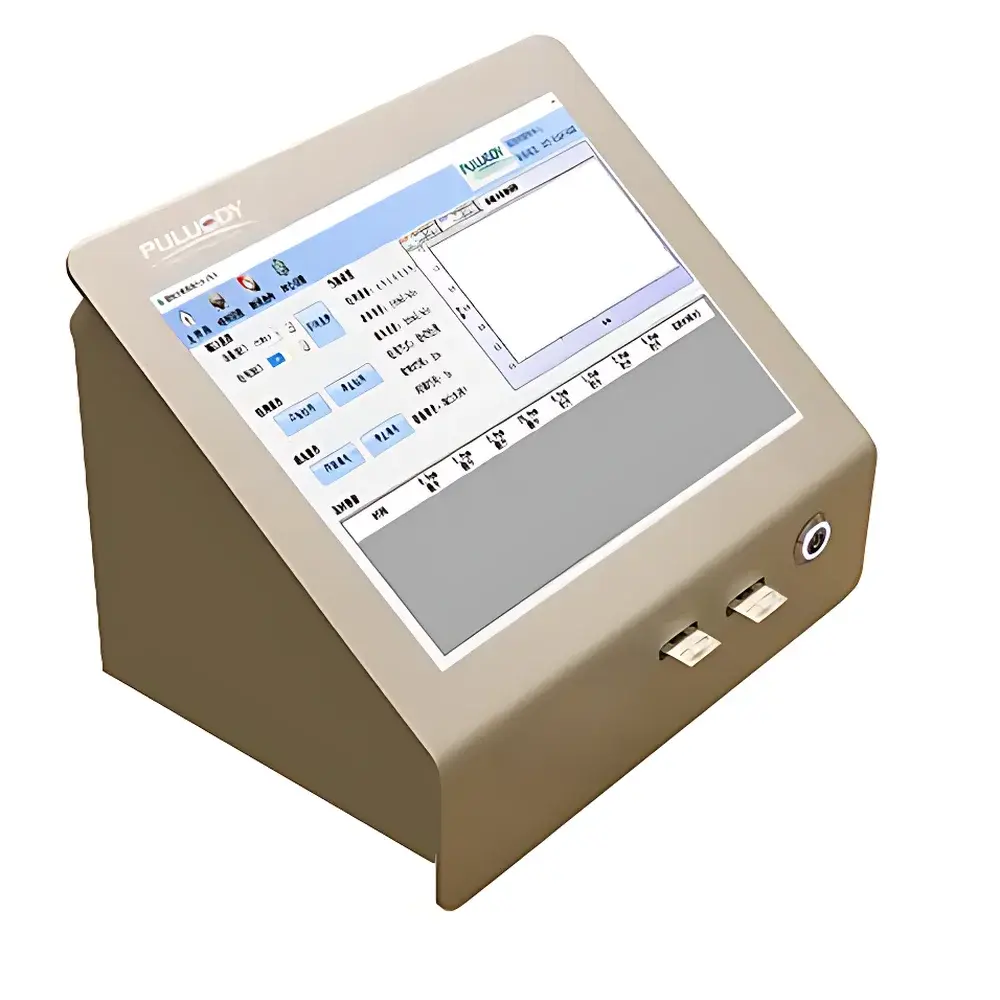
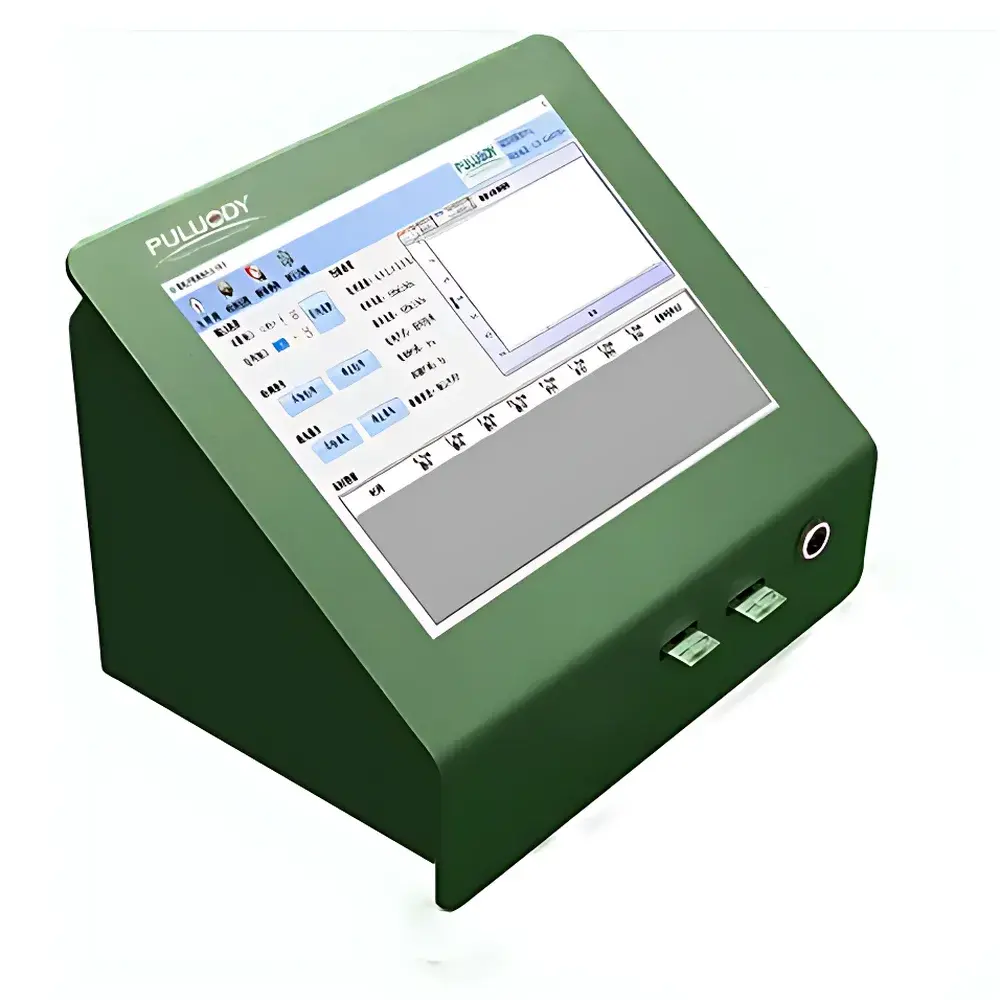
PULUODY PLD-0203 Cloud-Integrated Portable Hydraulic Oil Contamination Analyzer
| Brand | PULUODY |
|---|---|
| Origin | Shaanxi, China |
| Manufacturer Type | OEM Manufacturer |
| Product Category | Domestic |
| Model | PLD-0203 |
| Instrument Type | Optical Particle Counter |
| Detection Principle | Light Obscuration (LO) & Light Scattering (LS) |
| Calibration Standards | ISO 11171, ASTM F658-87 (PSL), GB/T 18854, MTD/ISO 11171, ACFTD/ISO 4402 |
| Compliance | ISO 4406:2017, NAS 1638, SAE AS4059F, GJB 420B, DL/T 432, GJB 380, ISO 11500 |
| Sensor Generations | 7th-generation dual-laser narrow-beam optical sensors |
| Software | P6.4 Integrated Particle Analysis Suite (PC & embedded versions) |
| Control Interface | Industrial-grade touchscreen HMI + optional IPC integration |
| Measurement Range | 0.03 μm to 3000 μm (configurable sensor modules A–N) |
| Channel Count | Up to 1000 user-configurable size channels (any 16 active per test) |
| Sensitivity | 1 μm (per ISO 4402) or 4 μm(c) (per ISO 11171 / GB/T 18854) |
| Accuracy | < ±3% |
| Volume Precision | ±1% |
| Sample Volume | 1–200 mL (programmable) |
| Flow Rate | Sampling 5–60 mL/min |
| Max Online Pressure | 0–0.6 MPa (standard) |
| Viscosity Range | Offline ≤99 mm²/s |
| Coincidence Limit | 10,000 particles/mL (≤5% coincidence error) |
| Resolution | ≥90% at 60 mL/min |
| Reporting | Real-time particle count per size bin, distribution histogram, cumulative curve, ISO/NAS/GJB contamination code, pass/fail flagging |
| Data Output | RS232, RS485, USB, analog 4–20 mA / 0–5 V, MODBUS RTU |
| Alarm Logic | Configurable threshold-based超标 alert (hardware + software) |
| Storage Capacity | Up to 6,000 test records (200 × 30-result sets) |
| Auto-Cleaning | Integrated post-test fluidic purge cycle |
| Operating Temp. | Sample 20–65 °C |
| Power | 220 VAC, 50 Hz, <80 W |
| Metrological Accreditation | CALIBRATED BY National Northwest Metrology & Testing Center (civil) / CASC First-Level Particle Metrology Station (defense) |
Overview
The PULUODY PLD-0203 Cloud-Integrated Portable Hydraulic Oil Contamination Analyzer is an advanced, field-deployable optical particle counter engineered for real-time, in-situ assessment of particulate contamination in hydraulic fluids, aviation lubricants, phosphate ester hydraulic oils, jet fuels, and ultra-pure process liquids. It operates on dual optical detection principles—light obscuration (LO) for precise volumetric particle sizing and counting, and light scattering (LS) for enhanced sensitivity to submicron and transparent contaminants. Designed to meet the stringent requirements of aerospace, defense, power generation, and heavy industrial maintenance programs, the PLD-0203 delivers metrologically traceable data aligned with international standards including ISO 4406:2017, NAS 1638, SAE AS4059F, and GJB 420B. Its portable architecture supports both offline benchtop analysis and online monitoring via pressurized sampling loops (up to 31.5 MPa with integrated pressure regulation), eliminating the need for sample dilution or pre-filtration.
Key Features
- Seventh-generation dual-laser narrow-beam optical detection system ensures high signal-to-noise ratio and minimal sizing drift across extended operation.
- Modular sensor configuration supporting 14 interchangeable optical modules (A–N), enabling application-specific range selection from 0.03 μm to 3000 μm with up to 1000 programmable size channels.
- Real-time, multi-standard compliance reporting: automatic conversion and display of contamination codes per ISO 4406, NAS 1638, GJB 420B, and SAE AS4059F with configurable pass/fail thresholds.
- Embedded P6.4 Particle Analysis Software Suite featuring full GLP-compliant audit trail, electronic signature support, and 21 CFR Part 11–ready data integrity controls (when deployed with validated PC environment).
- Industrial-grade 7-inch color capacitive touchscreen HMI with intuitive workflow navigation, offline operation capability, and onboard thermal printer for immediate hardcopy reporting.
- Automated fluidic management system includes programmable sampling volume (1–200 mL), variable flow control (5–60 mL/min), and self-contained cleaning cycle using compatible solvents or system flush media.
- Robust mechanical design rated for field deployment: IP54 enclosure, shock-absorbing chassis, and thermal stabilization for ambient operation between 0–50 °C.
Sample Compatibility & Compliance
The PLD-0203 is validated for use with a broad spectrum of non-aqueous and low-conductivity fluids, including MIL-PRF-5606/83282/87257 hydraulic oils, Skydrol® phosphate esters, JP-5/JP-8 jet fuels, turbine oils (MIL-PRF-23699), and synthetic lubricants. Its optical design accommodates corrosive and high-viscosity media (online viscosity ≤500 mm²/s) without sensor degradation. All calibration protocols adhere to ISO 11171:2010 and GB/T 18854–2002, with traceability to NIST-traceable PSL standards (ASTM F658-87). Instrument certification is performed by the National Northwest Metrology & Testing Center (CNAS-accredited, civil applications) or the CASC First-Level Particle Metrology Station (defense-grade accreditation under GJB 2725A). The system supports full documentation for ISO/IEC 17025 laboratory accreditation and satisfies data integrity requirements for GMP/GLP-regulated environments when configured with appropriate IT controls.
Software & Data Management
The P6.4 Analysis Software Suite provides comprehensive data acquisition, visualization, and reporting functionality. It enables simultaneous display of differential and cumulative particle distributions, time-series trending, statistical summary (mean, SD, CV%), and batch-level comparison. Raw data files are stored in vendor-neutral CSV and XML formats, with metadata including instrument ID, operator, timestamp, calibration status, and environmental parameters. The software supports role-based access control (RBAC), electronic signatures, and immutable audit logs compliant with FDA 21 CFR Part 11 Annex 11 expectations. Integration with PULUODY’s Oil Monitoring Cloud Platform allows secure remote data upload, centralized fleet-level analytics, predictive maintenance alerts, and automated report generation for regulatory submission. Local storage retains up to 6,000 test records (200 × 30-point datasets), with optional USB export and network backup via Ethernet or Wi-Fi (optional module).
Applications
- Aerospace maintenance: On-wing oil analysis for turbine engines, flight control actuators, and landing gear systems per SAE AS4059F and GJB 420B.
- Military logistics: Field verification of hydraulic fluid cleanliness prior to equipment deployment or after storage; wear debris monitoring in armored vehicle transmission systems.
- Power generation: Turbine lube oil and control fluid monitoring in nuclear, hydro, and thermal plants per DL/T 432 and ISO 11500.
- Hydraulic system commissioning: Pre-operation validation of filter efficiency and system flushing effectiveness per ISO 4406 target codes.
- Research & development: Quantitative evaluation of additive package stability, filtration media performance, and contaminant generation mechanisms under controlled shear conditions.
- Pharmaceutical and semiconductor ultrapure water systems: Detection of sub-100 nm non-volatile residues where traditional conductivity methods lack specificity.
FAQ
What particle size ranges can the PLD-0203 measure?
The instrument supports configurable detection from 0.03 μm to 3000 μm via interchangeable optical sensor modules; standard configurations include 0.1–100 μm (800-channel), 1–150 μm (1000-channel), and sub-0.1 μm modules (4-channel PSL-validated).
Is the PLD-0203 suitable for online installation in high-pressure hydraulic circuits?
Yes — with optional pressure regulation module, it operates continuously at line pressures up to 31.5 MPa, making it compatible with aircraft hydraulic systems, offshore drilling BOPs, and high-pressure test benches.
How is calibration traceability maintained?
Calibration follows ISO 11171:2010 using NIST-traceable PSL reference materials (ASTM F658-87); certificates are issued by national metrology institutes accredited to ISO/IEC 17025.
Can the instrument comply with FDA 21 CFR Part 11 requirements?
When operated with validated P6.4 PC software, enabled audit trail, electronic signatures, and secure network configuration, the system meets core technical controls for Part 11 compliance in regulated pharmaceutical and biotech applications.
Does the analyzer require sample filtration or dilution before testing?
No — the PLD-0203 performs direct analysis of as-received samples; no pre-treatment is necessary due to its wide dynamic range, coincidence correction algorithm, and robust fluid handling design.



