
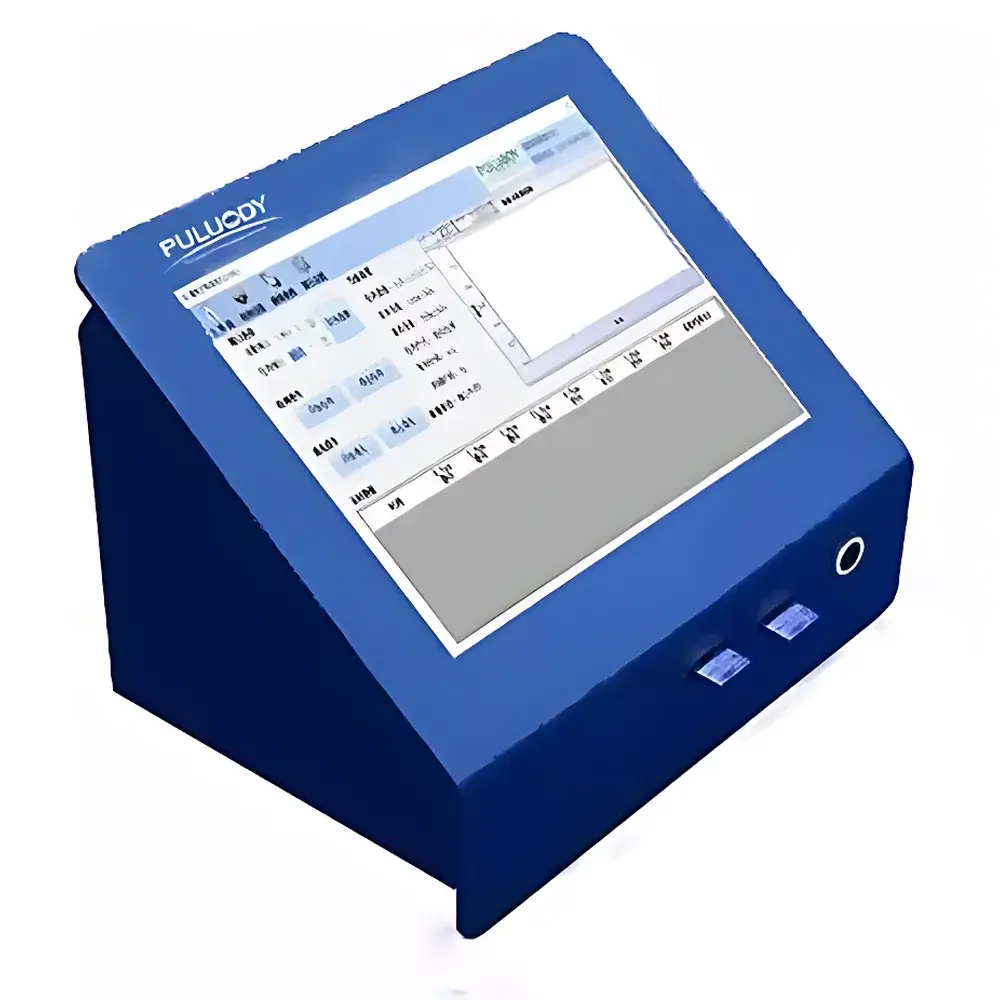
PULUODY PLD-0203 Series Portable Optical Particle Counter
| Brand | PULUODY |
|---|---|
| Origin | Shaanxi, China |
| Manufacturer Type | Manufacturer |
| Country of Origin | China |
| Model | PLD-0203 Series |
| Instrument Type | Optical Particle Counter |
| Detection Principle | Light Obscuration (LO) & Light Scattering (LS) |
| Laser Sensor | 7th-generation dual-laser narrow-beam detector |
| Measurement Range | 0.03 µm – 3000 µm (configurable sensor modules) |
| Channel Count | Up to 1000 channels (user-selectable 16 size bins) |
| Sensitivity | 1 µm (ISO 4402) or 4 µm(c) (ISO 11171 / GB/T 18854) |
| Resolution | ≥90% @ 60 mL/min |
| Coincidence Limit | 10,000 particles/mL (≤5% coincidence error) |
| Sample Volume Accuracy | ±1% |
| Viscosity Range | Offline: 0–99 mm²/s |
| Online | 0–500 mm²/s |
| Flow Rate | Sampling: 5–60 mL/min |
| Cleaning | 5–150 mL/min |
| Pressure Rating | 0–0.6 MPa (standard) |
| Standards Compliance | ISO 4406:1999/2017, NAS 1638, SAE AS4059F, GJB 420B, DL/T 432, GJB 380, ISO 11500, GB/T 18854, JJG 1061, MTD/ISO 11171, ACFTD/ISO 4402, ASTM F658-87 (PSL calibration) |
| Software | P6.4 Integrated Analysis & Testing Software (PC & embedded versions) |
| Control Interface | Industrial-grade touchscreen LCD (integrated IPC or external industrial PC) |
| Data Output | Real-time particle count per channel, size distribution histogram, cumulative curve, contamination grade classification (NAS/ISO), built-in thermal printer, RS232/RS485/USB, MODBUS, 4–20 mA & 0–5 V analog outputs |
| Storage Capacity | Up to 6,000 test records (200 tests × 30 results each) |
| Self-Cleaning Function | Yes |
| Operating Temperature | Sample: 20–65 °C |
| Ambient | 0–50 °C |
| Power Supply | 220 VAC, 50 Hz, <80 W |
| Calibration Traceability | Certified by National Northwest Metrology & Testing Center (civil) or CASC First-Level Particle Metrology Station (defense) |
Overview
The PULUODY PLD-0203 Series Portable Optical Particle Counter is a field-deployable, dual-mode (light obscuration and light scattering) instrument engineered for high-fidelity particulate contamination analysis in liquid media—primarily hydraulic fluids, aviation fuels, lubricants, phosphate ester hydraulic oils, and ultra-pure solvents or water. Designed under the technical heritage of PULUODY Analytical Testing Group (UK), the PLD-0203 integrates seventh-generation dual-laser narrow-beam detection with modular optical sensor architecture to support configurable measurement ranges from 0.03 µm to 3000 µm. Its core principle relies on calibrated light blockage (LO) for robust quantification of particle number concentration and size distribution in opaque or semi-transparent fluids, supplemented by light scattering (LS) for enhanced sensitivity in low-conductivity or low-refractive-index matrices. The instrument meets stringent metrological requirements for military, aerospace, power generation, and pharmaceutical applications where real-time, trace-level particulate monitoring directly informs equipment reliability, maintenance scheduling, and fluid lifecycle management.
Key Features
- Modular optical sensor design supporting up to 14 interchangeable detection modules (A–N), enabling application-specific configuration—from sub-100 nm colloidal particles to >1 mm debris.
- Dual-laser narrow-beam detection technology ensures stable signal-to-noise ratio across wide viscosity ranges (0–500 mm²/s online; 0–99 mm²/s offline) and mitigates refractive index bias in aggressive solvents (e.g., phosphate esters).
- 1000-channel high-resolution sizing capability with user-definable binning—up to 16 custom particle size intervals per test, compliant with ISO 11171 resolution criteria.
- Integrated industrial-grade touchscreen HMI with embedded IPC control or optional external industrial PC interface, eliminating dependency on external computing hardware during field operation.
- Automated self-cleaning cycle post-analysis using programmable reverse-flow rinse protocols, minimizing carryover and ensuring inter-sample reproducibility (RSD <3% at 10,000 p/mL).
- Real-time contamination grading per ISO 4406:2017, NAS 1638, SAE AS4059F, and GJB 420B, with direct export of pass/fail status against preset thresholds—including configurable alarm triggers via 4–20 mA or MODBUS.
Sample Compatibility & Compliance
The PLD-0203 is validated for use with aviation turbine fuel (Jet A-1, JP-5, JP-8), MIL-PRF-23699 and MIL-PRF-6081 engine oils, fire-resistant phosphate ester hydraulic fluids (e.g., Skydrol®, Pyrofluid®), transformer oil, deionized water, and pharmaceutical-grade purified water (PW/UPW). It complies with ISO 11500 for optical particle counting methodology and supports full audit-trail documentation required under GLP and GMP frameworks. Calibration traceability is maintained through national-level certification—National Northwest Metrology & Testing Center (CNAS-accredited, civil sector) or CASC First-Level Particle Metrology Station (defense-grade, MIL-STD-45662A equivalent). All internal calibrations adhere to JJG 1061, GB/T 18854, and ISO 4402 (ACFTD) or ISO 11171 (MTD) reference standards, with optional PSL sphere validation per ASTM F658-87.
Software & Data Management
The embedded P6.4 Analysis & Testing Software provides full control over acquisition parameters, statistical evaluation, and regulatory reporting. It supports multi-language UI (English, Chinese, Russian), time-stamped raw data logging with operator ID tagging, and encrypted local storage of up to 6,000 test records. Data export formats include CSV, PDF reports (with embedded histograms and grade classifications), and XML for LIMS integration. The software enforces 21 CFR Part 11-compliant electronic signatures, audit trails, and role-based access control when deployed in regulated environments. Optional cloud synchronization via PULUODY Oil Monitoring Cloud enables remote fleet-wide contamination trending, predictive maintenance alerts, and cross-site benchmarking—all without compromising data sovereignty.
Applications
- Aerospace: In-service monitoring of aircraft hydraulic systems, fuel filtration integrity verification, and wear debris analysis in gearbox and bearing lubricants.
- Defense: Field-level assessment of battlefield vehicle hydraulic fluid cleanliness per GJB 420B; pre-deployment verification of missile system hydraulic media.
- Power Generation: Turbine oil cleanliness verification prior to commissioning; real-time monitoring of stator cooling water purity in nuclear facilities.
- Pharmaceutical Manufacturing: Final rinse water qualification per USP , clean-in-place (CIP) validation, and sterile filtration challenge testing.
- R&D Laboratories: Nanoparticle dispersion stability studies, emulsion droplet sizing, and catalyst slurry characterization in chemical process development.
FAQ
Does the PLD-0203 require sample filtration or dilution prior to analysis?
No—samples are introduced directly without pre-filtration, centrifugation, or dilution, preserving native particle morphology and concentration integrity.
Can the instrument operate continuously in online mode under high system pressure?
Yes—when equipped with the integrated pressure regulator, it supports continuous online sampling at pressures up to 31.5 MPa, suitable for main hydraulic lines and high-pressure fuel circuits.
How is sensor calibration verified during routine use?
Calibration is verified using NIST-traceable PSL spheres (ASTM F658-87) or certified ISO MTD/ACFTD suspensions; automated recalibration routines are triggered after every 50 tests or upon user command.
Is raw channel data accessible for third-party statistical analysis?
Yes—full 1000-channel pulse height data is exported in ASCII format, enabling advanced distribution modeling (e.g., Rosin-Rammler, log-normal fitting) in MATLAB, Python, or JMP.
What cybersecurity measures are implemented for cloud-connected deployments?
All cloud communications use TLS 1.2+ encryption; device authentication employs X.509 certificates; no credentials or raw particle data are stored on the cloud platform—only anonymized metadata and trend summaries.



