
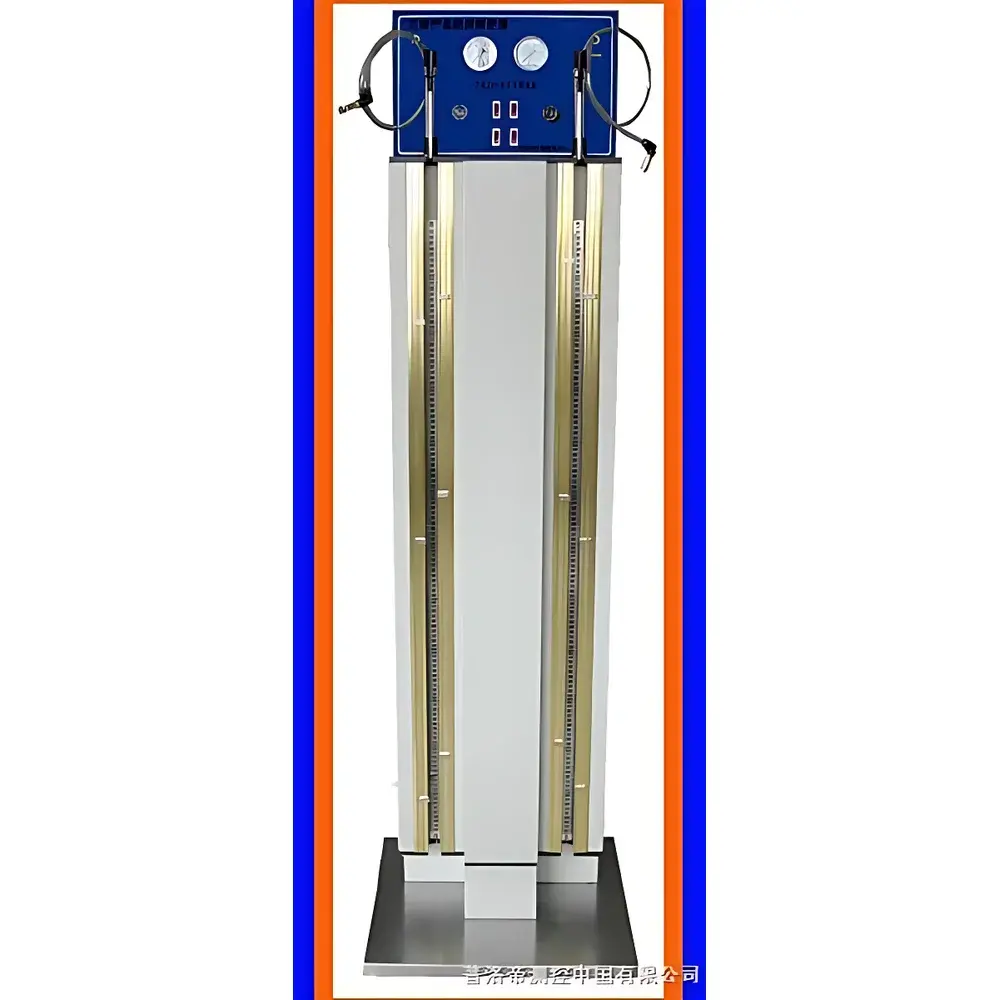
PULUODY PLD-11132A Hydrocarbon Analyzer for Liquid Petroleum Products
| Brand | PULUODY |
|---|---|
| Model | PLD-11132A |
| Standard Compliance | GB/T 11132 |
| Measurement Principle | Fluorescent Indicator Adsorption (FIA) Chromatography |
| Capillary Adsorption Column | Conforms to GB/T 11132 specifications |
| Fluorescent Indicator | Imported silica gel impregnated with fluorescent dye or fluorescent indicator solution |
| Silica Gel Mesh Size | 100–200 mesh |
| Electric Oscillator | Frequency 100 Hz ± 2 Hz, Amplitude > 1.5 mm |
| UV Light Source | 365 nm ± 5 nm (3650 Å ± 50 Å) |
| Structural Frame | Stainless steel square tubing, mobile and modular |
| Pressure Regulation | Adjustable per test requirements |
| Power Supply | AC 220 V, 50 Hz |
| Operating Environment | 10–30 °C, ≤80% RH |
| Sample Compatibility | Liquid petroleum products including gasoline, naphtha, kerosene, and diesel fractions |
Overview
The PULUODY PLD-11132A Hydrocarbon Analyzer for Liquid Petroleum Products is a precision laboratory instrument engineered to perform quantitative hydrocarbon group-type analysis in accordance with GB/T 11132—China’s national standard equivalent to ASTM D1319 (Standard Test Method for Hydrocarbon Types in Liquid Petroleum Products by Fluorescent Indicator Adsorption). It implements the Fluorescent Indicator Adsorption (FIA) chromatographic method, wherein liquid petroleum samples are separated into saturates, olefins, and aromatics on a silica gel column under controlled pressure and UV visualization. The analyzer relies on differential migration rates of hydrocarbon classes in the presence of a fluorescent dye, enabling clear band delineation under ultraviolet illumination at 365 nm. Designed for routine QC laboratories in refineries, independent testing labs, and petrochemical R&D centers, the PLD-11132A delivers high reproducibility in compositional profiling critical for fuel formulation, blending optimization, and regulatory compliance reporting.
Key Features
- GB/T 11132-compliant capillary adsorption column assembly, fabricated to exact dimensional and packing density specifications for consistent phase separation.
- Imported fluorescent indicator system—either pre-impregnated silica gel or standardized fluorescent indicator solution—ensuring stable, low-background fluorescence response across repeated analyses.
- High-purity silica gel (100–200 mesh) with uniform particle size distribution and controlled surface activity, minimizing band broadening and improving resolution between adjacent hydrocarbon zones.
- Integrated electric oscillator with precise frequency control (100 Hz ± 2 Hz) and mechanical amplitude > 1.5 mm, facilitating rapid and homogeneous sample introduction without column disturbance.
- Dedicated UV light source calibrated to 365 nm ± 5 nm, optimized for maximum fluorescence excitation of indicator-dyed bands while minimizing photodegradation of sensitive hydrocarbon fractions.
- Modular stainless-steel support frame with lockable casters, allowing flexible benchtop integration, ergonomic height adjustment, and vibration-isolated column alignment.
- Regulatable inlet pressure system compatible with standard nitrogen or dry air supply lines, supporting both manual and semi-automated pressure ramping protocols.
Sample Compatibility & Compliance
The PLD-11132A is validated for use with transparent, low-viscosity liquid petroleum distillates—including motor gasoline, reformulated gasoline blends, straight-run naphthas, jet fuel fractions, and light diesel cuts—within the boiling range of approximately 30–250 °C. Samples must be free of suspended solids, water, and heavy polynuclear aromatics that may interfere with silica gel activity or cause column clogging. Instrument operation adheres strictly to GB/T 11132 procedural requirements, including specified sample volume (0.75 ± 0.05 mL), eluent composition (95 % v/v n-pentane / 5 % v/v acetone), and development time (≤ 30 min under 20–30 psi pressure). While not certified to ISO/IEC 17025 out-of-the-box, the system supports GLP-aligned documentation when paired with traceable calibration records, operator training logs, and raw data retention practices.
Software & Data Management
The PLD-11132A operates as a manual-to-semi-automated benchtop platform with no embedded microprocessor or proprietary software. All analytical parameters—including UV exposure duration, oscillator timing, pressure setpoints, and ambient temperature/humidity—are recorded manually in laboratory notebooks or LIMS-integrated electronic lab notebooks (ELN). Users are responsible for implementing audit-trail-capable documentation systems compliant with internal QA policies or external regulatory expectations (e.g., CNAS-CL01, API RP 9B, or refinery-specific SOPs). Optional digital imaging accessories (e.g., calibrated UV-sensitive CCD cameras with spectral filters) may be integrated externally for archival band photography and post-acquisition quantification using third-party image analysis tools.
Applications
- Quantitative determination of saturates, olefins, and aromatics (SOA) in gasoline-range fuels for octane number correlation and refinery process monitoring.
- Verification of hydrocarbon composition in reformulated gasoline to meet regional sulfur and benzene content regulations (e.g., China VI, EU Fuel Quality Directive).
- Batch release testing of naphtha feedstocks prior to catalytic reforming or steam cracking units.
- Research-scale investigation of hydrocarbon distribution shifts following hydrotreating, alkylation, or isomerization processes.
- Supporting ASTM D1319 equivalency studies for international export certification where GB/T 11132 is accepted as a technically equivalent alternative method.
FAQ
Does the PLD-11132A comply with ASTM D1319?
It implements the same fluorescent indicator adsorption principle and operational sequence as ASTM D1319; however, formal conformance requires validation against the latest ASTM edition and documented method equivalence assessment.
Can the instrument analyze diesel fuel?
Yes—provided the sample is within the specified volatility range and pre-treated to remove particulates and water; heavier diesel fractions may require modified eluent ratios or extended development times per GB/T 11132 Annex B.
Is UV safety interlock included?
No built-in interlock is provided; users must follow institutional radiation safety protocols, including UV-blocking eyewear and timed exposure limits per IEC 62471.
What maintenance is required for the silica gel column?
Columns must be regenerated after each analysis using oven-drying (150 °C, 2 h) and re-impregnation with fresh fluorescent indicator solution—full replacement recommended after 20–30 runs or visible band distortion.
Is technical support available outside China?
PULUODY provides remote application guidance and calibration verification documentation; local distributor partnerships determine on-site service availability in specific export markets.





