
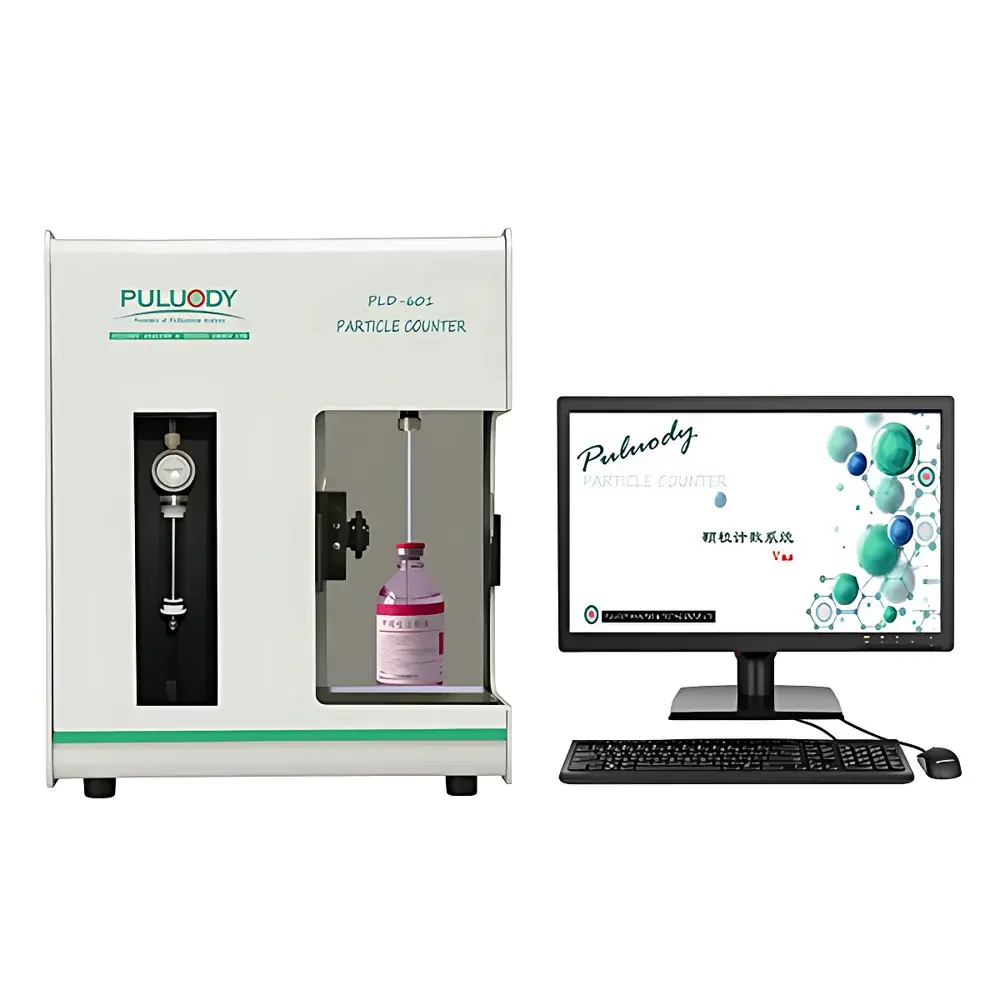
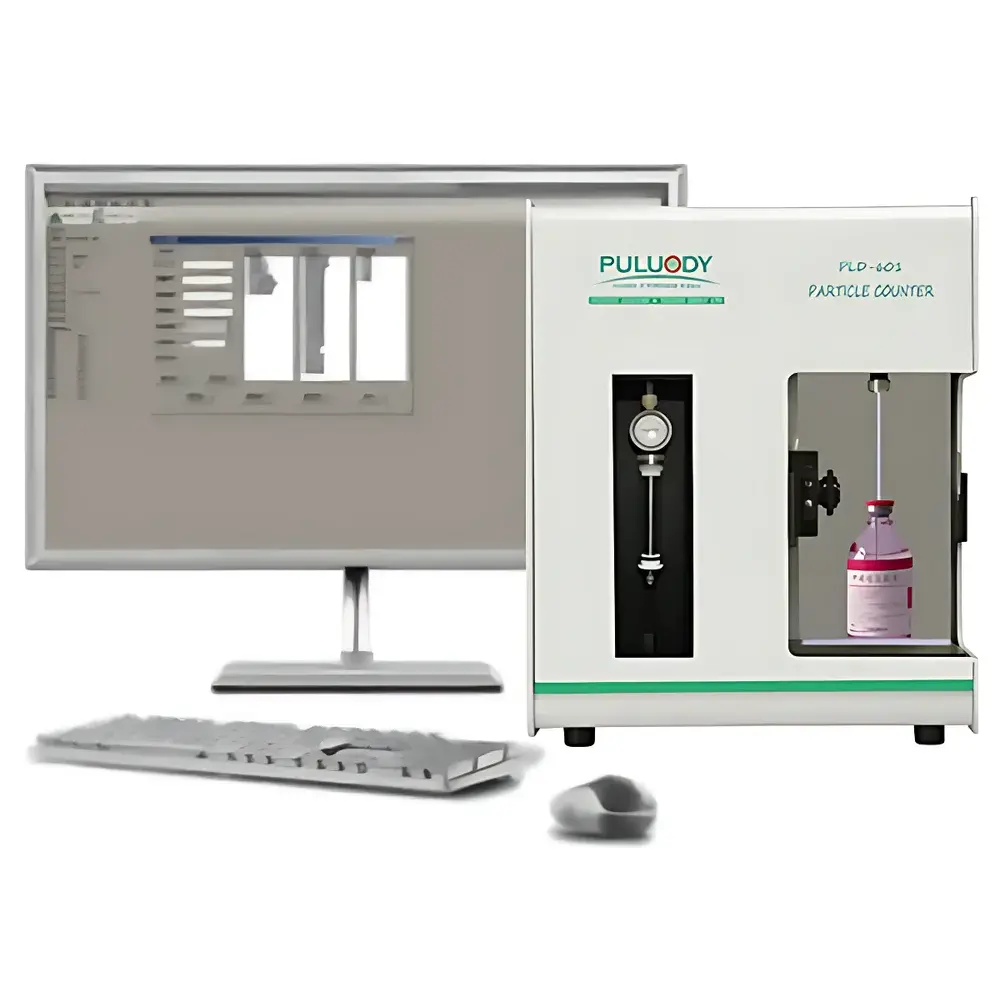
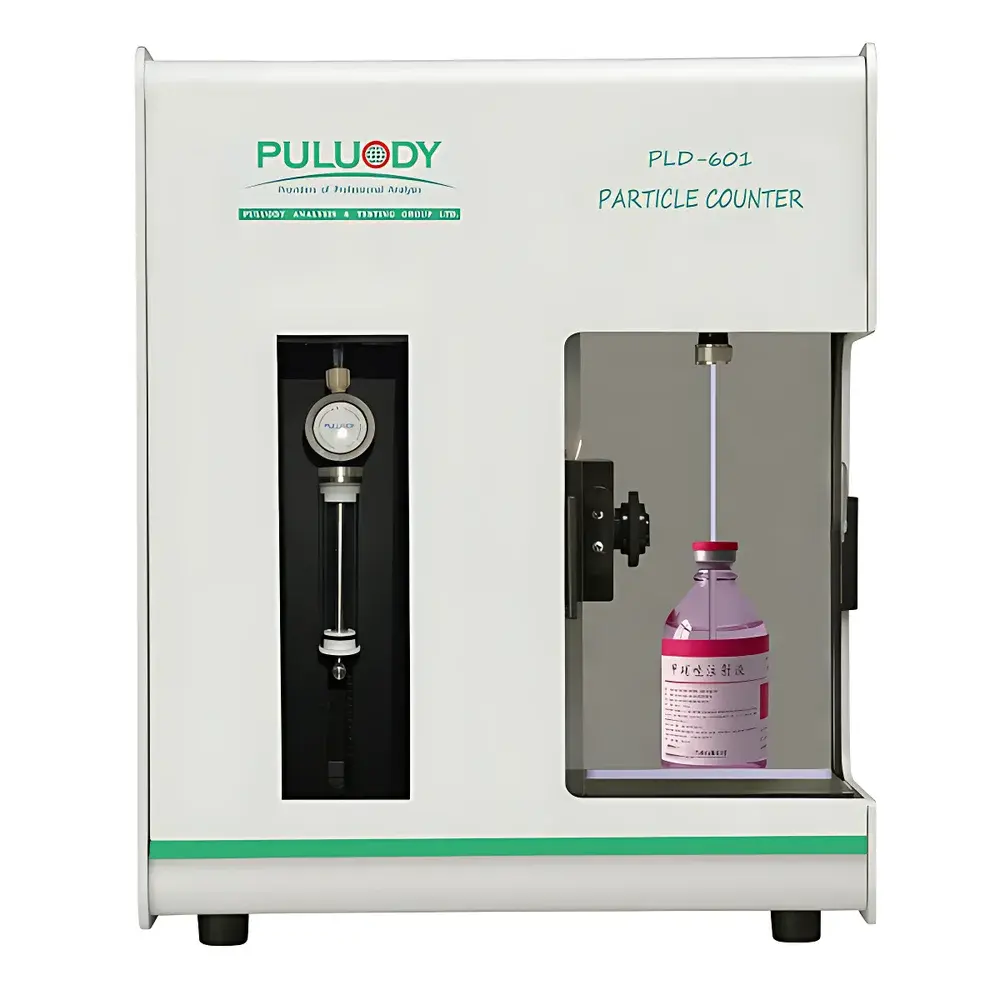
PULUODY PLD-601 Optical Particle Counter for Insoluble Particulate Matter in Parenteral Solutions and Small-Volume Injections
| Brand | PULUODY |
|---|---|
| Model | PLD-601 |
| Instrument Type | Optical Particle Counter (Light Obscuration Method) |
| Detection Principle | Dual-Laser Narrow-Beam Light Obscuration |
| Sensor Generation | 8th-Generation Dual-Laser Detector |
| Channel Count | 1000 Adjustable Channels (Down to 0.01 µm resolution) |
| Particle Size Range | 1–450 µm (Extended Range: 0.03–3000 µm Optional) |
| Sample Flow Rate | 5–150 mL/min |
| Rinse Flow Rate | 5–500 mL/min |
| Temperature Range (Fluid) | 0–80 °C |
| Environmental Operating Range | −15–50 °C |
| Sampling Accuracy | < ±1% |
| Coincidence Limit | ≤2.5% at 1000 particles/mL |
| Resolution | >95% (Calibrated per ChP 2015/2020), <10% (Calibrated per USP/ISO 21501) |
| Software | V8.9 Integrated PC & Touchscreen Analysis Suite |
| Compliance | FDA 21 CFR Part 11, Annex 11, GLP/GMP Data Integrity Requirements, Audit Trail, Electronic Signature, Five-Tier User Permissions |
| Standards Supported | ChP 0903 (2015 & 2020), USP <788>, <789>, <797>, EP 10.0/9.0/8.0, BP 2019/2018, JP 17/16/15, WHO IntPh IV, YBB00272004-2015, GB/T 11446.9-2013, ISO 21501-4, ISO 11171, ISO 4406, NAS 1638, SAE AS4059, MIL-STD-1246, ASTM D6786, GB/T 18854, DL/T 432, GJB/T 420A/B |
Overview
The PULUODY PLD-601 Optical Particle Counter is a regulatory-grade, light obscuration (LO) based instrument engineered for precise quantification and sizing of insoluble particulate matter in parenteral pharmaceuticals and high-purity liquid systems. It operates on the principle of single-particle optical sensing: as particles suspended in a laminar fluid stream pass through two spatially separated, collimated laser beams, they generate transient light attenuation signals proportional to their cross-sectional area. The dual-laser configuration enables real-time coincidence error correction and enhanced signal-to-noise discrimination—critical for accurate counting at high particle concentrations (>1000 particles/mL). Designed to meet the stringent metrological and data integrity requirements of global pharmacopoeias, the PLD-601 delivers traceable, reproducible results for quality control laboratories operating under GMP, GLP, or ISO/IEC 17025 frameworks.
Key Features
- 8th-generation dual-laser narrow-beam sensor with sub-micron detection capability (down to 0.01 µm nominal resolution) and built-in thermal drift compensation
- Dual-flow precision control architecture: high-accuracy metering piston pump (±0.5% volumetric repeatability) combined with ultra-stable electromagnetic flow regulation for consistent sample delivery across viscosity ranges
- 1000 fully programmable size channels—enabling granular distribution analysis aligned with any of 510+ international standards including USP , ChP 0903, and ISO 21501-4
- V8.9 analytical software suite compliant with FDA 21 CFR Part 11 and EU Annex 11: featuring five-level role-based access control, immutable audit trail with timestamped operator actions, electronic signature workflow, and automated backup/recovery of raw data and metadata
- Modular calibration support: traceable to NIST-traceable polystyrene latex (PSL) standards, ISO 21501-4 reference materials, or JJG 1061 national metrology verification protocols
- Integrated touchscreen interface (10.1″ capacitive LCD) with optional wireless keyboard/mouse operation—supporting both English and Chinese language modes without firmware reconfiguration
Sample Compatibility & Compliance
The PLD-601 accommodates a broad spectrum of liquid matrices requiring particulate contamination assessment. These include aqueous parenterals (e.g., large-volume infusions, small-volume injections, ophthalmic solutions, vaccines), sterile powders reconstituted in WFI, injectable concentrates, pharmaceutical excipients, medical device extracts (e.g., infusion sets per GB 8368), packaging component leachables, and ultrapure process waters (UPW, PW, WFI per USP ). Its fluid path is chemically inert (316L stainless steel + PEEK + sapphire capillary), supporting operation with aggressive solvents, low-surface-tension fluids (e.g., CMP slurries), and high-viscosity formulations (up to 50 cP at 25 °C). All hardware and software modules undergo design qualification (DQ), installation qualification (IQ), operational qualification (OQ), and performance qualification (PQ) in accordance with ICH Q9 and ASTM E2500. Validation documentation packages—including URS, FRS, and test scripts—are provided for GxP-regulated environments.
Software & Data Management
The V8.9 software platform implements ALCOA+ principles (Attributable, Legible, Contemporaneous, Original, Accurate, Complete, Consistent, Enduring, Available) throughout the data lifecycle. Raw pulse data, calibrated channel thresholds, and environmental logs are stored in encrypted SQLite databases with SHA-256 hashing. Each report generation event triggers an immutable audit record containing user ID, timestamp, instrument state, calibration status, and deviation flags. Export formats include PDF/A-2b (for long-term archiving), CSV (for statistical process control integration), and XML (compatible with LIMS via ASTM E1482 or HL7 ADT interfaces). Batch-level reporting supports dynamic pass/fail evaluation against configurable limits per pharmacopoeial monograph or internal SOP—automatically flagging outliers and generating non-conformance notifications.
Applications
- Pharmaceutical QC/QA: Routine testing of injectables per ChP 0903, USP , and EP 2.9.19; filter integrity validation (e.g., terminal sterilizing filters); extractables/leachables screening from elastomeric closures and plastic containers
- Biologics & Cell Therapy: Monitoring particulate load in monoclonal antibody formulations, viral vector suspensions, and cryopreservation media
- Water Systems: Continuous monitoring of UPW loops per ASTM D5127 and ISO 14644-1 Class 5/7 environments; trend analysis of particle shedding from RO membranes and storage tanks
- Semiconductor Manufacturing: Quantifying abrasive particles in CMP slurries (SiO₂, CeO₂), post-etch rinse solutions, and wafer cleaning baths
- Advanced Materials: Characterizing dispersion stability of nanomaterials (graphene oxide, quantum dots), pigment agglomerates in inkjet inks, and catalyst residues in battery electrolytes
FAQ
Does the PLD-601 comply with FDA 21 CFR Part 11 requirements for electronic records and signatures?
Yes—the system implements full Part 11 compliance including role-based permissions, electronic signatures with biometric or token-based authentication, time-stamped audit trails, and data immutability controls.
Can the instrument be calibrated to ISO 21501-4 using PSL reference standards?
Yes—calibration protocols for ISO 21501-4 are embedded in the software, and certified PSL standards (e.g., Thermo Scientific NIST-traceable kits) are supported for both factory and field verification.
Is it possible to define custom particle size channels outside standard pharmacopoeial bins?
Yes—users may configure up to 1000 arbitrary size thresholds between 0.01 µm and 3000 µm, enabling bespoke reporting for internal specifications or emerging regulatory guidance.
What maintenance intervals are recommended for routine operation?
Daily system flush with filtered deionized water; weekly optical path inspection and flow rate verification; annual sensor recalibration and pump seal replacement—documented in the included Preventive Maintenance Logbook.
How does the dual-laser architecture improve accuracy compared to single-beam LO instruments?
It enables real-time coincidence correction by detecting overlapping pulses across two independent beam paths, reducing counting errors at concentrations exceeding 500 particles/mL—particularly critical for concentrated biologics and vaccine suspensions.



