
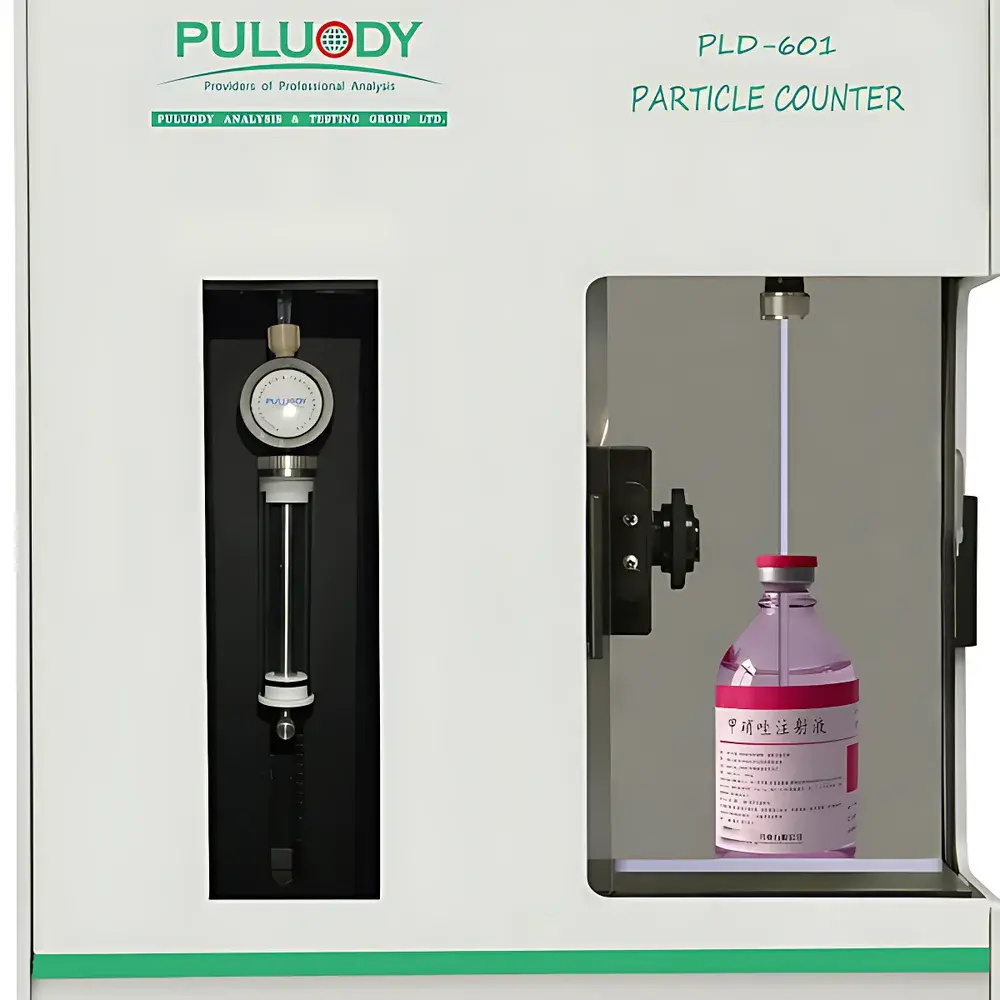
PULUODY PLD-601C Single-Use Blood Collection Set Insoluble Particle Analyzer
| Brand | PULUODY |
|---|---|
| Origin | Shaanxi, China |
| Model | PLD-601C |
| Instrument Type | Optical Liquid Particle Counter |
| Detection Principle | Light Obscuration (LO) / Dual-Laser Narrow-Beam Sensor |
| Measurement Range | 1–450 µm (optional 0.03–3000 µm) |
| Channel Count | 1000 adjustable channels |
| Flow Control | Precision Metering Piston Pump + High-Accuracy Electromagnetic Flow Regulation |
| Calibration Standards | ISO 21501-4, USP <788>, EP 2.9.19, ChP 0903, GB/T 11446.9-2013, ISO 11171, JJG 1061 |
| Software Compliance | FDA 21 CFR Part 11, Audit Trail, Electronic Signature, 5-Level User Permission Management |
| Sample Compatibility | Aqueous & non-aqueous sterile solutions, lyophilized powders, ophthalmic preparations, vaccines, WFI, medical packaging, infusion devices, CMP slurries, ultrapure water |
| Operating Temperature | 0–80 °C (fluid), 0–50 °C (ambient) |
| Sampling Flow Rate | 5–150 mL/min |
| Rinse Flow Rate | 5–500 mL/min |
| Accuracy | ±5% typical (per ChP/USP), ±1% volumetric precision |
| Coincidence Limit | ≤5% at 1000 particles/mL |
| Resolution | >95% (ChP-aligned), <10% (ISO 21501/USP-aligned) |
Overview
The PULUODY PLD-601C Single-Use Blood Collection Set Insoluble Particle Analyzer is a high-precision optical liquid particle counter engineered for regulatory-grade particulate contamination assessment in parenteral pharmaceuticals, biologics, and critical fluid systems. It operates on the light obscuration (LO) principle—where particles suspended in a liquid stream pass through a focused dual-laser narrow-beam detection zone, generating pulse signals proportional to their cross-sectional area. This eighth-generation sensor architecture enables stable, repeatable quantification of insoluble particulates across a broad dynamic range (1–450 µm standard; optional extension to 0.03–3000 µm). Designed specifically to meet the stringent requirements of pharmacopoeial monographs—including USP , , , EP 2.9.19, ChP 0903, and ISO 21501-4—the PLD-601C delivers trace-level particle enumeration with metrological traceability to national standards (e.g., NIM, NWMS, and DL/T 1096-certified calibration). Its primary application domain spans quality control of injectables, validation of terminal filtration efficacy, and routine monitoring of cleanroom process fluids, water-for-injection (WFI), and semiconductor-grade ultrapure water.
Key Features
- Dual-laser narrow-beam optical sensor with real-time signal discrimination to minimize refractive index dependency and improve sizing fidelity for transparent and semi-transparent particles.
- Integrated dual-flow control architecture: a precision metering piston pump ensures volumetric accuracy (<±1%), while an electromagnetic flow regulator maintains stable laminar flow during sampling and rinsing cycles (5–150 mL/min sampling; 5–500 mL/min rinse).
- 1000 fully customizable particle size channels—from sub-micron (0.01 µm) to coarse particulates (up to 450 µm)—enabling compliance with over 510 international and regional particle counting standards.
- V8.9 Analytical Software Suite with full 21 CFR Part 11 compliance: role-based five-tier user permissions, immutable audit trail, electronic signature workflow, automated data backup/recovery, and power-failure recovery protocol.
- Touchscreen HMI with bilingual (English/Chinese) interface optimized for GMP laboratory environments; supports rapid method setup, real-time histogram visualization, and automated report generation per USP/EP/ChP templates.
- Calibration traceability to ISO 11171 reference materials and certified by national metrology institutes (e.g., NWMS No. 116 Station, China National Institute of Metrology).
Sample Compatibility & Compliance
The PLD-601C is validated for use with low-viscosity aqueous and organic liquids commonly encountered in pharmaceutical and biotechnology manufacturing. Compatible sample types include: sterile aqueous injections (e.g., saline, dextrose), lyophilized powder reconstitutes, ophthalmic solutions, vaccine suspensions, water-for-injection (WFI), purified water (PW), ultrapure water (UPW), medical device extracts (e.g., IV sets, blood collection tubing), and semiconductor process chemicals (e.g., CMP slurries). All measurements adhere to globally harmonized regulatory frameworks—specifically USP and for injectables, EP 2.9.19 for particulate matter in parenterals, ChP 0903 for insoluble particle testing, and ISO 21501-4 for instrument performance verification. The system supports configurable pass/fail criteria aligned with NAS 1638, ISO 4406, and SAE AS4059 for industrial fluid cleanliness grading.
Software & Data Management
The embedded V8.9 software platform provides end-to-end data integrity assurance. It implements ALCOA+ principles (Attributable, Legible, Contemporaneous, Original, Accurate, Complete, Consistent, Enduring, Available) through timestamped audit logs, session-level electronic signatures, and cryptographic hash verification of raw datasets. Data export formats include CSV, PDF, XML, and SQL-compatible dumps for LIMS integration. Automated report templates are preloaded for USP, EP, ChP, and ISO-compliant documentation—including particle count histograms, cumulative distribution curves, and filter efficiency calculations (e.g., log reduction value, LRv). System validation packages (IQ/OQ/PQ) and electronic records comply with FDA 21 CFR Part 11, EU Annex 11, and WHO TRS 992 Annex 5 requirements.
Applications
- Pharmaceutical QC: Quantitative assessment of insoluble particles in final-fill injectables, lyophilized products, ophthalmic preparations, and vaccine formulations per pharmacopoeial mandates.
- Filtration Validation: Evaluation of terminal sterilizing filter performance—including challenge studies using standardized latex spheres and calculation of particle removal efficiency (PRE) and log reduction values (LRV).
- Water Systems Monitoring: Routine surveillance of WFI, PW, UPW, and electronic-grade water per ASTM D5127, ISO 3696, and SEMI F63 specifications.
- Medical Device Testing: Extraction and analysis of particulates leached from IV administration sets, blood collection tubes, syringes, and stoppers per ISO 8536, GB 8368, and YBB 00272004.
- Semiconductor Manufacturing: Slurry cleanliness verification in chemical mechanical planarization (CMP) processes and wafer rinse water qualification per SEMI C12 and JIS B 9933.
- Industrial Fluids: Cleanliness grading of hydraulic oils, lubricants, and cleaning agents per ISO 4406, NAS 1638, and SAE AS4059.
FAQ
Does the PLD-601C support USP automated reporting?
Yes—the V8.9 software includes preconfigured USP reporting modules with automatic pass/fail evaluation based on specified volume, particle thresholds (≥10 µm and ≥25 µm), and statistical confidence intervals.
Can the instrument be calibrated to ISO 11171 reference materials?
Yes—calibration is performed using NIST-traceable polystyrene latex (PSL) spheres compliant with ISO 11171:2011, with full documentation provided per JJG 1061-2010 or customer-specified metrology protocols.
Is remote software update and diagnostic support available?
Yes—secure remote access is enabled via encrypted TLS tunneling for firmware updates, parameter optimization, and predictive maintenance diagnostics without compromising data security or 21 CFR Part 11 compliance.
What is the maximum allowable viscosity for samples tested on the PLD-601C?
The system is optimized for liquids with kinematic viscosity ≤20 cSt at 25 °C; higher-viscosity samples require dilution or optional high-viscosity flow module configuration.
How does the PLD-601C handle particle coincidence error at high concentrations?
Coincidence correction algorithms are applied in real time, with built-in validation against ISO 21501-4 linearity limits; the system flags results exceeding 5% coincidence error at 1000 particles/mL and recommends dilution or reduced flow rate.



