
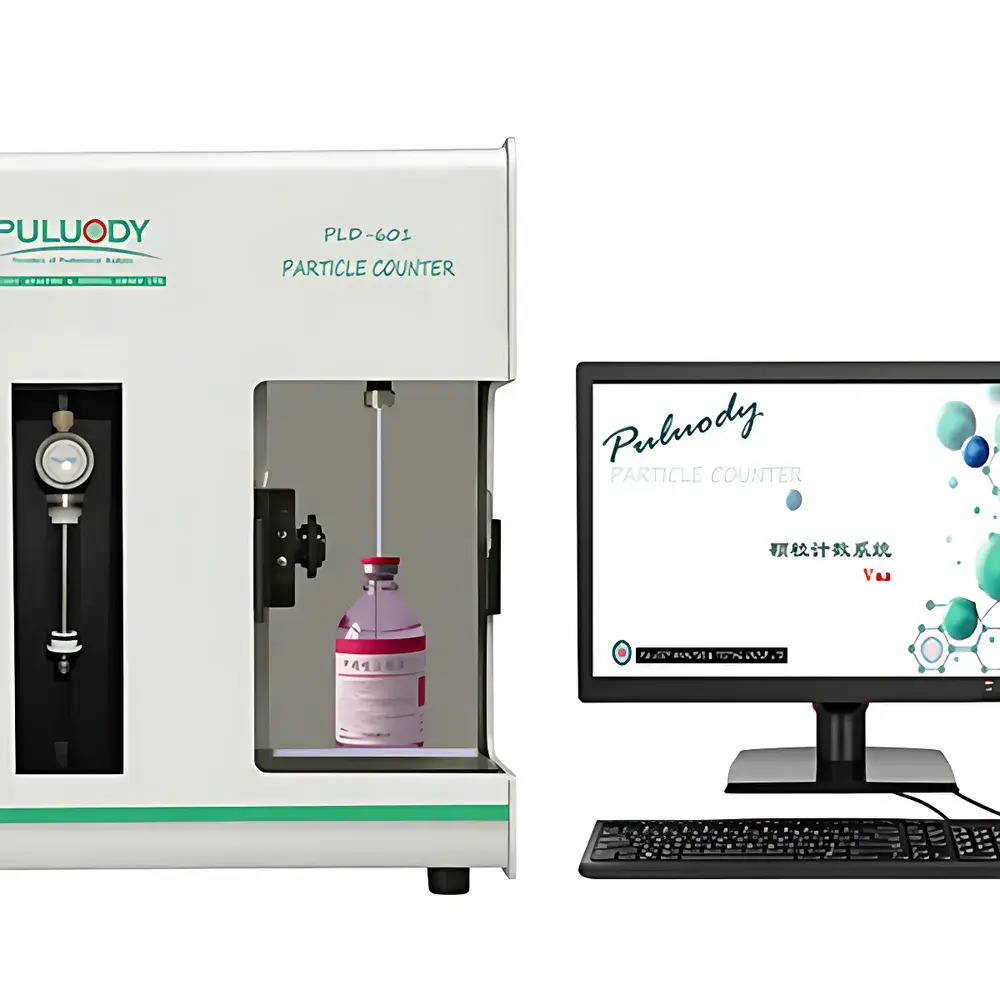
PULUODY PLD-601D Optical Liquid Particle Counter for Injectable Solutions and Infusion Devices
| Brand | PULUODY |
|---|---|
| Model | PLD-601D |
| Instrument Type | Optical Particle Counter (Light Obscuration Method) |
| Detection Principle | Dual-Laser Narrow-Beam Light Obscuration |
| Sensor Generation | 8th-Generation Dual-Laser Sensor |
| Channel Count | 1000 Adjustable Channels |
| Minimum Detectable Size | 0.01 µm (c) |
| Measurement Range | 1–450 µm |
| Sample Flow Rate | 5–150 mL/min |
| Accuracy | ±5% typical |
| Sampling Precision | <±1% |
| Coincidence Limit | 1000 particles/mL (5% coincidence error) |
| Resolution | >95% (per ChP 2015/2020), <10% (per USP/ISO 21501) |
| Compliance | USP <788>, <789>, <797> |
Overview
The PULUODY PLD-601D Optical Liquid Particle Counter is a regulatory-grade instrument engineered for quantitative detection and size-resolved enumeration of insoluble particulate matter in parenteral pharmaceuticals, medical devices, and ultra-pure process liquids. It operates on the light obscuration (LO) principle—where particles suspended in a liquid stream pass through a precisely collimated dual-laser sensing zone, generating transient signal pulses proportional to their cross-sectional area. The 8th-generation dual-laser narrow-beam sensor delivers enhanced signal-to-noise ratio and superior discrimination of sub-micron particles down to 0.01 µm (c), enabling high-fidelity compliance testing per pharmacopoeial standards including USP , ChP 0903, EP 10.0, and JP 17. Designed specifically for end-user validation of infusion sets, IV bags, syringes, and terminal filters, the PLD-601D supports both routine QC release testing and advanced filter challenge studies—including particle removal efficiency (PRE) quantification under defined flow dynamics.
Key Features
- Dual-laser narrow-beam optical detection system with real-time pulse analysis for improved resolution of overlapping particles and reduced coincidence error at high concentrations (≤5% up to 1000 particles/mL).
- High-precision dual-flow control architecture: volumetric piston pump for metered sampling + electromagnetic flow regulator for dynamic compensation across 5–150 mL/min range.
- 1000 fully customizable particle size channels—configurable from 4 to 128 discrete bins—supporting simultaneous multi-standard reporting (e.g., USP 10 µm/25 µm vs. ISO 4406 4 µm(c)/6 µm(c)/14 µm(c)).
- V8.9 Regulatory Software Suite compliant with FDA 21 CFR Part 11: role-based 5-level user access, full electronic audit trail, time-stamped electronic signatures, automated report generation, and encrypted data backup/recovery.
- Integrated thermal management system maintaining fluid temperature stability between 0–80°C—critical for viscosity-sensitive biologics and thermolabile formulations.
- Touchscreen HMI with bilingual (English/Chinese) interface, intuitive workflow navigation, and context-aware calibration prompts aligned with GLP/GMP laboratory practices.
Sample Compatibility & Compliance
The PLD-601D accommodates a broad spectrum of sample matrices without dilution or filtration pre-treatment: sterile aqueous solutions (e.g., saline, dextrose), lyophilized powder reconstitutes, ophthalmic drops, vaccine suspensions, injectable excipients, WFI, purified water, semiconductor CMP slurries, and cleanroom rinse fluids. Its design conforms to ISO 21501-4 for light obscuration instrumentation verification and supports traceable calibration using NIST-traceable polystyrene latex (PSL) standards or certified reference materials per JJG 1061. All hardware and software modules undergo annual metrological verification by CNAS-accredited laboratories—including the National Northwest Metrology Testing Center (NWMC) and China Academy of Metrology’s Defense Science & Technology Commission Grade-I Particle Metrology Station #116.
Software & Data Management
The V8.9 software platform provides comprehensive data governance functionality required for regulated environments. It enforces ALCOA+ principles (Attributable, Legible, Contemporaneous, Original, Accurate, Complete, Consistent, Enduring, Available) via immutable audit logs capturing every user action—including parameter changes, calibration events, report exports, and method modifications. Raw pulse data, histogram metadata, and channel-specific counts are stored in vendor-neutral SQLite databases with SHA-256 hashing for integrity verification. Export options include PDF/e-signature reports, CSV for LIMS integration, and XML formats compatible with enterprise quality management systems (QMS). Software validation documentation (IQ/OQ/PQ protocols) and 21 CFR Part 11 configuration files are supplied as standard.
Applications
- Pharmaceutical QC: Quantitative assessment of insoluble particles in injectables per USP , ChP 0903, and EP 2.9.19—covering solution-type injections, lyophilized powders, concentrated solutions, APIs, ophthalmic preparations, and vaccines.
- Medical device evaluation: Filter performance validation for IV sets, administration sets, and terminal filters per GB 8368 and ISO 8536-4; calculation of particle removal efficiency (PRE) and breakthrough profiles.
- Water purity monitoring: Solid particle contamination grading of WFI, PW, UPW, and electronic-grade water per ASTM D5127, ISO 14644-1, and SEMI F57.
- Process fluid characterization: Slurry stability analysis in semiconductor CMP, nanoparticle dispersion uniformity in drug delivery systems, and wear debris quantification in hydraulic and lubrication fluids.
- Regulatory submission support: Generation of validated, auditable datasets for ANDA, NDA, and MA dossier submissions to FDA, EMA, PMDA, and NMPA.
FAQ
Does the PLD-601D comply with FDA 21 CFR Part 11 requirements for electronic records and signatures?
Yes—the system implements full Part 11 functionality including role-based access control, electronic audit trails, operator authentication, and cryptographic hash verification of all data objects.
Can the instrument be calibrated to multiple pharmacopoeial standards simultaneously?
Yes—V8.9 software allows concurrent configuration of USP, EP, ChP, and JP thresholds within a single test method, with automatic unit conversion and binning logic per standard.
What is the minimum detectable particle size, and how is it verified?
The validated lower detection limit is 0.01 µm (c) per ISO 21501-4, confirmed using monodisperse PSL standards traceable to NIST SRM 1963 and verified annually by NWMC.
Is third-party metrological certification included with purchase?
Each unit ships with a Certificate of Calibration issued by the National Northwest Metrology Testing Center (CNAS L2291), valid for 12 months under standard operating conditions.
How does the dual-laser sensor improve measurement robustness compared to single-beam systems?
Dual orthogonal laser paths reduce orientation-dependent signal variance, suppress noise from air bubbles or refractive index fluctuations, and enable real-time coincidence correction via differential pulse timing analysis.



