
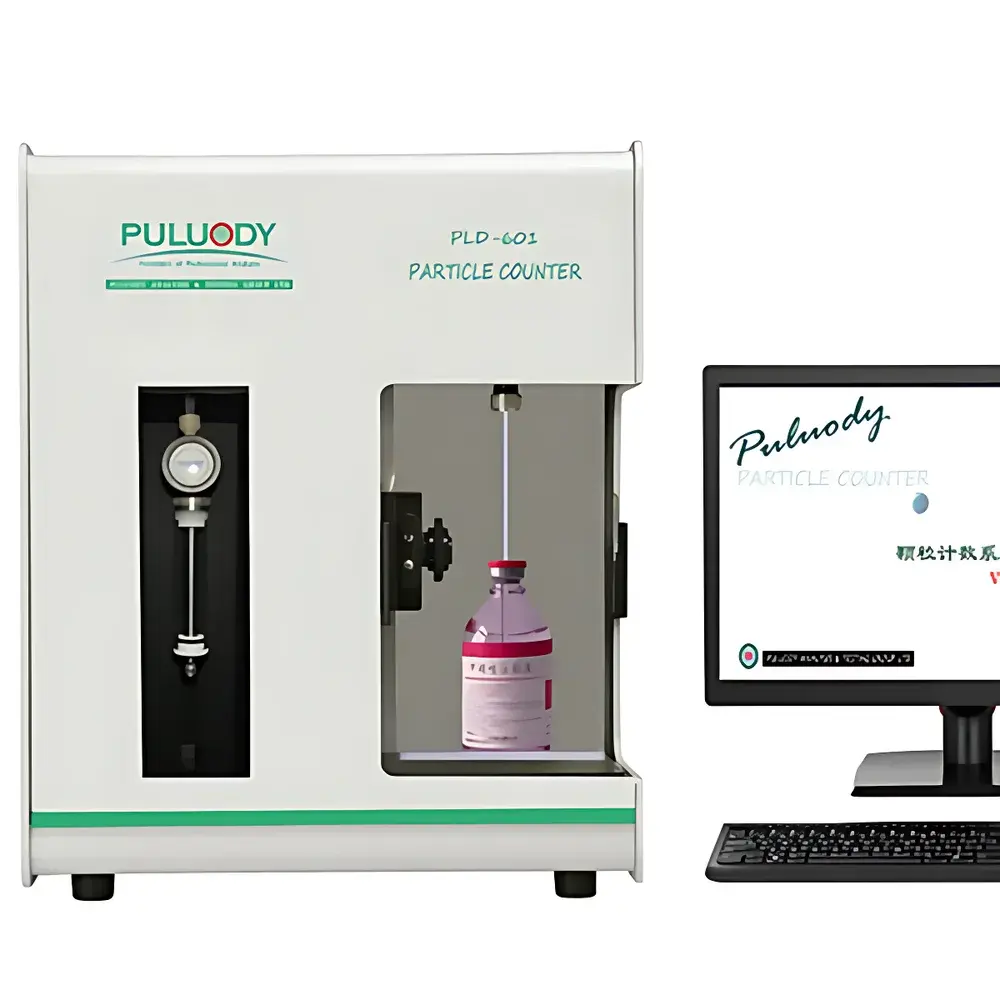
PULUODY PLD-601MZ Anesthetic Agent Insoluble Particulate Analyzer
| Brand | PULUODY |
|---|---|
| Model | PLD-601MZ |
| Instrument Type | Optical Particle Counter (Light Obscuration Principle) |
| Detection Range | 1–450 µm (optional extension to 0.03–3000 µm) |
| Channel Count | 1000 customizable size channels (down to 0.01 µm resolution) |
| Flow Control | Dual-precision piston pump + ultra-precise electromagnetic flow regulation |
| Accuracy | ±2.5% typical (per ChP 2020 & USP <788>) |
| Repeatability | <2.5% coincidence error at 1000 particles/mL |
| Calibration Standards | ISO 21501-4, JJG 1061, NIST-traceable latex spheres |
| Software Compliance | FDA 21 CFR Part 11, ALCOA+ data integrity, 5-level user permission architecture, full audit trail, electronic signature, auto-backup & restore |
| Operating Temperature | 0–80 °C (fluid), 0–50 °C (ambient) |
| Sample Compatibility | Aqueous & organic solvents, sterile injectables, ophthalmic solutions, vaccines, WFI, USP-grade water, pharmaceutical packaging extracts, infusion devices, filter challenge media |
| Regulatory Alignment | ChP 0903 (2015/2020), USP <788>, <789>, <797>, EP 10.0, BP 2019, JP 17, ISO 21510, ISO 11171, NAS 1638, ISO 4406, YBB 00272004-2015, GB/T 11446.9-2013 |
Overview
The PULUODY PLD-601MZ Anesthetic Agent Insoluble Particulate Analyzer is a high-precision optical particle counter engineered for regulatory-compliant particulate quantification in parenteral drug products and critical liquid pharmaceuticals. It operates on the light obscuration (LO) principle—where particles suspended in a laminar fluid stream pass through a focused laser beam, generating transient reductions in photodetector signal amplitude proportional to particle cross-sectional area. This first-principles measurement enables traceable, repeatable sizing and counting of insoluble particulates from 1 µm up to 450 µm (with optional extended range configurations). Designed specifically for anesthetic agents, IV admixtures, lyophilized powders, ophthalmic formulations, and vaccine suspensions, the instrument meets the stringent physical testing requirements defined in global pharmacopoeias and quality standards—including mandatory compliance with ChP 0903, USP , and EP 10.0. Its dual-laser narrow-beam sensor architecture minimizes Mie scattering artifacts and improves detection fidelity across broad refractive index ranges (1.3–1.7), ensuring robust performance in low-conductivity, low-viscosity, and high-clarity matrices common in sterile manufacturing environments.
Key Features
- Eighth-generation dual-laser narrow-beam sensor with real-time pulse-height analysis and adaptive thresholding for optimal signal-to-noise ratio
- Dual-flow control system: precision metering piston pump (±1% volumetric accuracy) coupled with closed-loop electromagnetic flow regulation (5–150 mL/min programmable)
- 1000-channel particle sizing capability with user-definable bin boundaries—supporting simultaneous compliance with >510 international standards including USP , ISO 21501-4, and YBB 00272004-2015
- V8.9 Analytical Software Suite with FDA 21 CFR Part 11-compliant architecture: five-tier role-based access control, immutable audit trail, time-stamped electronic signatures, and automated data backup/recovery
- Integrated thermal management system enabling stable operation across fluid temperatures from 0 °C to 80 °C—critical for temperature-sensitive biologics and anesthetic formulations
- Modular calibration workflow compliant with JJG 1061, ISO 21501-4, and NIST-traceable polystyrene latex standards; validated by National Northwest Metrology Testing Center (CNAS-accredited)
Sample Compatibility & Compliance
The PLD-601MZ accommodates a wide spectrum of pharmaceutical and industrial liquids without solvent compatibility limitations. Validated applications include aqueous injectables (e.g., propofol emulsions, ketamine HCl solutions), sterile lyophilized reconstitutes, ophthalmic drops, vaccine suspensions (e.g., mRNA-LNP formulations), Water for Injection (WFI), Purified Water (PW), and container-closure system extracts. It supports filter challenge testing per USP Annex and evaluates terminal filter retention efficiency using standardized challenge suspensions (e.g., ISO 11171-certified latex). The system conforms to Good Manufacturing Practice (GMP) Annex 1 requirements for particulate monitoring in Grade A/B environments and supports GLP audit readiness via full metadata capture—including environmental logs, operator ID, calibration history, and raw pulse-data archives.
Software & Data Management
The V8.9 software platform provides end-to-end data lifecycle governance. All measurements are timestamped, digitally signed, and stored in encrypted SQLite databases with SHA-256 hashing. Audit trails record every action—including parameter edits, report generation, and user logins—with irreversible linkage to original sensor pulses. Electronic signatures comply with ICH GCP and FDA guidance on electronic records. Data export supports CSV, PDF/A-2, and XML formats compatible with LIMS integration (ASTM E1482, HL7 FHIR). Customizable reporting templates align with pharmacopoeial submission requirements—including USP summary tables, EP 10.0 particle distribution histograms, and ChP 0903 pass/fail decision logic.
Applications
- Pharmaceutical QC labs: Routine batch release testing of injectables, pre-filtration and post-filtration verification, extractables/leachables screening of IV bags and stoppers
- Biomanufacturing: Monitoring microaggregate formation during cold-chain transport of monoclonal antibodies and ADCs
- Medical device validation: Quantifying particulate shedding from syringe plungers, IV tubing, and anesthesia vaporizer components
- Water purification: Certification of ultrapure water systems used in API synthesis per ASTM D5127 and SEMI F63
- Electronics: CMP slurry cleanliness verification per SEMI C12 and JEDEC JESD22-A106
- Academic research: Fundamental studies on nucleation kinetics, protein aggregation, and colloidal stability under shear
FAQ
Does the PLD-601MZ support method transfer from legacy light obscuration instruments?
Yes—the instrument accepts user-defined channel mappings and integrates seamlessly with existing SOPs based on USP or ChP 0903. Raw pulse data export enables retrospective re-analysis using alternative sizing algorithms.
Can it quantify submicron particles relevant to nanomedicine formulations?
While primary detection begins at 1 µm, optional sensor configurations extend lower detection limits to 0.03 µm using enhanced signal processing and low-noise amplification—validated per ISO 21501-4 Annex B.
Is hardware validation documentation provided for regulatory submissions?
Yes—each unit ships with a Factory Acceptance Test (FAT) report, IQ/OQ protocol templates, and metrological certification from China’s National Northwest Metrology Testing Center (No. 116 Station, DMC).
How does the system handle viscous or non-Newtonian anesthetic carriers?
The dual-pump architecture maintains laminar flow profiles across viscosities up to 20 cP; optional heated sample path (up to 40 °C) reduces viscosity-related wall adhesion effects.
Are software updates included in the service contract?
All regulatory-aligned software upgrades—including new pharmacopoeia modules and Part 11 enhancements—are covered under the standard 3-year Platinum Support Agreement.



