
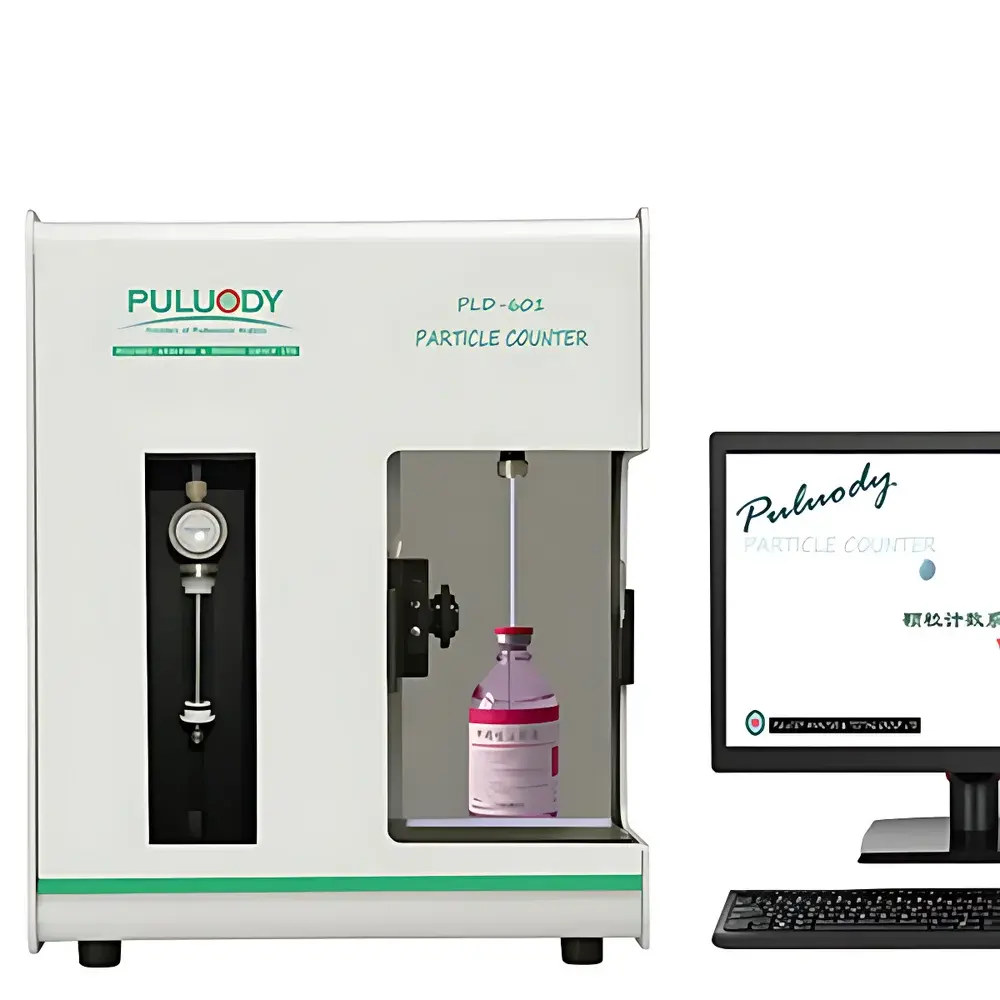
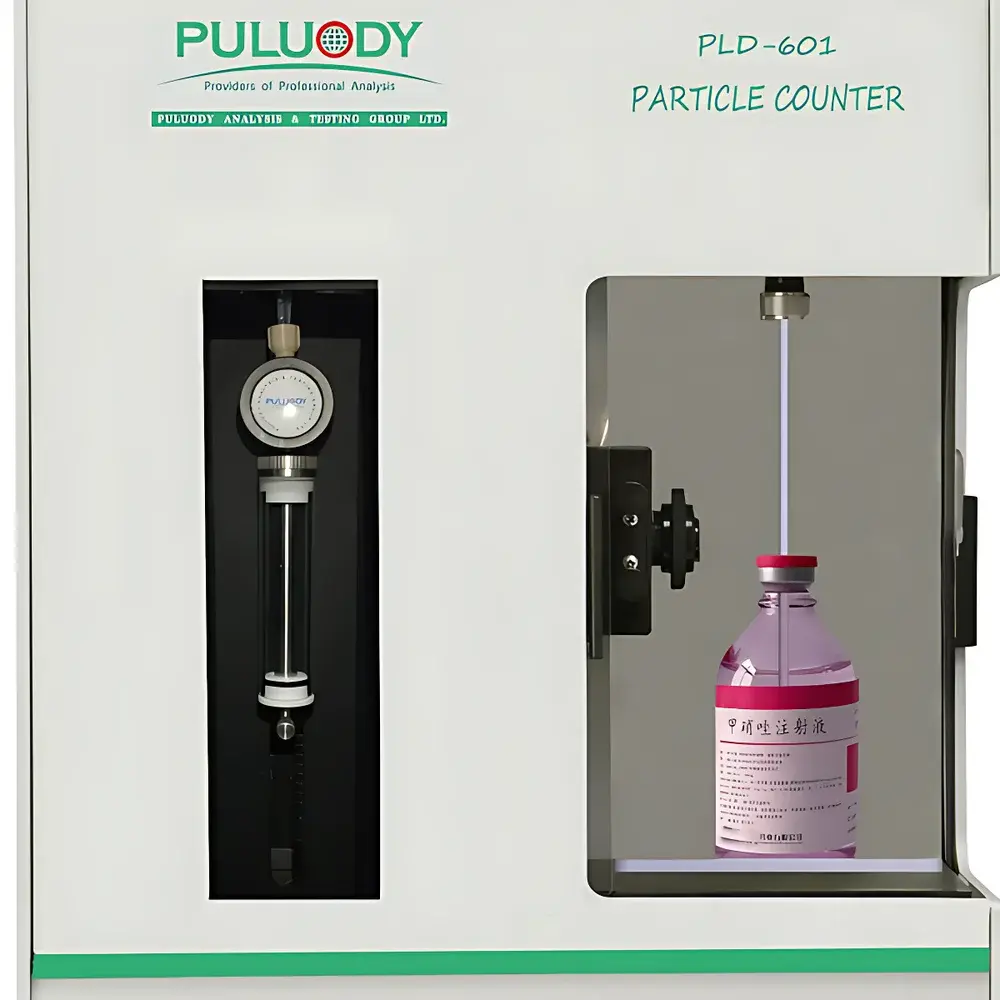
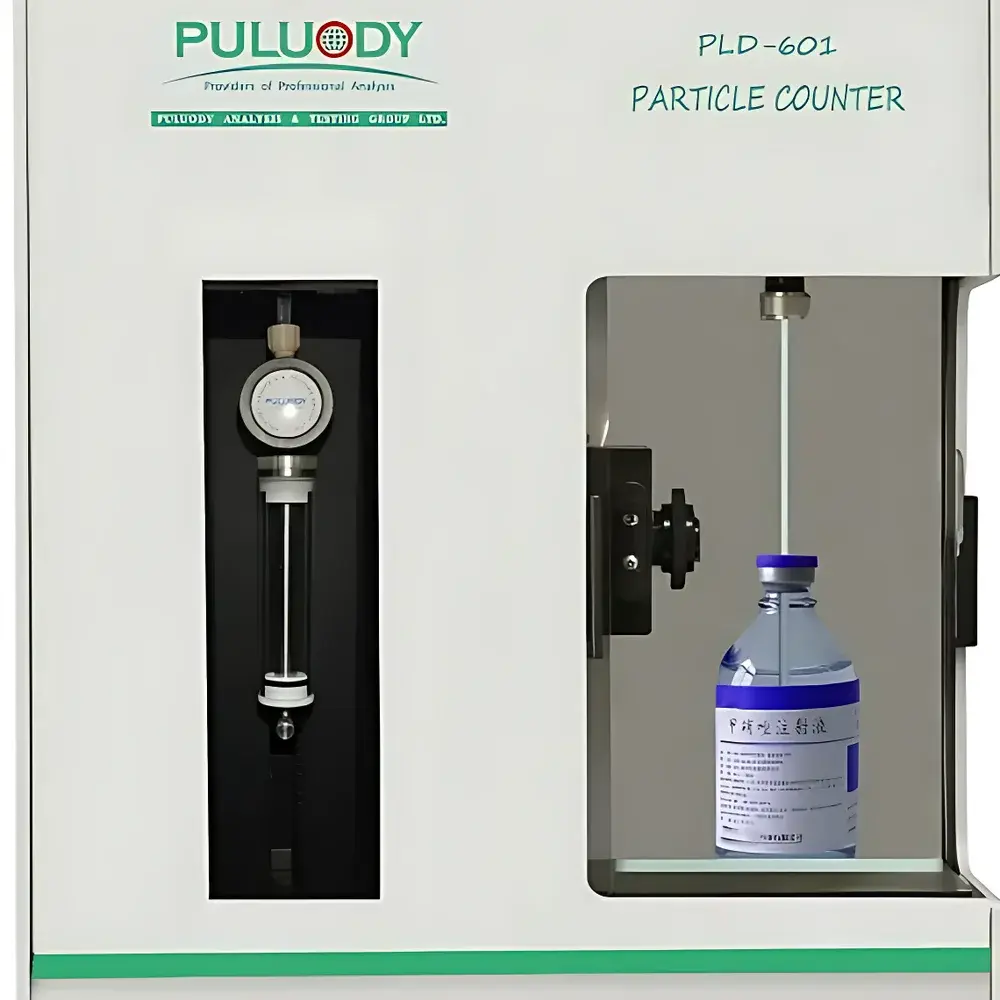
PULUODY PLD-601X Optical Particle Counter for Insoluble Particulate Testing in Single-Use Plastic Blood Bags
| Brand | PULUODY |
|---|---|
| Origin | Shaanxi, China |
| Model | PLD-601X |
| Instrument Type | Optical Particle Counter |
| Detection Principle | Light Obscuration (LO) / Dual-Laser Narrow-Beam Sensor |
| Channel Resolution | 1000 channels |
| Measurable Size Range | 1–450 µm (optional extension to 0.03–3000 µm) |
| Sampling Flow Rate | 5–150 mL/min |
| Rinse Flow Rate | 5–500 mL/min |
| Temperature Range (Fluid) | 0–80 °C |
| Accuracy | ±5% typical |
| Counting Precision (Coincidence Limit) | ≤5% at 1000 particles/mL |
| Resolution | >95% (calibrated per ChP 2015/2020), <10% (per USP <788> & ISO 21501) |
| Software Compliance | FDA 21 CFR Part 11, Audit Trail, Electronic Signature, 5-Level User Permission Management |
| Calibration Standards | JJG 1061, ISO 21501, NIST-traceable latex spheres |
| Regulatory Alignment | USP <788>, <789>, <797> |
Overview
The PULUODY PLD-601X Optical Particle Counter is a laboratory-grade instrument engineered for the quantitative detection and size-resolved enumeration of insoluble particulate matter in parenteral pharmaceutical products—specifically designed to meet the stringent requirements of single-use plastic blood bag quality control. It operates on the principle of light obscuration (also known as the optical blocking or light extinction method), where particles suspended in a liquid medium pass through a precisely collimated dual-laser narrow-beam sensing zone. Each particle generates a transient pulse proportional to its cross-sectional area, enabling high-fidelity sizing and counting across a continuous 1000-channel resolution spectrum from 1 µm to 450 µm (with optional extended range configurations). The system integrates a precision metering piston pump and ultra-precise electromagnetic flow control to ensure volumetric accuracy better than ±1% and counting reproducibility validated against ISO 21501 and Chinese Pharmacopoeia (ChP) 2020 General Chapter 0903.
Key Features
- Dual-laser narrow-beam sensor (8th-generation PULUODY proprietary design) with enhanced signal-to-noise ratio and reduced optical interference from air bubbles or refractive index variations.
- 1000-channel high-resolution analysis capability, supporting user-defined channel groupings (e.g., 4, 8, 16, 32, 64, 128, or full 1000 bins) for granular compliance mapping against multiple pharmacopoeial thresholds.
- Fully compliant software architecture (V8.9 Integrated Edition) featuring 5-tier role-based access control, electronic signatures, immutable audit trails, automatic data backup/recovery, and power-failure recovery protocols.
- Regulatory-ready validation support: preconfigured test methods aligned with USP , , EP 10.0, ChP 0903, YBB 00272004-2015, and ISO 21510; traceable calibration using NIST-certified latex standards or JJG 1061 reference materials.
- Wide operational flexibility: fluid temperature range 0–80 °C; sampling flow rate adjustable from 5 to 150 mL/min; rinse flow up to 500 mL/min; compatible with aggressive solvents, aqueous buffers, and low-conductivity ultrapure water matrices.
Sample Compatibility & Compliance
The PLD-601X is validated for use across a broad spectrum of regulated liquid samples, including but not limited to: sterile injectable solutions, lyophilized powder reconstitutes, ophthalmic preparations, vaccines, injection-grade water (WFI, PW), pharmaceutical packaging components (e.g., blood bag films, IV tubing, stoppers), and terminal filtration devices. It supports filter challenge testing—including quantitative assessment of particle removal efficiency (PRE) for 0.22 µm and 0.45 µm sterilizing-grade membranes per ISO 13408-2. All measurement protocols adhere to Good Manufacturing Practice (GMP) and Good Laboratory Practice (GLP) frameworks, with full documentation support for FDA, EMA, PMDA, and NMPA inspections. The instrument’s firmware and software are architected to satisfy 21 CFR Part 11 requirements for electronic records and signatures, including time-stamped audit logs, operator authentication, and change-control history.
Software & Data Management
The V8.9 analytical software suite provides an intuitive bilingual (English/Chinese) interface with touchscreen and wireless peripheral compatibility. It enables real-time visualization of particle distribution histograms, cumulative counts, and differential concentration plots. Raw pulse data are stored in encrypted binary format with SHA-256 checksum integrity verification. Users may export reports in PDF, CSV, or XML formats—including customizable templates compliant with internal SOPs or external regulatory submissions. Built-in statistical tools support trending analysis, batch comparison, and out-of-specification (OOS) investigation workflows. Data archival follows ALCOA+ principles (Attributable, Legible, Contemporaneous, Original, Accurate, Complete, Consistent, Enduring, Available), with optional integration into LIMS or MES platforms via OPC UA or HL7 interfaces.
Applications
- Pharmaceutical QC: Routine particulate testing of final fill containers, container-closure systems, and raw material excipients per ChP, USP, and EP monographs.
- Medical device evaluation: Quantitative assessment of extractables and leachables from PVC, polyolefin, and thermoplastic elastomer blood bags and infusion sets.
- Water purity monitoring: Solid particle contamination profiling in WFI, purified water, and ultrapure water used in bioprocessing and semiconductor rinsing.
- Advanced materials R&D: Characterization of CMP slurries, nanomaterial dispersions, inkjet inks, and functional coatings where sub-5 µm particle dispersion stability is critical.
- Filter validation: Determination of beta-ratio, retention efficiency, and challenge breakthrough profiles for depth and membrane filters under defined pressure and flow conditions.
FAQ
Does the PLD-601X comply with USP and ChP 0903?
Yes—the instrument’s optical detection geometry, flow calibration, and software reporting logic are fully aligned with both standards, including mandatory 10 µm and 25 µm threshold reporting, sample volume verification, and system suitability testing protocols.
Can it measure particles below 1 µm?
Standard configuration begins at 1 µm; optional sensor modules extend lower detection limits to 0.03 µm using enhanced scattering sensitivity, subject to application-specific validation per ISO 21501-2.
Is third-party metrological certification available?
Yes—certified calibration and verification services are provided by the National Northwest Metrology and Testing Center (CNAS-accredited) and the Defense Science & Technology Commission Level-1 Particle Measurement Station (No. 116).
What maintenance is required for long-term reliability?
Routine tasks include weekly system flushes with isopropyl alcohol and deionized water, quarterly optical window inspection, annual flow rate recalibration, and biannual sensor alignment verification using certified reference standards.
How does the dual-laser design improve measurement robustness?
Dual orthogonal laser paths minimize orientation-dependent bias, suppress false positives from air microbubbles, and enable simultaneous verification of particle transit velocity—enhancing count accuracy in viscous or heterogeneous media.



