
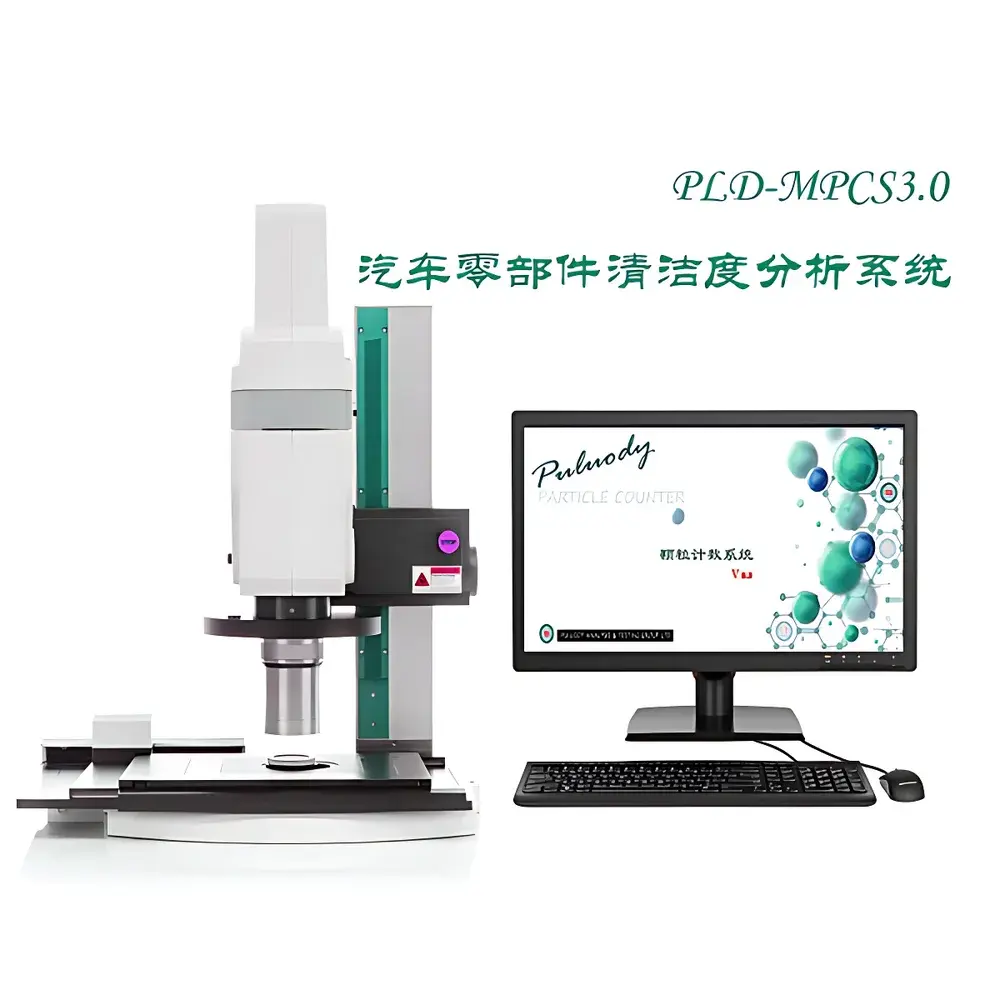
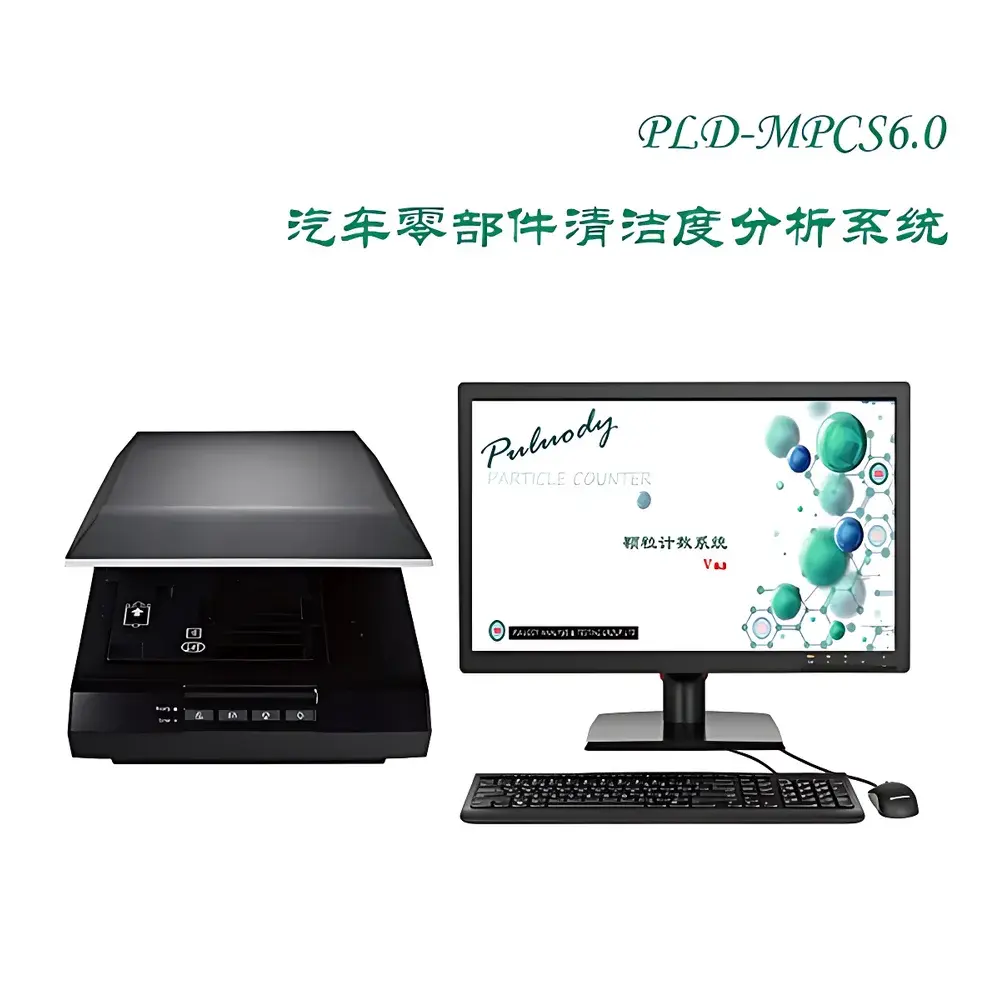
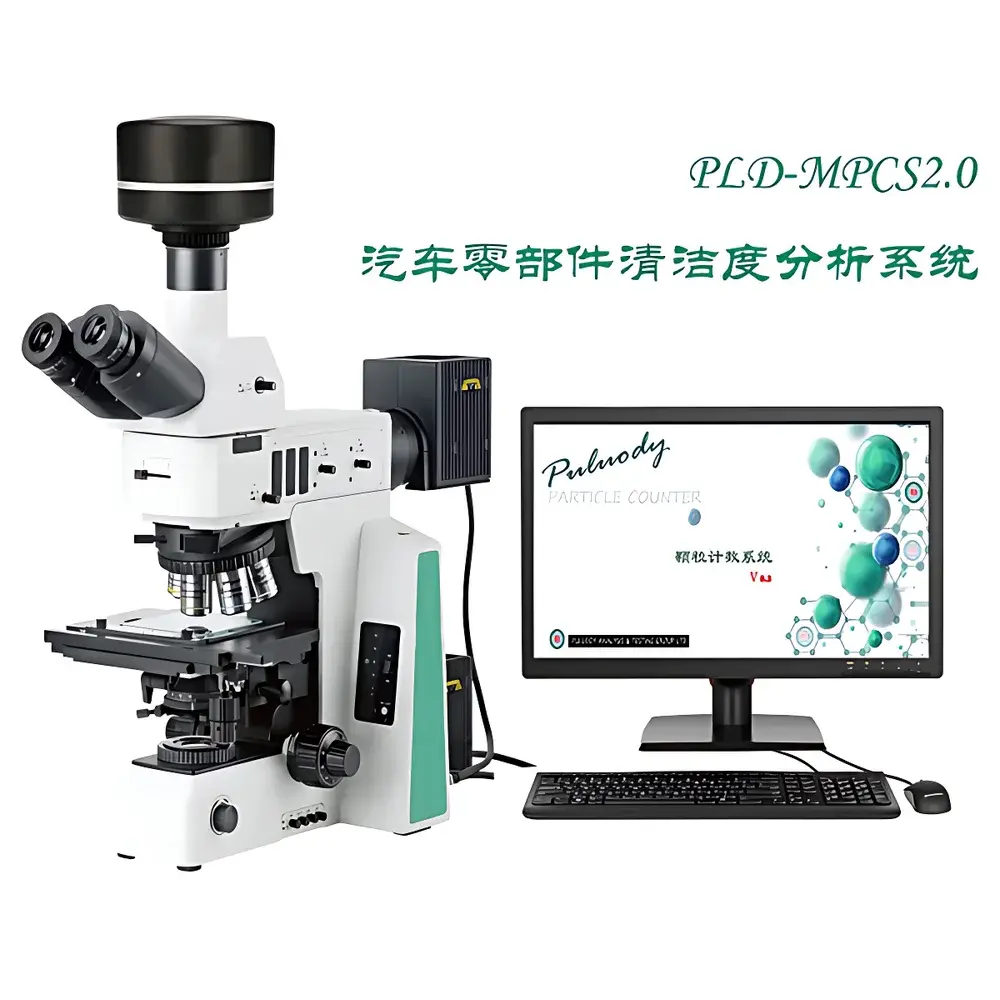
PULUODY PLD-MPCS Series Microscopic Particle Contamination Analysis System for Automotive Components
| Brand | PULUODY |
|---|---|
| Origin | Shaanxi, China |
| Manufacturer Type | OEM Manufacturer |
| Product Category | Domestic |
| Model | PLD-MPCS Series |
| Instrument Type | Optical Microscopy-Based Particle Counter |
| Key Imaging Resolution | 0.1 µm |
| Measurement Range | 1–500 µm |
| Magnification | 40×–1000× |
| CCD Sensor | ≥5 MP (standard configuration) |
| Repeatability Error | < 5% (excluding sample preparation variability) |
| Particle Segmentation Speed | < 1 s per field |
| Segmentation Success Rate | > 93% |
| Software Platform | Windows OS-compatible image analysis suite with RS232/USB interface |
| Compliance Standards | ISO 16232, ISO 4406, VDA 19, GME 7061, GMW 16037-2017, JB/T 7858, GB/T 20110, DL 432 |
Overview
The PULUODY PLD-MPCS Series Microscopic Particle Contamination Analysis System is a high-precision, research-grade optical microscopy platform engineered for quantitative particulate contamination assessment in critical mechanical and hydraulic components. Unlike laser diffraction or light obscuration methods, this system employs digital polarized-light microscopy combined with automated image acquisition and morphological classification algorithms to deliver traceable, metrologically robust particle data—including size, shape, aspect ratio, circularity, material class (metallic vs. non-metallic), and spatial distribution—on filter-captured residues. Its core measurement principle follows the ISO 16232 “microscopic analysis” methodology, where particles retained on extraction filters are imaged under calibrated magnification, digitally segmented, and classified using geometric and optical contrast features. Designed specifically for automotive powertrain, transmission, braking, and steering systems—as well as aerospace hydraulics and industrial lubrication circuits—the PLD-MPCS system enables full compliance with international cleanliness specifications including VDA 19, ISO 4406, and GMW 16037.
Key Features
- Automated XYZ-stage scanning with sub-micron positioning accuracy (0.1 µm step resolution) and hardware-accelerated autofocus for consistent focus across multi-field mosaics
- Dual-mode optical imaging: brightfield and polarized-light illumination to differentiate ferrous, non-ferrous, and non-metallic contaminants based on birefringence and reflectivity signatures
- High-sensitivity 5-megapixel scientific CCD camera with adjustable exposure control and real-time histogram-based auto-exposure optimization
- Full-featured image analysis software supporting ISO-compliant particle sizing (equivalent circle diameter, Feret min/max, Martin length, convex hull area), shape descriptors (circularity, aspect ratio, solidity), and statistical reporting per NAS, ISO, or custom grading schemes
- Integrated calibration traceability via NIST-traceable stage micrometers and certified reference slides; all measurement parameters logged with timestamp, operator ID, and instrument configuration metadata
- Automated multi-field stitching and particle-by-particle annotation with exportable CSV, PDF, and XML datasets compliant with FDA 21 CFR Part 11 audit trail requirements (when deployed with validated software configuration)
Sample Compatibility & Compliance
The PLD-MPCS system accepts standard filtration membranes (e.g., polycarbonate, mixed cellulose ester, or polyvinylidene fluoride) with pore sizes ranging from 0.45 µm to 5.0 µm, enabling detection of particles ≥1 µm across fluid extracts from engine oil, ATF, brake fluid, power steering fluid, and hydraulic working media. It supports direct analysis of filter discs up to 47 mm diameter and accommodates custom mounting fixtures for irregular substrates. All analytical workflows adhere strictly to ISO 16232 Parts C–F (microscopic particle counting and characterization), VDA 19.1 (technical cleanliness in assembly), and JB/T 7858 (hydraulic component cleanliness evaluation). The system’s measurement uncertainty budget accounts for optical diffraction limits, sampling representativeness, and operator-independent segmentation thresholds—ensuring results meet GLP/GMP documentation standards for Tier 1 automotive suppliers and OEM validation labs.
Software & Data Management
The proprietary PULUODY ParticleVision™ analysis software provides a modular, configurable interface for method setup, acquisition control, image processing, and regulatory reporting. Each analysis session generates a structured metadata log including microscope settings, stage coordinates, illumination intensity, exposure time, and user-defined pass/fail criteria. Raw images and processed binary masks are stored in lossless TIFF format with embedded EXIF tags. Batch processing supports automated report generation per ISO 4406 coding (e.g., “18/16/13”), particle count histograms, and cumulative size distributions. Software updates are delivered free-of-charge over the instrument’s lifetime and include backward-compatible firmware patches, expanded calibration libraries, and enhanced AI-assisted segmentation models trained on industry-specific contamination databases. Export formats comply with ASTM E2454 and ISO/IEC 17025 data integrity guidelines.
Applications
This system is routinely deployed in R&D laboratories and production QA/QC environments for evaluating cleaning process efficacy across automotive subsystems—including cylinder heads, fuel injectors, valve train assemblies, torque converters, ABS modulators, EPS motor housings, and EV battery cooling loop components. It serves as a primary tool for validating ultrasonic, aqueous, and solvent-based cleaning protocols; qualifying filtration media performance; diagnosing wear mechanisms (e.g., fatigue spalling vs. abrasive gouging); and supporting root-cause analysis during field failure investigations. Beyond automotive, it meets cleanliness verification needs in aerospace hydraulic actuators (per SAE AS4059), wind turbine gearboxes (per ISO 17123), and semiconductor manufacturing tooling coolant lines.
FAQ
What particle size range can the PLD-MPCS system reliably quantify?
It detects and characterizes particles from 1 µm to 500 µm with measurement repeatability better than ±5% (CV), assuming standardized sample preparation per ISO 16232-C.
Does the system support automated identification of metallic versus non-metallic particles?
Yes—using polarized-light contrast analysis and grayscale thresholding optimized for reflectivity differences between ferrous alloys, aluminum, ceramics, rubber, and fiber debris.
Is the software compliant with FDA 21 CFR Part 11 requirements?
When configured with electronic signature modules, role-based access controls, and audit-trail logging enabled, the software satisfies Part 11 technical controls for regulated pharmaceutical and medical device applications.
Can the system integrate with LIMS or enterprise MES platforms?
Yes—via standardized ODBC drivers and configurable XML/JSON API endpoints for bidirectional data exchange with LabWare, Thermo Fisher SampleManager, or Siemens Opcenter.
What maintenance intervals are recommended for optical calibration and stage alignment?
Annual recalibration using NIST-traceable stage micrometers and reference particle slides is advised; daily focus verification and weekly illumination uniformity checks are part of standard operating procedures.



