
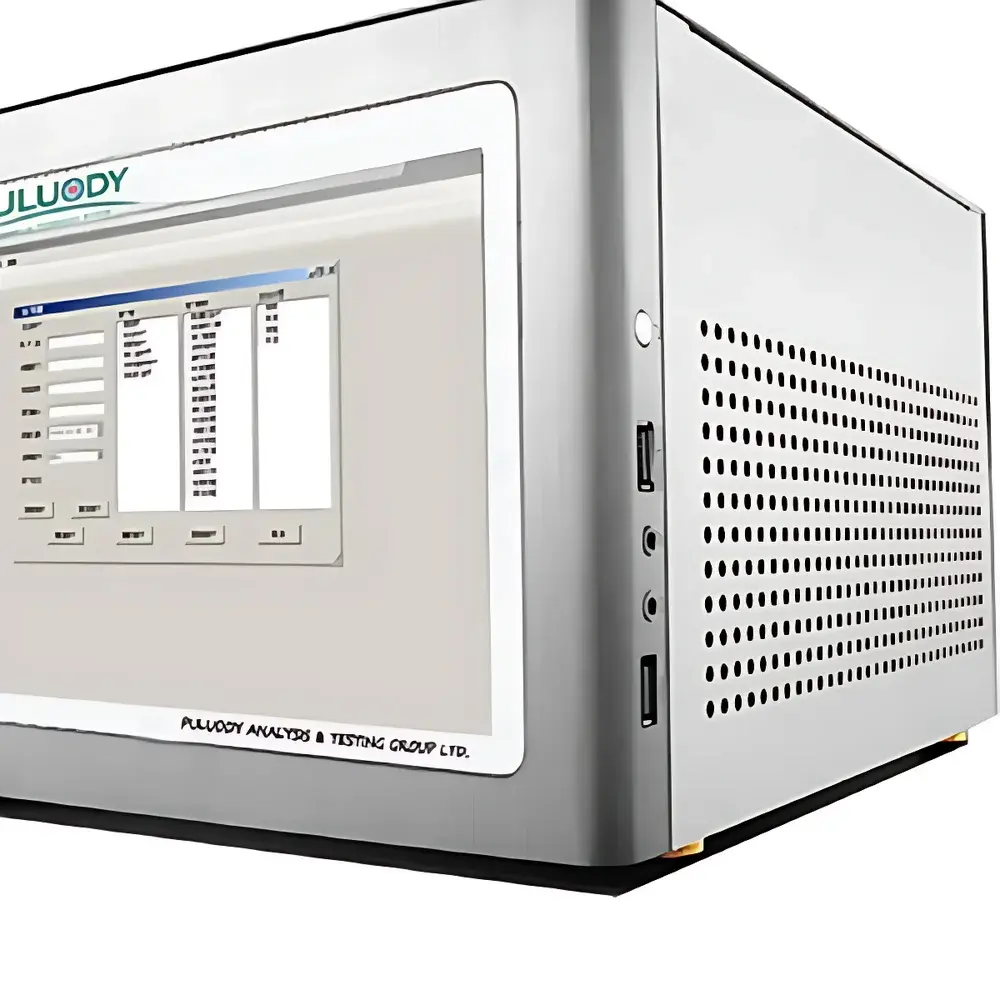
PULUODY PMT-2-33 Online Liquid Particle Counter for Ultrapure Water Replacement
| Brand | PULUODY |
|---|---|
| Origin | Shaanxi, China |
| Manufacturer Type | Authorized Distributor |
| Regional Category | Domestic (China) |
| Model | PMT-2-33 |
| Instrument Type | Optical Particle Counter |
| Detection Principle | Dual-Laser Narrow-Beam Light Scattering |
| Sensor Generation | 8th-Generation Dual-Laser Detector |
| Measurement Range | 0.1–1.0 µm & 0.2–2.0 µm (standard) |
| Sampling Method | Precision Metering Piston Pump |
| Flow Control | Dual-Stage Electromagnetic + Piston Pump Regulation |
| Accuracy | ±5% typical |
| Sampling Precision | <±1% |
| Coincidence Limit | 10,000 particles/mL (5% coincidence error) |
| Output Interface | 4–20 mA analog output |
| Alarm Function | Configurable particle concentration threshold alert |
| Calibration Standards | JJG 1061, ISO 21501-2, NIST-traceable latex spheres |
| Software | PULUODY V8.3 Integrated Analysis & Calibration Software (PC + touchscreen UI) |
| Display | Color LCD touchscreen + optional wireless keyboard/mouse |
| Power Input | 100–265 VAC, 50–60 Hz |
| Compliance Support | GLP/GMP audit trail capability, FDA 21 CFR Part 11–ready software architecture (user roles, electronic signatures, data integrity logging) |
Overview
The PULUODY PMT-2-33 Online Liquid Particle Counter is an industrial-grade optical particle counter engineered for continuous, real-time monitoring of solid particulate contamination in ultrapure water (UPW), semiconductor process chemicals, cleaning agents, and other low-conductivity or organic liquid streams. It employs an 8th-generation dual-laser narrow-beam scattering sensor—developed in collaboration with the UK-based PULUODY Analytical Testing Group—to deliver high-resolution detection of submicron particles down to 0.1 µm(c) with calibrated sensitivity across multiple size channels. Unlike conventional single-wavelength systems, the dual-laser configuration enables improved signal-to-noise ratio and enhanced discrimination between refractive index variations and true particulate events, making it especially suited for applications where trace-level contamination directly impacts yield, such as wafer rinsing, photomask cleaning, and flat-panel display etch processes. The instrument operates on the principle of light obscuration and Mie scattering, compliant with ISO 21501-2 for calibration traceability and performance validation.
Key Features
- 8th-generation dual-laser narrow-beam optical sensor with configurable detection thresholds from 0.1 µm(c) to 100 µm
- Dual-stage flow control system combining a precision metering piston pump and ultra-stable electromagnetic flow regulation for <±1% volumetric repeatability
- Real-time online monitoring with continuous sampling, automatic alarm triggering upon user-defined particle concentration thresholds
- Modular hardware architecture supporting both fixed-installation and portable offline measurement modes
- V8.3 integrated software platform with separate analysis and calibration modules to eliminate cross-interference during routine operation
- 4–20 mA analog output interface compatible with DCS/SCADA systems; configurable digital I/O for integration into automated cleanroom control networks
- Full compliance support for regulated environments: electronic audit trails, role-based access control, and 21 CFR Part 11–ready data management protocols
Sample Compatibility & Compliance
The PMT-2-33 is validated for use with ultrapure water (resistivity ≥18.2 MΩ·cm), aqueous cleaning solutions (e.g., SC1, SC2), photoresist strippers, CMP slurries, polymer solutions, and low-viscosity organic solvents. Its wetted path is constructed from chemically inert materials including fused silica flow cells and PFA fluidic tubing, ensuring minimal leaching and no catalytic degradation of sensitive samples. Calibration adheres to ISO 21501-2 using NIST-traceable polystyrene latex (PSL) standards, with optional verification per Chinese national metrology regulation JJG 1061. For pharmaceutical and biotech applications, the system supports USP and particulate matter testing workflows when operated in offline mode with appropriate sample handling protocols.
Software & Data Management
PULUODY V8.3 software provides a unified interface for instrument control, real-time data visualization, statistical trend analysis, and regulatory reporting. The architecture separates calibration routines from daily analysis functions—preventing accidental parameter override during production runs. All raw scatter pulse data are stored with metadata (timestamp, operator ID, calibration status, environmental conditions). Reports generate ISO 4406, NAS 1638, and custom particle count-per-milliliter outputs, alongside dynamic contamination grade mapping. Audit logs record every user action, including login/logout, method changes, and result exports—fully satisfying GLP and GMP documentation requirements. Data export formats include CSV, PDF, and XML for LIMS integration.
Applications
- Semiconductor front-end manufacturing: UPW loop monitoring at point-of-use (POU), DI water recirculation systems, and chemical delivery lines
- Flat-panel display production: rinse tank effluent analysis, glass substrate cleaning verification, and TFT array defect root-cause investigation
- Pharmaceutical water systems: WFI and PW distribution loop surveillance per EU Annex 1 and FDA guidance
- Nanofiltration and ultrafiltration validation: challenge testing with standardized particle suspensions
- Electronics assembly: solder paste carrier solvent purity assessment and conformal coating solution qualification
- Research laboratories: colloidal stability studies, nanoparticle synthesis batch consistency evaluation, and microfluidic device clogging diagnostics
FAQ
What particle size ranges can the PMT-2-33 detect?
Standard configurations support 0.1–1.0 µm and 0.2–2.0 µm channels; custom firmware enables user-defined bins from 1–100 µm or 4–70 µm(c), including selectable 0.1 µm(c) detection.
Is the system suitable for organic solvents?
Yes—wetted components are chemically resistant to common solvents including IPA, acetone, PGMEA, and DMSO; compatibility verification is recommended for aggressive halogenated or highly acidic media.
How is calibration traceability maintained?
Calibration uses ISO 21501-2–compliant PSL standards with documented NIST traceability; certificate of calibration includes uncertainty budget and drift assessment over 90-day intervals.
Can the PMT-2-33 integrate with existing factory automation systems?
Yes—via 4–20 mA analog output, Modbus RTU/TCP, and optional OPC UA gateway for seamless connection to MES, DCS, or PLC platforms.
Does the software support multi-user environments with audit compliance?
Yes—V8.3 implements full 21 CFR Part 11 functionality including electronic signatures, session locking, and immutable audit trails for all critical operations.



