
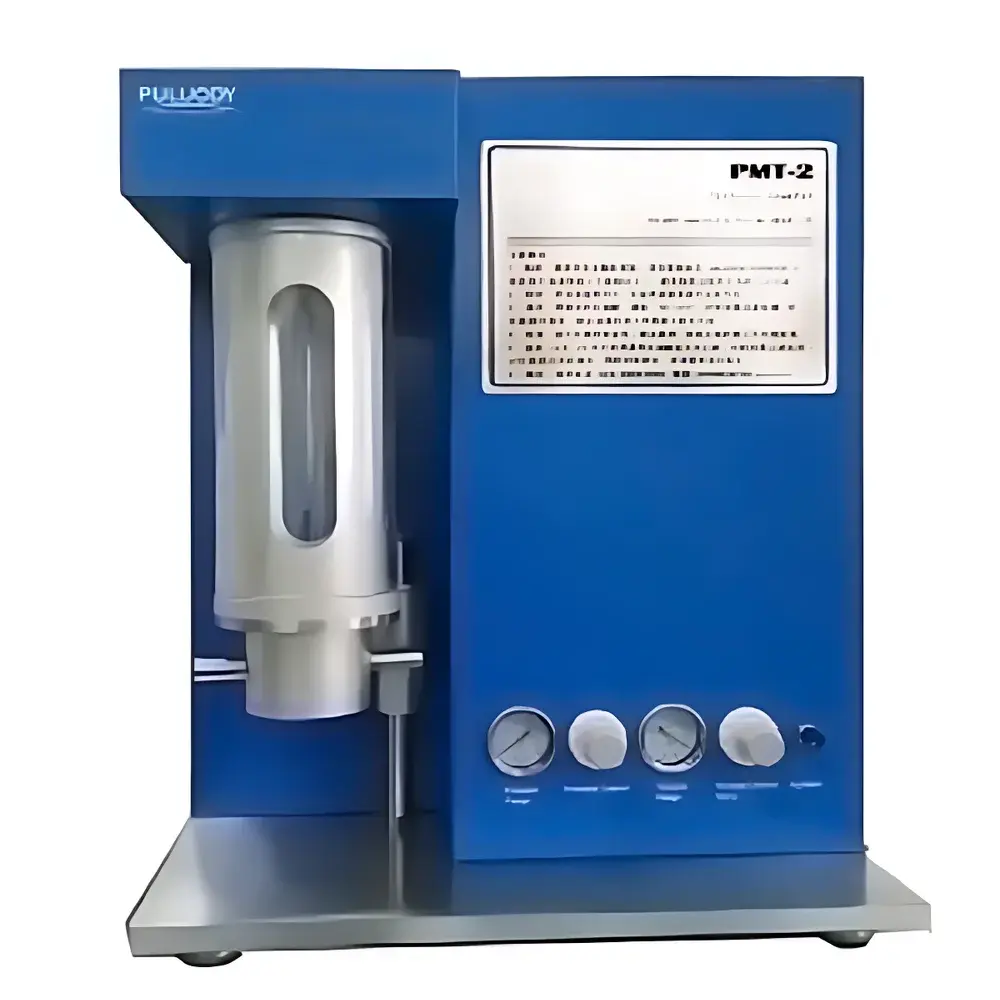
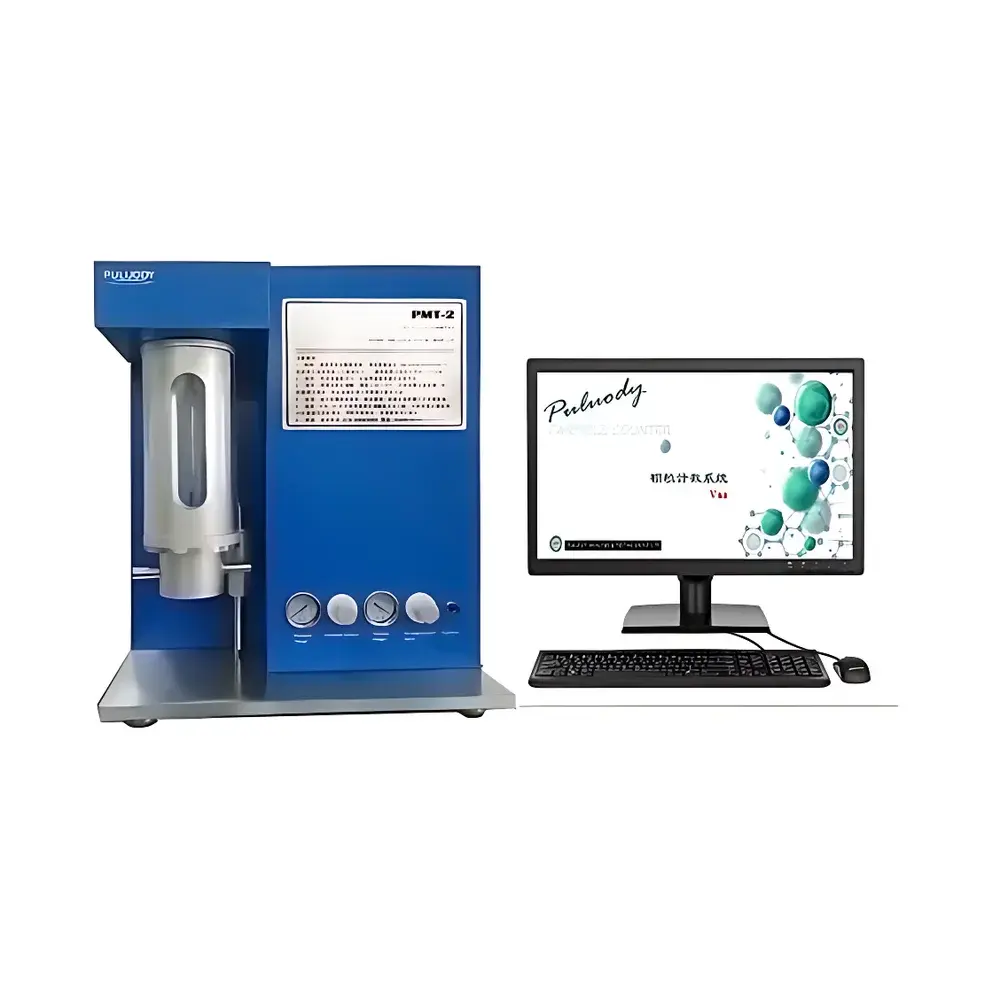
PULUODY PMT-2-X Optical Liquid Particle Counter
| Brand | PULUODY |
|---|---|
| Origin | Shaanxi, China |
| Manufacturer Type | Authorized Distributor |
| Product Category | Domestic |
| Model | PMT-2-X |
| Instrument Type | Optical Particle Counter |
| Detection Principle | Dual-Laser Narrow-Beam Light Scattering |
| Measurement Range | 0.5–5.0 µm (standard) |
| Sampling Accuracy | < ±1% |
| Counting Accuracy | < ±3% (typical) |
| Coincidence Limit | 1000 particles/mL (2.5% coincidence error) |
| Calibration Standards | ISO 21501, JJG 1061, NIST-traceable latex spheres |
| Compliance | Chinese Pharmacopoeia 2015/2020, USP <788>, EP 2.9.19, BP, GB 8368 |
| Output Interface | 4–20 mA analog output with configurable alarm threshold |
| Data Acquisition | iPad-integrated real-time acquisition |
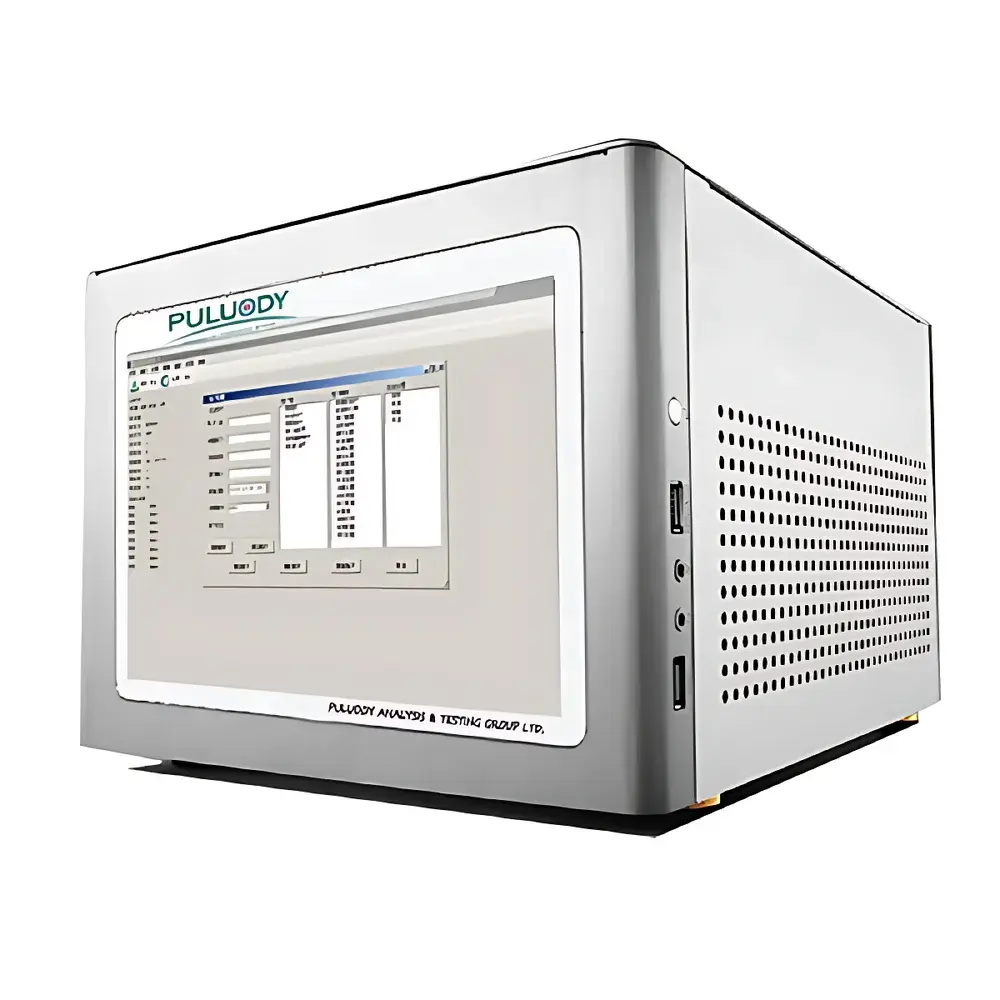
| Software | V8.3 Integrated Analysis & Calibration Software (PC + embedded touchscreen version) |
| Display & Control | Color LCD touchscreen + optional wireless keyboard/mouse |
| Power Input | 100–265 VAC, 50–60 Hz |
Overview
The PULUODY PMT-2-X Optical Liquid Particle Counter is a high-precision, dual-laser narrow-beam particle detection system engineered for ultra-clean liquid analysis in semiconductor manufacturing, pharmaceutical water systems, microelectronics fabrication, and advanced material processing. It operates on the principle of light extinction and scattered-light detection—leveraging two spatially separated laser sources to minimize signal noise and enhance sizing resolution across sub-micron to low-micron ranges. Unlike single-beam optical counters, the eighth-generation dual-laser architecture enables simultaneous intensity and pulse-width discrimination, significantly improving classification accuracy for near-spherical and irregular particulates in low-conductivity, low-viscosity media such as ultrapure water (UPW), electronic-grade solvents, photoresist developers, and cleaning formulations. Designed for both online process monitoring and offline laboratory verification, the PMT-2-X delivers trace-level particle quantification with robust reproducibility under GMP-aligned operational conditions.
Key Features
- Dual-laser narrow-beam optical sensor with independent wavelength optimization for enhanced sensitivity at 0.5 µm and improved dynamic range up to 5.0 µm (extendable to 100 µm via custom calibration)
- Precision metering piston pump combined with electromagnetic flow control ensures volumetric sampling accuracy better than ±1%, critical for compliance-driven reporting
- Modular architecture supports seamless integration into cleanroom piping networks or benchtop workflows—enabling either continuous online surveillance or portable offline measurement
- Embedded V8.3 software separates analytical computation from calibration routines, eliminating cross-interference between routine testing and metrological validation
- Real-time data acquisition via iPad interface with time-stamped event logging, configurable alarm thresholds, and 4–20 mA analog output for PLC/SCADA connectivity
- Comprehensive audit trail functionality—including user login tracking, parameter change history, and report generation timestamps—supports FDA 21 CFR Part 11 readiness when deployed in regulated environments
Sample Compatibility & Compliance
The PMT-2-X is validated for use with non-aqueous and aqueous liquids exhibiting conductivity below 1 µS/cm and viscosity under 5 cP—including deionized water, hydrogen peroxide solutions, isopropyl alcohol (IPA), acetone, ethylene glycol-based coolants, and polymer precursor solutions. Its sensor design mitigates electrostatic interference common in low-dielectric fluids, ensuring stable baseline performance during extended unattended operation. Regulatory alignment includes full conformance with Chinese Pharmacopoeia Chapters 0903 (Particulate Matter in Injections) and 0904 (Particulate Matter in Large Volume Parenterals), USP and , European Pharmacopoeia 2.9.19, British Pharmacopoeia Appendix XVII, and national standard GB 8368 for medical infusion equipment. Calibration traceability follows ISO 21501-4 for liquid-borne particle counters and JJG 1061–2010 (Chinese National Verification Regulation), with optional NIST-traceable polystyrene latex (PSL) sphere certification available upon request.
Software & Data Management
The integrated V8.3 software suite provides dual-mode operation: an embedded touchscreen interface for field deployment and a full-featured PC client for advanced post-processing. All raw pulse data—including amplitude, duration, and inter-pulse interval—is retained for retrospective reanalysis without loss of fidelity. Reports are exportable in CSV, PDF, and XML formats, with configurable templates aligned to ISO 14644-1 cleanroom classification tables or USP-defined particle concentration limits (e.g., NMT 25 particles ≥10 µm per mL). The system enforces role-based access control (RBAC), digital signature capture for critical actions, and immutable storage of calibration certificates—ensuring GLP/GMP-compliant documentation integrity throughout the instrument lifecycle.
Applications
Typical deployment scenarios include real-time monitoring of UPW distribution loops in 300 mm wafer fabs; particulate trending in photolithography track-and-develop tools; contamination assessment of CMP slurries and etchant baths; QC release testing of sterile ophthalmic solutions; qualification of point-of-use filtration integrity in biopharmaceutical water-for-injection (WFI) systems; and validation of nano-filtration membrane performance in lithium-ion battery electrolyte purification lines. The instrument also supports method development for emerging applications such as nanoparticle suspension stability studies and microplastic quantification in ultrapure rinse streams.
FAQ
What particle size ranges can the PMT-2-X detect?
Standard configuration covers 0.5–5.0 µm; extended ranges (e.g., 1–100 µm or 4–70 µm(c)) are achievable through sensor recalibration and software configuration.
Is the system compliant with FDA 21 CFR Part 11 requirements?
Yes—when operated with audit trail enabled, electronic signatures activated, and secure user authentication protocols configured per organizational SOPs.
Can it be used for organic solvent analysis?
Yes—provided the fluid’s refractive index contrast with the sensor housing material allows sufficient light scattering; compatibility verification is recommended for solvents with RI 1.45.
Does it support automatic calibration verification?
The V8.3 software includes scheduled calibration check routines using onboard reference standards; full recalibration requires external PSL suspensions traceable to NIST or UKAS.
What maintenance intervals are recommended for continuous online operation?
Optical window cleaning every 72 hours in high-particulate environments; full fluidic path inspection and pump seal replacement every 6 months or 2000 operating hours, whichever occurs first.



