
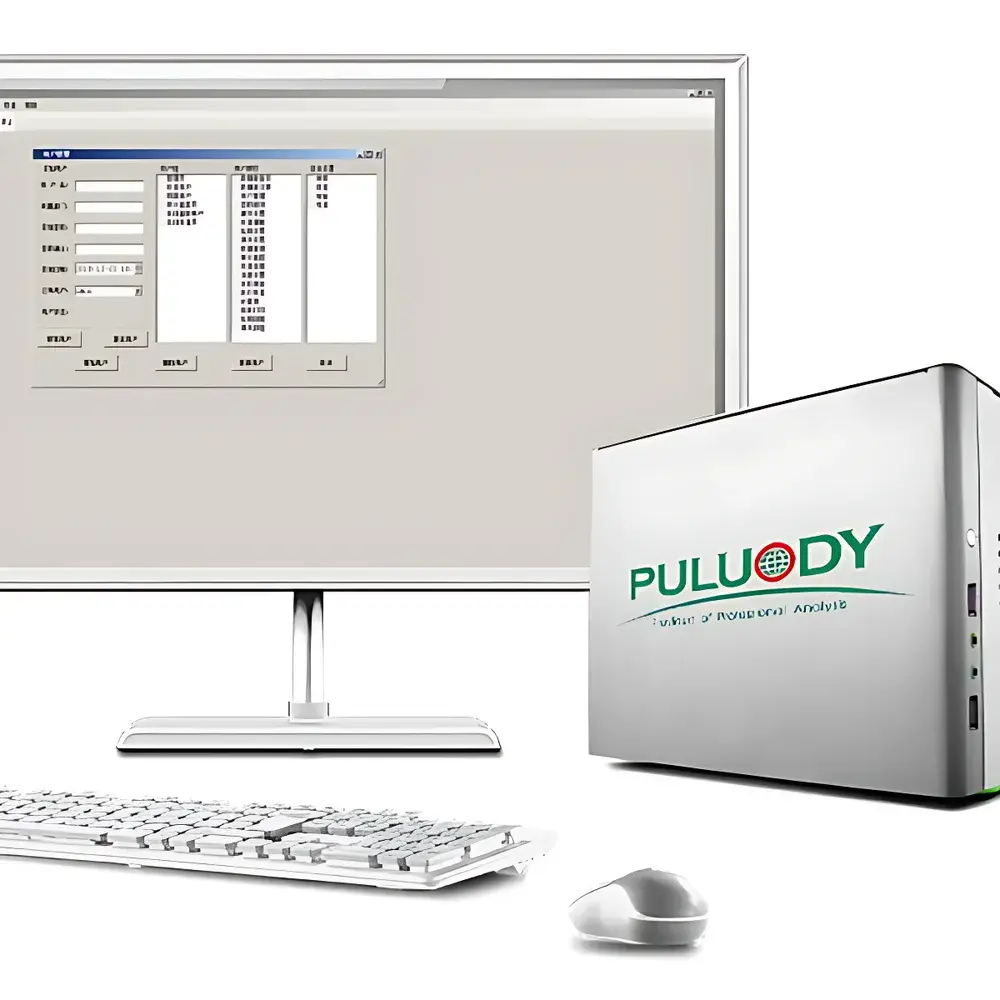
PULUODY PMT-2GJ Low-Viscosity Photoresist Liquid Particle Counter
| Brand | PULUODY |
|---|---|
| Origin | Shaanxi, China |
| Manufacturer Type | Authorized Distributor |
| Country of Origin | China |
| Model | PMT-2GJ |
| Price | USD 75,000 (FOB) |
| Detection Principle | Dual-Laser Narrow-Beam Light Scattering |
| Calibration Standards | ISO 21501-4, JJG 1061, NIST-Traceable Latex Spheres |
| Detection Range | 0.1–100 µm (configurable sub-ranges: 0.1–0.5 µm, 4–70 µm(c), or user-defined 1–100 µm) |
| Sample Flow Control | Precision Piston Pump + Electromagnetic Flow Regulation |
| Accuracy | ±3% typical |
| Sampling Precision | <±1% |
| Coincidence Limit | ≤2.5% error at 1000 particles/mL |
| Output | 4–20 mA analog signal,超标 alarm relay (customizable) |
| Data Interface | iPad-compatible wireless acquisition, USB, RS232 |
| Display & Control | Color LCD touchscreen + optional wireless keyboard/mouse |
| Reporting | Particles per mL and ISO 4406 / NAS 1638 contamination codes |
| Power Input | 100–265 VAC, 50–60 Hz |
| Software | PULUODY V8.3 Analysis & Calibration Suite (PC & embedded) |
Overview
The PULUODY PMT-2GJ Low-Viscosity Photoresist Liquid Particle Counter is an engineered solution for high-sensitivity particulate contamination monitoring in ultra-clean process fluids used throughout semiconductor fabrication, photolithography, and advanced display manufacturing. It operates on the principle of dual-laser narrow-beam light scattering—where two spatially separated laser sources illuminate a precisely defined flow path—to enable simultaneous detection of sub-micron and micron-scale particles with minimized optical interference and enhanced signal-to-noise ratio. Unlike conventional single-beam instruments, this eighth-generation sensor architecture mitigates Mie scattering artifacts and improves sizing resolution across the 0.1 µm to 100 µm range, particularly critical for low-viscosity photoresists (<10 cP), developer solutions, and post-etch rinse chemistries where particle-induced defects directly impact yield. Designed for integration into cleanroom-grade fluid handling systems, the PMT-2GJ supports both online continuous monitoring and offline batch analysis, delivering traceable, repeatable, and audit-ready data under GLP/GMP-aligned workflows.
Key Features
- Dual-laser narrow-beam optical detection system optimized for low-viscosity organic solvents and polymer-based photoresists
- Precision piston pump coupled with electromagnetic flow regulation ensures volumetric sampling accuracy better than ±1% and repeatability within ±3% typical
- Configurable detection thresholds: standard 0.1–0.5 µm submicron mode; selectable extended ranges including 4–70 µm(c) for coarse particle screening or user-defined 1–100 µm windows
- Real-time analog output (4–20 mA) with programmable alarm relays for integration into SCADA and MES platforms
- Embedded color LCD touchscreen interface with optional wireless keyboard/mouse support for flexible operation in glovebox or tool-mounted configurations
- V8.3 analysis software suite compliant with ISO 21501-4 calibration protocols and traceable to NIST-certified latex standards (e.g., Duke Scientific 6003 series)
Sample Compatibility & Compliance
The PMT-2GJ is validated for use with non-aqueous, low-viscosity liquids commonly employed in front-end semiconductor processes—including g-line/i-line/EUV photoresists (e.g., TOK, JSR, Shin-Etsu formulations), TMAH developers, DI water rinses, CMP slurries, and cleaning agents such as SC-1 and DHF. Its wetted path employs chemically inert materials (e.g., sapphire flow cell, PFA tubing, ceramic pump components) resistant to aggressive solvents and acids. Instrument performance adheres to ISO 21501-4 for light-scattering particle counters and supports calibration verification per Chinese national metrology regulation JJG 1061. Full audit trail functionality—including operator ID, timestamped calibration logs, and raw scatter pulse records—is maintained in accordance with FDA 21 CFR Part 11 requirements when operated with the PC-based V8.3 software.
Software & Data Management
PULUODY V8.3 is a dual-mode platform comprising an embedded firmware module for real-time instrument control and a Windows-based desktop application for advanced data review, statistical trending, and report generation. The software implements strict separation between measurement execution and calibration management—eliminating cross-contamination of operational parameters during routine validation. All particle counts are stored with metadata (sample ID, operator, date/time, temperature, viscosity input) and exportable in CSV, PDF, or XML formats compatible with LIMS environments. Batch comparison tools support pass/fail evaluation against user-defined limits (e.g., ISO 4406 Class 12/9/6), while trend charts visualize particle concentration shifts over time—critical for root cause analysis of filter breakthrough or tank degradation events.
Applications
- In-line monitoring of photoresist dispense lines prior to spin-coating to prevent defect-inducing agglomerates
- Quality control of reclaimed developer solutions in track systems
- Validation of point-of-use filtration integrity for ultrapure water distribution networks
- Offline verification of cleaning efficacy on silicon wafers, glass substrates, and MEMS components
- Contamination assessment of nano-dispersions in OLED encapsulation materials and quantum dot inks
- Supporting IEST-STD-CC1246D cleanliness certification for cleanroom consumables and packaging
FAQ
What calibration standards are supported?
The PMT-2GJ supports calibration using ISO 21501-4–compliant polystyrene latex spheres (e.g., 0.1 µm, 0.3 µm, 0.5 µm, 5 µm), certified reference materials traceable to NIST, or custom size distributions per JJG 1061.
Can it measure particles in highly volatile solvents like PGMEA?
Yes—the flow path is sealed and pressure-stabilized; compatibility with common photoresist carriers (PGMEA, ethyl lactate, cyclohexanone) has been verified at temperatures up to 40 °C and vapor pressures ≤15 kPa.
Is remote diagnostics available?
Via optional Ethernet/Wi-Fi module, technicians can perform firmware updates, log retrieval, and sensor health checks through secure SSH or HTTPS sessions.
Does the system meet semiconductor industry ESD requirements?
The enclosure meets ANSI/ESD S20.20 Class 0 specifications; all connectors and sample ports incorporate grounded static-dissipative materials.
How is coincidence error managed at high concentrations?
Coincidence correction algorithms are applied in real time based on pulse height distribution analysis; maximum valid concentration is 1000 particles/mL with ≤2.5% error—beyond which dilution or reduced flow rate is recommended.





