
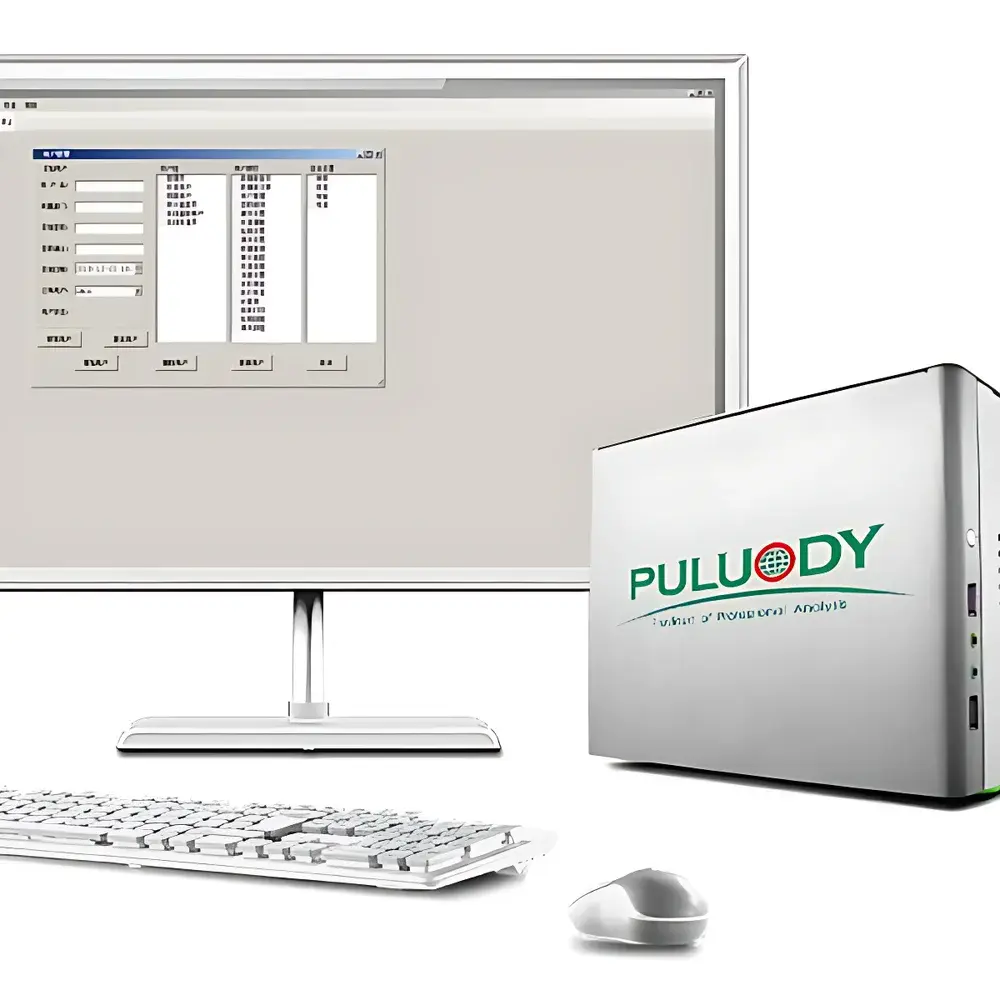
PULUODY PMT-2s Electronic-Grade Hydrogen Peroxide Liquid Particle Counter
| Brand | PULUODY |
|---|---|
| Model | PMT-2s |
| Instrument Type | Optical Liquid Particle Counter |
| Detection Principle | Dual-Laser Narrow-Beam Light Scattering |
| Detection Range | 0.1–1.0 µm (standard) |
| Sample Flow Control | Precision Piston Pump + Electromagnetic Flow Regulation |
| Accuracy | ±3% typical |
| Sampling Precision | <±1% |
| Coincidence Limit | ≤2.5% at 1000 particles/mL |
| Calibration Standards | JJG 1061, ISO 21501-4, NIST-Traceable Latex Spheres |
| Output | 4–20 mA analog signal,超标 alarm (customizable) |
| Data Reporting | Particles per mL & ISO 4406 / NAS 1638 contamination codes |
| Power Input | 100–265 VAC, 50–60 Hz |
| Compliance | Designed for ISO Class 1–5 cleanroom liquid monitoring environments |
| Software | PULUODY V8.3 Analysis & Calibration Suite (PC + integrated touchscreen UI) |
| Interface | Color LCD touchscreen + optional wireless keyboard/mouse |
| Connectivity | USB, Ethernet, optional iPad-based remote acquisition |
Overview
The PULUODY PMT-2s Electronic-Grade Hydrogen Peroxide Liquid Particle Counter is a high-sensitivity optical particle counter engineered specifically for ultrapure process liquids in semiconductor fabrication, flat-panel display manufacturing, and advanced microelectronics cleaning workflows. It employs dual-laser narrow-beam light scattering detection—a principle grounded in Mie scattering theory—to resolve sub-micron particulate contaminants in hydrogen peroxide (H2O2) solutions, deionized water, photoresist solvents, and other low-conductivity, low-absorbance chemistries. Unlike conventional single-wavelength counters, the eighth-generation dual-laser architecture enables simultaneous differential signal discrimination across two discrete wavelengths, significantly improving refractive index independence and reducing false counts from dissolved organics or bubble artifacts. The instrument operates under laminar flow conditions maintained by a precision piston metering pump and closed-loop electromagnetic flow regulation—ensuring volumetric accuracy better than ±1% and enabling repeatable, traceable sampling critical for ISO 14644-1 cleanroom liquid qualification and IEST-RP-CC034.2 compliance.
Key Features
- Dual-laser narrow-beam optical sensor with real-time signal differentiation to minimize interference from non-particulate optical noise
- Calibration traceable to NIST-certified latex standards per ISO 21501-4 and Chinese national metrology standard JJG 1061
- Configurable detection thresholds: standard 0.1–1.0 µm; extended ranges include 1–100 µm or 4–70 µm(c), with optional 0.1 µm(c) sensitivity mode
- Integrated analog output (4–20 mA) with programmable contamination-level alarm thresholds for integration into SCADA or MES systems
- V8.3 analysis software with dual-mode operation: standalone calibration module (GLP-compliant audit trail) and independent testing module (ISO 4406/NAS 1638 reporting)
- Touchscreen HMI with IP65-rated front panel, supporting both on-device operation and remote control via wireless keyboard/mouse or iPad-connected acquisition
- Robust fluidic path constructed from chemically inert, low-outgassing materials compatible with ≥30% H2O2, ammonium hydroxide, and dilute HF solutions
Sample Compatibility & Compliance
The PMT-2s is validated for use with electronic-grade hydrogen peroxide (≥30% w/w), ultrapure water (UPW, <1 ppt TOC), semiconductor-grade solvents (e.g., PGMEA, DMSO), and low-viscosity polymer solutions. Its wetted components meet SEMI F57 and ASTM D7923 specifications for particle counter compatibility with aggressive chemistries. The system supports both online continuous monitoring (via bypass loop or direct inline installation with pressure-rated flow cell) and offline batch analysis (using portable sample vials or syringe-driven aspiration). All measurement protocols align with ISO 11171 (hydraulic fluids) and adapted methodologies for liquid chemical purity assessment per SEMI C37 and JEDEC JESD22-A107. Full audit trails—including calibration history, operator ID, timestamped results, and raw scatter pulse logs—are retained in accordance with FDA 21 CFR Part 11 requirements when operated with validated V8.3 software configuration.
Software & Data Management
PULUODY V8.3 software provides two logically separated functional domains: a calibration environment governed by metrological rigor (with password-protected access, electronic signatures, and immutable calibration certificate generation), and a production testing interface optimized for rapid pass/fail evaluation. Data export supports CSV, PDF, and XML formats compliant with LIMS integration standards. Each report includes particle concentration (particles/mL), cumulative/differential histograms, and automated contamination classification per ISO 4406:2017 (e.g., 12/9/6) or NAS 1638 Class Code. Optional time-series trending tools enable statistical process control (SPC) charting—supporting Cp/Cpk calculation for in-line filtration validation. All data storage adheres to IEC 62443-3-3 cybersecurity guidelines, with encrypted local database and role-based user permissions.
Applications
- Real-time monitoring of H2O2 delivery lines in wafer cleaning tools (e.g., SC2 baths) to detect filter breakthrough or tank leaching events
- Offline verification of UPW polishing filter integrity prior to point-of-use distribution
- Quality release testing of photoresist developers and etch inhibitors in TFT-LCD and OLED production
- Validation of nano-filtration membranes used in chemical recirculation loops
- Contamination diagnostics during silicon wafer reclaim processes involving multi-step rinse cycles
- Supporting ISO 14644-9 liquid cleanliness certification for Class 1–5 cleanroom chemical supply systems
FAQ
What particle size ranges are certified for hydrogen peroxide solutions?
The PMT-2s is factory-verified for 0.1–1.0 µm detection in 30% H2O2; extended ranges require application-specific validation using traceable polystyrene latex standards.
Does the system support 21 CFR Part 11 compliance?
Yes—when deployed with V8.3 software in “validated mode” (including electronic signature, audit trail, and secure user authentication), it meets predicate rule requirements for regulated pharmaceutical and medical device manufacturing environments.
Can the instrument be integrated into an existing PLC-controlled wet bench?
Yes—the 4–20 mA analog output and Modbus TCP/Ethernet interfaces allow seamless integration with Allen-Bradley, Siemens, and Mitsubishi PLC platforms for automated alarm triggering and data logging.
Is recalibration required after each sample type change?
No—calibration is fluid-independent due to dual-wavelength compensation; however, a system suitability check using reference standard is recommended before critical measurement batches.
What maintenance intervals are specified for the optical sensor and fluidic path?
Optical alignment verification every 6 months; full sensor cleaning and flow-path inspection every 12 months—or after 2000 hours of cumulative operation—per PULUODY Maintenance Protocol MP-PMT2S-REV4.



