
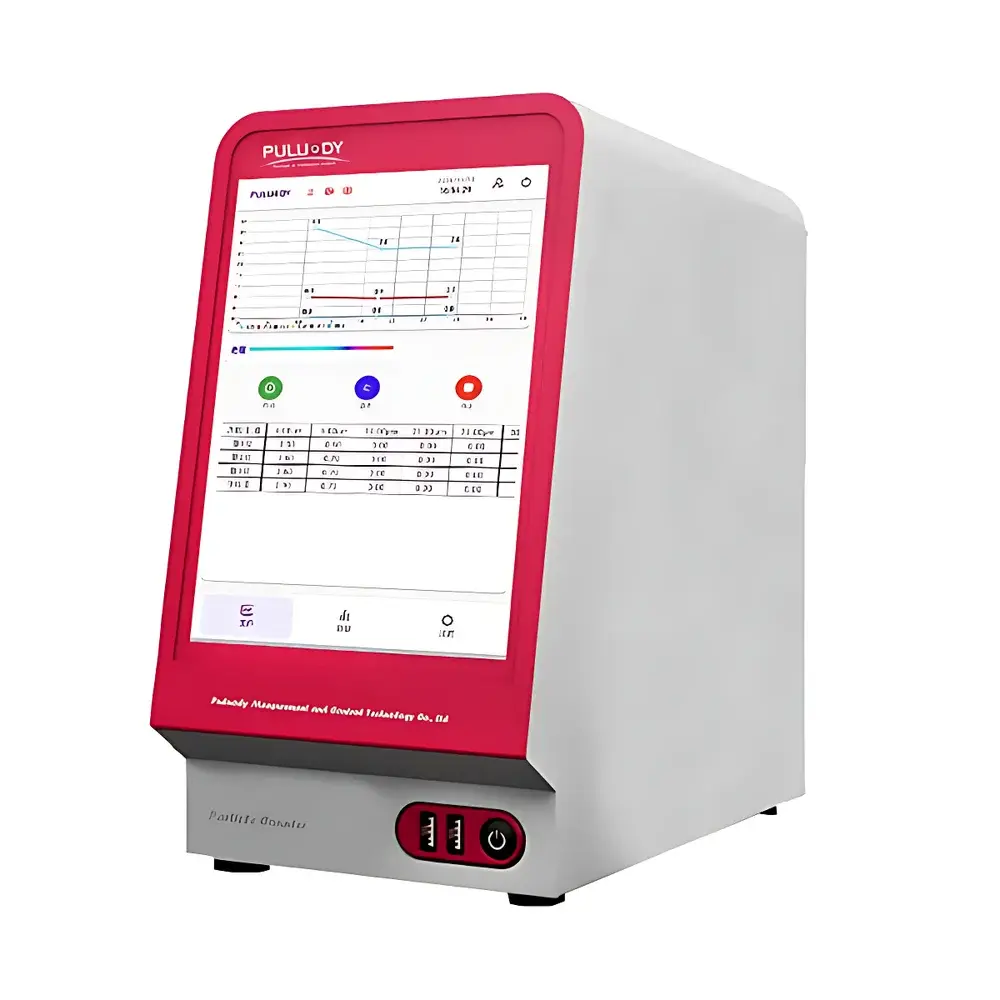
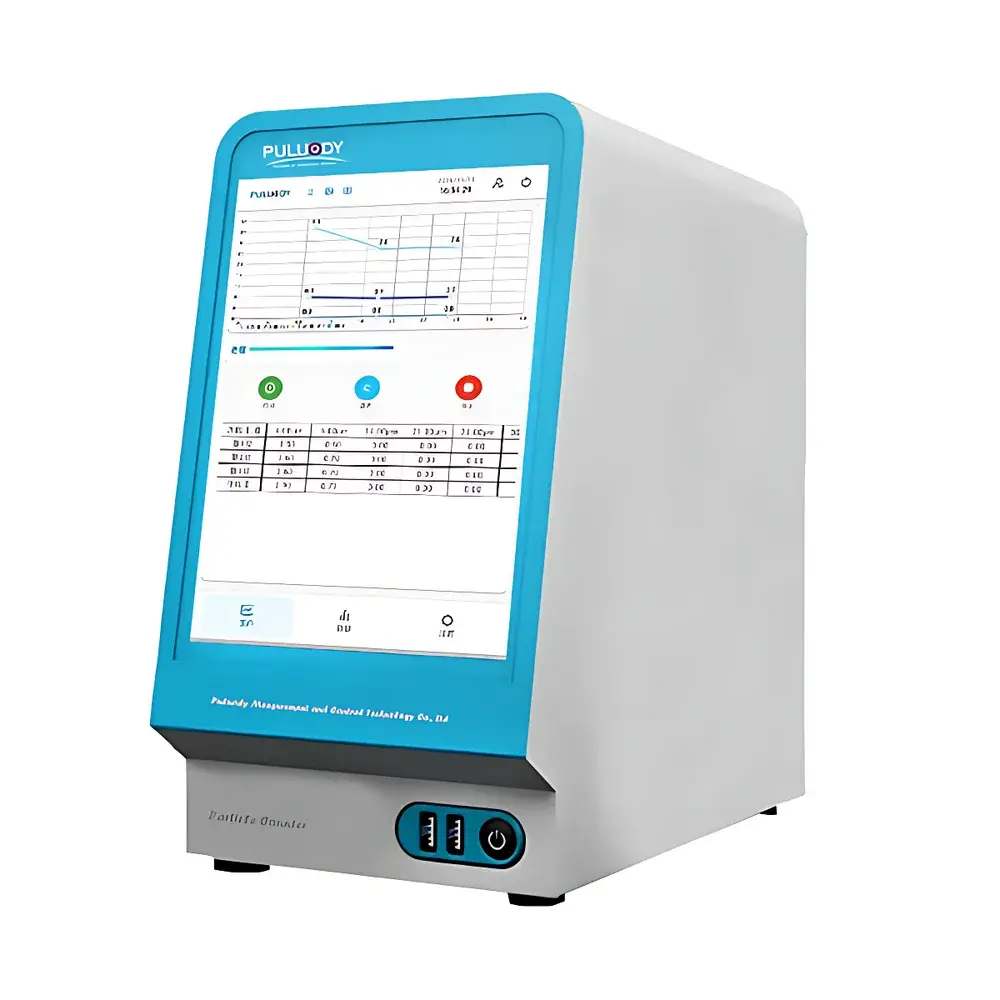
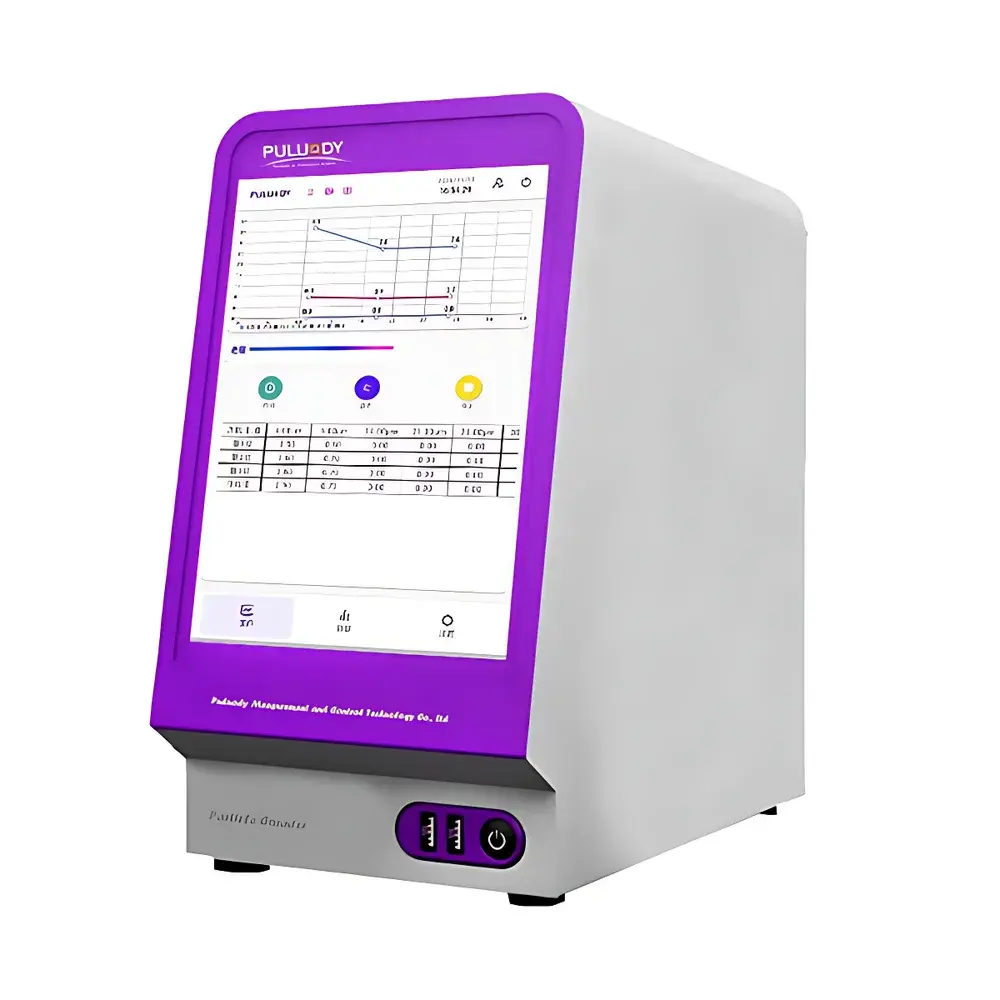
PULUODY PYX-2A Pharmaceutical Insoluble Particulate Analyzer
| Brand | PULUODY |
|---|---|
| Origin | Shaanxi, China |
| Model | PYX-2A |
| Instrument Type | Optical Light-Blockage Particle Counter |
| Detection Principle | Light Obscuration (LO) |
| Sensor | 8th-Generation Dual-Laser Narrow-Beam Detector |
| Measurement Range | 1–500 µm |
| Adjustable Channel Count | 16 (standard), up to 1096 user-defined channels |
| Sample Volume | 0.2 mL to custom-defined volume |
| Size Accuracy | ≥95% |
| Counting Accuracy | ±5% |
| Sampling Precision | ±0.5% |
| Flow Rate | 5–100 mL/min |
| Dimensions | 220 × 320 × 335 mm |
| Weight | 9.8 kg |
| Power Supply | 220–240 VAC, 50 Hz |
Overview
The PULUODY PYX-2A Pharmaceutical Insoluble Particulate Analyzer is a regulatory-compliant optical particle counter engineered for quantitative detection and sizing of insoluble particulates in parenteral pharmaceuticals, medical device packaging, and associated aqueous or organic solvent-based solutions. It operates strictly on the light obscuration (LO) principle as mandated by major pharmacopoeias—including USP , USP , EP 2.9.19, JP 6.07, and ChP 0903—ensuring full alignment with global quality control requirements for injectables, ophthalmic preparations, vaccines, sterile raw materials, and primary packaging components. The instrument features an 8th-generation dual-laser narrow-beam sensor architecture, delivering enhanced signal-to-noise ratio, improved baseline stability, and minimized optical path distortion during high-flow sampling. Its fluidic design incorporates dual-precision flow control to maintain laminar, pulse-free sample delivery across the sensing zone—critical for reproducible particle sizing and counting in compliance with ISO 21501-4 and ASTM F312-22 standards.
Key Features
- Dual-laser narrow-beam detection system optimized for high-resolution discrimination of particles from 1 µm to 500 µm, with ≥95% size accuracy verified against NIST-traceable latex sphere standards.
- Configurable channel architecture supporting 16 standard channels, scalable to 1096 user-defined bins—enabling granular distribution analysis per pharmacopoeial reporting requirements (e.g., ≥10 µm and ≥25 µm thresholds).
- Programmable sample volume ranging from 0.2 mL to fully customizable volumes, facilitating method transfer between QC labs and compatibility with low-volume biologics and lyophilized formulations.
- Flow rate control from 5 to 100 mL/min with ±0.5% volumetric precision, ensuring robust performance across viscous solutions, dilute buffers, and aggressive organic solvents (e.g., ethanol, IPA, acetonitrile).
- Integrated real-time limit alarm system compliant with USP alert thresholds, configurable per batch, lot, or product-specific acceptance criteria.
- Compact benchtop footprint (220 × 320 × 335 mm) and lightweight chassis (9.8 kg) designed for GMP-compliant lab environments with limited space and strict utility constraints.
Sample Compatibility & Compliance
The PYX-2A supports direct analysis of clarified aqueous and non-aqueous solutions without filtration or dilution—provided they meet optical clarity and viscosity limits for LO-based measurement. Validated applications include: sterile water for injection (WFI), large-volume parenterals (LVPs), small-volume parenterals (SVPs), lyophilized powder reconstitutes, ophthalmic solutions, vaccine suspensions, silicone oil–lubricated syringe barrels, polymer-based IV bags and tubing, glass vials, elastomeric stoppers, and final-filter effluents. All hardware and firmware comply with ISO 13485:2016 for medical device manufacturing environments and support audit-ready documentation for FDA 21 CFR Part 11, EU Annex 11, and PIC/S GMP inspections. Data integrity safeguards include electronic signatures, immutable audit trails, and time-stamped event logs.
Software & Data Management
The instrument operates via embedded firmware with optional PC-based analytical software (PYX-Suite v4.x) supporting IQ/OQ/PQ protocol templates, automated report generation (PDF/CSV/XLSX), and seamless integration into LIMS and MES platforms via OPC UA or HL7 interfaces. Software modules enforce ALCOA+ principles: attributable, legible, contemporaneous, original, accurate, complete, consistent, enduring, and available. Batch-level data export includes raw pulse amplitude histograms, cumulative/differential distributions, pass/fail status per USP/EP criteria, and operator-annotated deviation notes—all retained with hash-verified immutability.
Applications
- QC release testing of injectables per USP , EP 2.9.19, and ChP 0903.
- Filter validation and challenge studies for sterilizing-grade membranes (0.22 µm and 0.45 µm).
- Particulate shedding assessment of primary packaging (glass, polymer, elastomers) under simulated storage and handling conditions.
- Wear debris analysis of pharmaceutical processing equipment (pumps, valves, tubing).
- Monitoring of ultra-pure water systems (PW, WFI, PW-UP) per USP .
- Comparative evaluation of container-closure integrity and extractables/leachables impact on particle load.
FAQ
Does the PYX-2A comply with USP and other international pharmacopoeial methods?
Yes—the instrument implements light obscuration per USP , EP 2.9.19, JP 6.07, and ChP 0903, including required calibration, verification, and system suitability protocols.
Can it analyze organic solvents such as ethanol or DMSO?
Yes—provided the solvent is optically transparent at the laser wavelength (650 nm) and viscosity remains below 15 cP; optional wetted-material kits are available for aggressive chemistries.
Is the software 21 CFR Part 11 compliant?
Yes—PYX-Suite v4.x provides role-based access control, electronic signatures, audit trail review tools, and data encryption aligned with FDA and EMA expectations.
What maintenance is required for routine operation?
Daily system check with certified reference particles, quarterly optical alignment verification, and annual sensor calibration traceable to NIST SRM 1963 and SRM 2800.
How is sample carryover mitigated during sequential analysis?
The fluidic path includes programmable rinse cycles (up to 3× with deionized water or compatible solvent) and pressure-controlled purge sequences to ensure ≤0.01% residual carryover between samples.



