
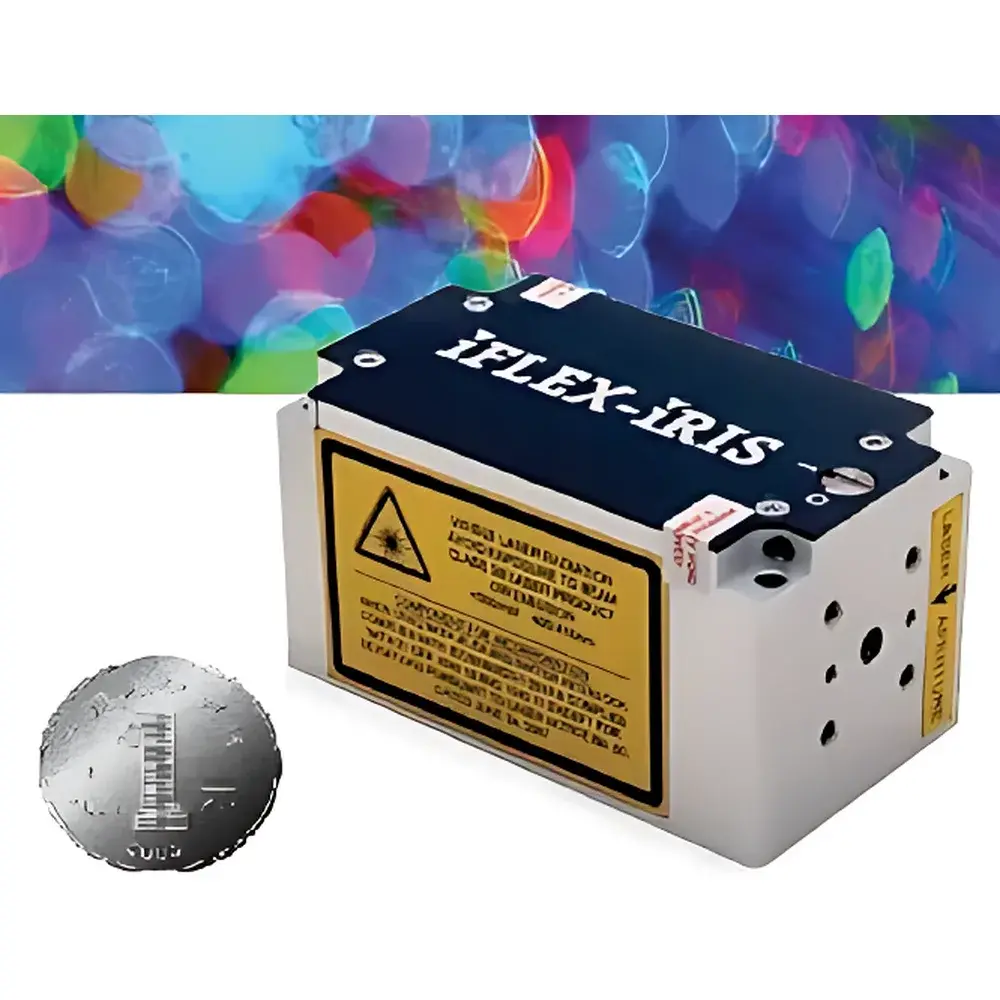
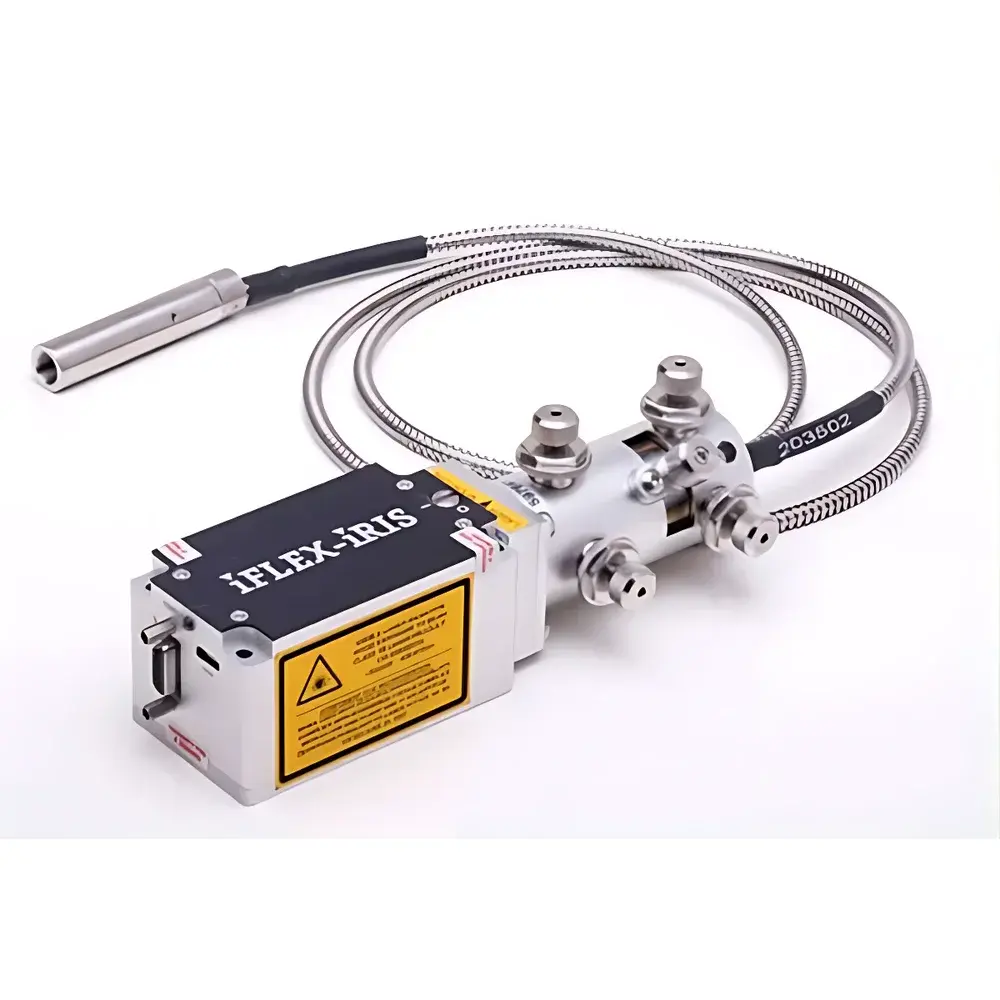
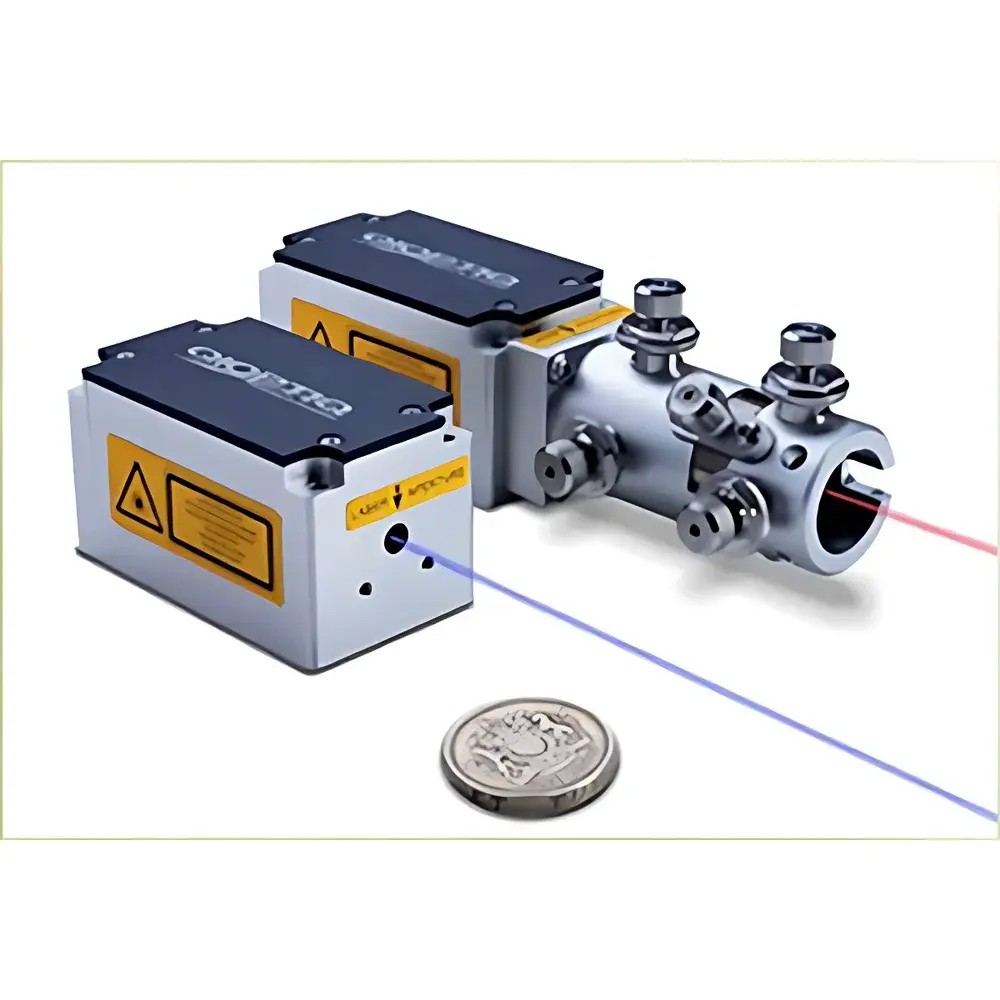
Qioptiq iFLEX-IRIS 780 nm Single-Mode Diode Laser System
| Brand | Qioptiq |
|---|---|
| Origin | United Kingdom |
| Model | iFLEX-IRIS 780 nm |
| Output Power | 25 mW |
| Beam Diameter (at aperture) | 0.7 mm |
| Beam Divergence | Diffraction-limited |
| Spatial Mode | TEM₀₀, M² < 1.1 |
| Power Stability (8 h) | < 0.5% RMS |
| Intensity Noise | < 0.05% RMS (20 Hz – 20 MHz) |
| Polarization Ratio | >200:1 (Vertical ±2°) |
| Pointing Stability | <1 µrad/°C |
| Dimensions | 70 mm × 40 mm × 38 mm |
| Output | Collimated Free-Space or Single-Mode Polarization-Maintaining Fiber-Coupled |
| Technology | CLM (Controlled Longitudinal Mode) + Active Thermal Stabilization |
| Custom Options | Circular or Shaped Beam Profile, Adjustable Output Power |
Overview
The Qioptiq iFLEX-IRIS 780 nm laser is a high-performance, single-longitudinal-mode (SLM) diode-based laser system engineered for applications demanding exceptional beam quality, spectral purity, and long-term amplitude stability. Operating at the biologically transparent and silicon-compatible wavelength of 780 nm, this laser leverages Controlled Longitudinal Mode (CLM) technology combined with active thermal stabilization to suppress mode hopping and intensity fluctuations. Unlike standard multimode semiconductor lasers, the iFLEX-IRIS delivers true TEM₀₀ output with an M² factor of less than 1.1—ensuring diffraction-limited focusing and minimal wavefront distortion. Its collimated free-space output (0.7 mm diameter, diffraction-limited divergence) or optional single-mode polarization-maintaining (PM) fiber coupling enables seamless integration into precision optical platforms where spatial coherence, polarization fidelity, and pointing accuracy are critical.
Key Features
- Stable single-longitudinal-mode (SLM) operation at 780 nm with linewidth < 1 MHz (typical), enabling high-resolution spectroscopy and interferometric applications.
- TEM₀₀ spatial profile with M² 200:1 (vertical orientation, ±2° tolerance), supporting polarization-sensitive measurements.
- Low-intensity noise (<0.05% RMS, 20 Hz–20 MHz bandwidth) and excellent power stability (<0.5% over 8 hours), essential for quantitative fluorescence detection and photon correlation spectroscopy.
- Ultra-low pointing drift (<1 µrad/°C) due to monolithic mechanical design and integrated thermal management—critical for alignment-sensitive setups such as confocal scanning or holographic reconstruction.
- Compact OEM-ready footprint (70 × 40 × 38 mm) with flexible output options: free-space collimated beam or PM fiber pigtail (SMF-28 or HI1060, FC/APC connector).
- Factory-configurable beam shaping (circular Gaussian or top-hat profiles) and analog/digital power modulation (0–100% range) via TTL or 0–5 V input.
Sample Compatibility & Compliance
The iFLEX-IRIS 780 nm laser is compatible with a broad range of optical components and instrumentation interfaces, including Nikon, Olympus, and Zeiss microscope side ports; Thorlabs and Newport optomechanics; and standard fiber-optic patch panels. It meets IEC 60825-1:2014 Class 3R laser safety requirements when operated within specified output limits. The device complies with CE marking directives (EMC 2014/30/EU, RoHS 2011/65/EU) and supports traceable calibration documentation upon request. For regulated environments—including clinical diagnostics labs and GMP-compliant manufacturing—the laser’s built-in monitoring outputs (photodiode feedback, temperature sensor signals) facilitate integration into audit-ready systems compliant with FDA 21 CFR Part 11 and ISO/IEC 17025 data integrity frameworks.
Software & Data Management
The iFLEX-IRIS integrates natively with industry-standard control ecosystems via USB 2.0 (CDC virtual COM port) and RS-232 interfaces. Qioptiq provides a Windows/Linux-compatible SDK supporting LabVIEW, MATLAB, Python (PySerial), and C/C++ development. Real-time telemetry—including diode current, thermistor voltage, photodiode output, and internal temperature—is logged with timestamped resolution down to 10 ms. All operational parameters are stored in non-volatile memory with write-cycle protection, enabling reproducible configuration recall across instrument reboots. Optional firmware updates support future protocol extensions, including SCPI command compliance for centralized lab automation platforms.
Applications
- Confocal and super-resolution microscopy: High spatial coherence and low noise enable optimal signal-to-noise ratio in STED, PALM, and STORM modalities requiring precise excitation control.
- DNA sequencing platforms: Stable 780 nm illumination improves base-calling accuracy in next-generation sequencers utilizing near-infrared fluorescent dyes (e.g., Cy5.5, Alexa Fluor 750).
- Flow cytometry and cell sorting: Polarization-maintained output ensures consistent excitation efficiency across heterogeneous cell populations in multi-parameter assays.
- Dynamic light scattering (DLS): Sub-0.05% RMS intensity noise minimizes autocorrelation function artifacts, enhancing hydrodynamic size distribution resolution in nanoparticle characterization.
- Holography and optical trapping: Diffraction-limited beam quality and pointing stability support stable interference fringe formation and precise gradient force manipulation of microspheres or biological specimens.
- Optical coherence tomography (OCT) source seeding: SLM operation enables narrow instantaneous linewidth required for high axial resolution in swept-source OCT configurations.
FAQ
Is the iFLEX-IRIS 780 nm laser suitable for use in GLP/GMP-regulated laboratories?
Yes—its real-time monitoring outputs, non-volatile configuration storage, and optional calibration certificates support compliance with GLP documentation standards and 21 CFR Part 11 electronic record requirements.
Can the laser be fiber-coupled to a custom optical setup?
Yes—standard configurations include single-mode polarization-maintaining fiber pigtails (HI1060 or SMF-28, FC/APC). Custom fiber types, lengths, and connectors are available under OEM agreements.
What thermal management is implemented to ensure long-term stability?
The unit incorporates a thermoelectric cooler (TEC) with PID-controlled feedback loop, coupled to a low-thermal-resistance aluminum housing and embedded NTC thermistors for sub-millikelvin temperature regulation.
Does the laser support external modulation for pulsed operation?
Yes—TTL-compatible digital modulation (up to 500 kHz) and analog voltage control (0–5 V) allow precise on/off gating or linear power ramping without mode instability.
How is beam circularity and pointing accuracy verified during manufacturing?
Each unit undergoes full beam profiling (ISO 11146-compliant) using a calibrated CCD-based beam analyzer, with pointing stability validated via angular displacement metrology under controlled thermal ramping (±5°C).






