
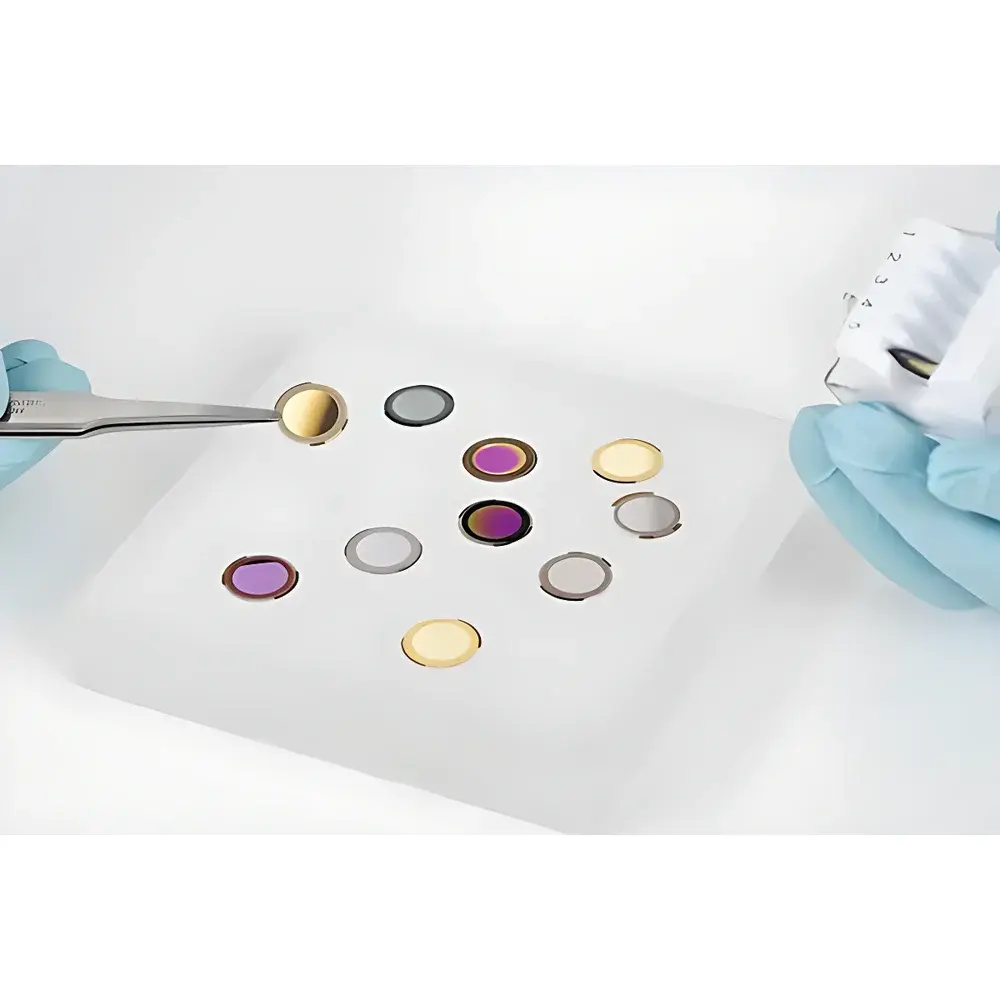
QSense Customized QCM-D Sensor Chips for QSense QCM-D Instruments
| Brand | QSense |
|---|---|
| Origin | Sweden |
| Model | Customized QSensor |
| Surface Coating Options | COP, EVA, FEP, PC, LDPE, PP, PUR, PES, PVC, CeO₂, SiGe, Cr22 Duplex Stainless Steel, Ti-6Al-4V, Ilmenite, Montmorillonite, WC, SnO₂, Pyrophyllite, Mg(OH)₂, AlO(OH), CuS, FeS, Carbon Soot, Sb₂S₃, SrSO₄, Clay |
| Certification Compliance | ISO 9001–certified manufacturing, GLP-compatible documentation support |
Overview
QSense Customized QCM-D Sensor Chips are precision-engineered quartz crystal resonators designed exclusively for integration with QSense QCM-D (Quartz Crystal Microbalance with Dissipation monitoring) instruments. These chips operate on the principle of piezoelectric resonance: when mass adsorbs or desorbs from the sensor surface, it induces a measurable shift in the crystal’s fundamental resonance frequency (Δf) and energy dissipation (ΔD), enabling real-time, label-free quantification of nanogram-level mass changes and viscoelastic properties of interfacial layers—such as protein films, polymer brushes, lipid bilayers, or mineral deposits—in liquid or gas environments. Unlike conventional QCM, QCM-D simultaneously tracks up to 13 overtones (typically 5th–13th), allowing robust separation of rigidly coupled mass from soft, hydrated, or dissipative layers. This dual-parameter output is essential for distinguishing structural rearrangements (e.g., conformational changes, swelling, or cross-linking) from simple adsorption events—critical in biomolecular interaction analysis, corrosion science, membrane fouling studies, and mineral flotation research.
Key Features
- High-purity AT-cut quartz crystals with gold electrodes (5–10 nm Ti adhesion layer + 50–100 nm Au), polished to <0.5 nm RMS roughness for reproducible baseline stability
- Customizable surface chemistries and thin-film coatings—including inert polymers (COP, PC, PP), functional elastomers (PUR), fluoropolymers (FEP), thermoplastics (LDPE, EVA), and inorganic materials (CeO₂, SnO₂, Ti-6Al-4V, SiGe, montmorillonite)—each deposited under controlled cleanroom conditions
- Batch-certified calibration data provided per chip lot: fundamental frequency (5 MHz ± 0.5 kHz), Q-factor (>15,000 in air), and overtone consistency across harmonics
- Compatible with all QSense QCM-D platforms (E4, Q4, and Q-Sense Explorer), supporting full dissipation monitoring from 5 MHz to 65 MHz (13th harmonic)
- Traceable manufacturing per ISO 9001; each chip supplied with individual QC report including surface characterization (XPS or contact angle where applicable) and electrical performance verification
Sample Compatibility & Compliance
QSense Customized QCM-D Sensor Chips accommodate diverse experimental media—including aqueous buffers (pH 2–12), organic solvents (ethanol, chloroform, THF), high-ionic-strength solutions (up to 2 M NaCl), and humidified gas streams—without compromising signal integrity. Surface coatings are selected and validated for chemical stability under operational conditions: e.g., FEP resists plasma etching and aggressive oxidants; Ti-6Al-4V enables electrochemical interface studies under potentiostatic control; CeO₂ and SnO₂ retain catalytic activity during in situ reaction monitoring. All chips meet requirements for GLP-compliant workflows: full traceability (lot number, coating date, deposition method), audit-ready documentation, and compatibility with FDA 21 CFR Part 11–enabled software environments when paired with QSense Instrument Control Software v5.0+.
Software & Data Management
Each sensor chip integrates seamlessly with QSense Instrument Control Software and QTools Analysis Suite. Raw f/n and D/n time-series data are acquired at user-defined sampling intervals (100 ms–10 s) and stored in vendor-neutral HDF5 format. The software supports batch processing of multi-chip experiments, automated baseline correction, Voigt-based viscoelastic modeling, and export to MATLAB, Python (via h5py), or Excel for third-party statistical analysis. For regulated environments, optional audit trail logging, electronic signature support, and role-based access control are available through QSense Compliance Pack—validated against ISO/IEC 17025 and ASTM E2500-18 guidelines for analytical instrument qualification.
Applications
- Biomaterials & Drug Delivery: Real-time binding kinetics of antibodies to COP- or PC-coated surfaces; swelling behavior of hydrogel coatings on PUR-modified sensors
- Mineral Processing & Flotation Chemistry: Adsorption isotherms and layer rigidity of collector reagents on ilmenite, pyrophyllite, or montmorillonite chips under simulated ore pulp conditions
- Corrosion & Electrode Interfaces: In situ oxide growth and breakdown on Cr22 duplex stainless steel or Ti-6Al-4V chips during cyclic voltammetry-coupled QCM-D
- Membrane Science: Fouling dynamics of proteins or polysaccharides on PES- or PVDF-coated sensors in cross-flow filtration mimics
- Catalysis & Environmental Remediation: Dynamic mass uptake and structural evolution of CeO₂ or SnO₂ surfaces during CO oxidation or NOₓ adsorption cycles
FAQ
Are custom coating specifications documented per chip lot?
Yes—each shipment includes a Certificate of Conformance listing coating thickness (where measured via ellipsometry or XRR), surface composition (XPS summary), contact angle (if hydrophobic/hydrophilic), and electrical validation data.
Can I reuse a QSensor chip after cleaning?
Reusability depends on coating type and exposure history. Inert polymer-coated chips (e.g., COP, PC) may be regenerated using oxygen plasma or UV-ozone, subject to post-cleaning f/D verification; metal or mineral coatings are generally single-use due to irreversible surface alteration.
Do you provide technical support for surface selection?
Yes—QSense Application Scientists offer free pre-purchase consultation, including literature review, coating feasibility assessment, and experimental design guidance based on your target analyte and matrix.
What is the typical lead time for custom orders?
Standard custom chips (from existing coating library) ship within 3–4 weeks; novel depositions requiring process development require 8–12 weeks and a feasibility study agreement.
Is there batch-to-batch performance variation?
No—coating processes are fully automated and monitored in real time; inter-lot coefficient of variation for Δf response to 10 ng/cm² BSA is ≤3.2%, verified by internal reference standards calibrated against NIST-traceable QCM methods.
Related Products





