
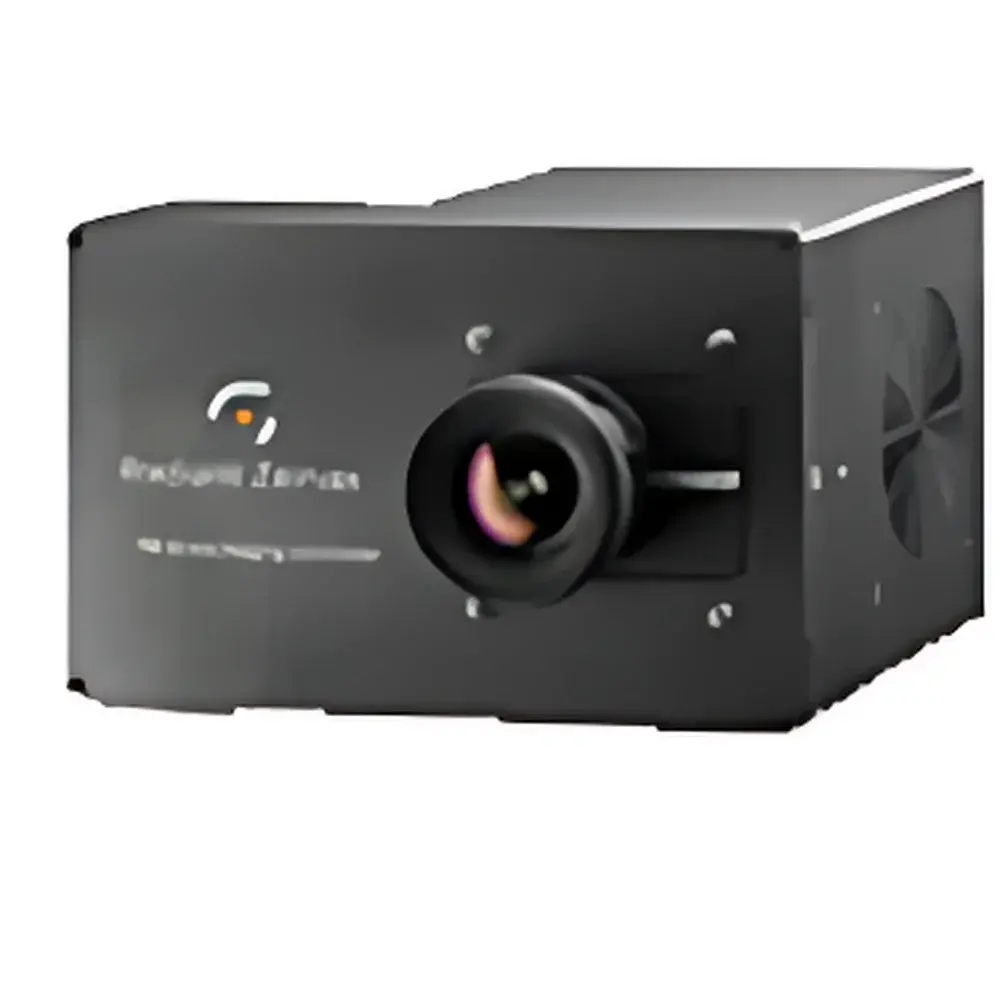
Radiant Zemax PM-1600F Series CCD-Based Imaging Photometer and Colorimeter
| Brand | Radiant Zemax |
|---|---|
| Origin | USA |
| Model | PM-1600F Series |
| Detector Type | TE-Cooled Scientific CCD |
| Resolution | 512 × 512 or 1024 × 1024 pixels |
| Dynamic Range | 16-bit (65,536 gray levels) |
| Minimum Luminance | 0.0005 cd/m² |
| Maximum Luminance (with ND filters) | 10¹⁰ cd/m² |
| Photometric Accuracy | ±3% for luminance (Y) and illuminance |
| Chromaticity Accuracy | ±0.003 in CIE x,y |
| Short-Term Repeatability | <±0.5% for luminance, ±0.0006 in CIE x,y |
| Measurement Time (at 100 cd/m²) | 2–9 sec depending on resolution and binning |
| FOV Range | 2°–38° (512×512), 5°–80° (1024×1024) |
| Interface | USB 2.0 |
| Dimensions | 154 mm (H) × 242 mm (W) × 200 mm (D) |
| Weight | 4.8 kg |
| Operating Temperature | 0–30 °C |
| Operating Humidity | 20–70% RH (non-condensing) |
| Software | ProMetric® v5.x or later |
| Compliance | ASTM E308, ISO/CIE 11664, CIE 15:2018, USP <1058>, FDA 21 CFR Part 11 (audit trail & electronic signature support) |
Overview
The Radiant Zemax PM-1600F Series is a high-precision, TE-cooled CCD-based imaging photometer and colorimeter engineered for quantitative spatial measurement of luminance, chromaticity, and uniformity across flat-panel displays, LED arrays, automotive lighting, and architectural lighting systems. Unlike spot photometers, the PM-1600F captures full-field radiometric and photometric data in a single acquisition—enabling pixel-level analysis of brightness distribution, chromaticity shift, hot-spot detection, and Mura defect quantification. Its optical architecture integrates CIE 1931 and CIE 1960 (u′,v′) color-matching functions via motorized filter wheels, ensuring traceable spectral response aligned with international photometric standards. The system operates on first-principles photometry: incident light is focused onto a scientific-grade CCD sensor calibrated against NIST-traceable standards; raw digital counts are converted to absolute photometric units (cd/m², lux, W/sr/m²) using factory-applied, temperature-compensated gain and offset matrices.
Key Features
- TE-cooled 16-bit scientific CCD sensor delivering thermal stability and low-noise performance for repeatable sub-0.5% luminance repeatability
- Motorized filter wheel supporting CIE-standard photopic (V(λ)), scotopic, and color-matching filters (x(λ), y(λ), z(λ)) plus neutral density (ND) attenuation up to OD 6
- Interchangeable lens system enabling field-of-view selection from 2° to 80°—optimized for near-field micro-display testing or wide-angle architectural luminaire characterization
- Full spatial metrology suite: luminance (cd/m²), illuminance (lux), radiance (W/sr/m²), irradiance (W/m²), luminous intensity (cd), CIE 1931 (x,y) and CIE 1960 (u′,v′) chromaticity coordinates, correlated color temperature (CCT), and Duv
- ProMetric software platform with scripting API (Python/Lua), automated test sequences, pass/fail mask generation, and statistical process control (SPC) charting
- Compliance-ready features including audit trail logging, user access levels, electronic signatures, and calibration certificate management per FDA 21 CFR Part 11 and ISO/IEC 17025 requirements
Sample Compatibility & Compliance
The PM-1600F supports measurement of emissive and reflective surfaces including OLED, MicroLED, LCD, Mini-LED backlights, automotive headlamps (AHS, DRL), signage panels, and projection screens. It accommodates samples ranging from 2 m architectural fixtures (via telephoto optics). All photometric calibrations are performed per CIE Publication 127:2007 and ASTM E308-22 methodologies. Device firmware and software maintain full traceability to NIST SRM 2241 and NIST SRM 2242 reference standards. System validation documentation satisfies GLP/GMP laboratory audit requirements and supports IQ/OQ/PQ protocols for regulated manufacturing environments.
Software & Data Management
ProMetric software provides unified control, acquisition, analysis, and reporting across Radiant’s imaging photometer portfolio. Key capabilities include real-time false-color mapping, region-of-interest (ROI) statistics, multi-point uniformity calculation (e.g., min/max ratio, Δu′v′ deviation), and automated report generation in PDF, CSV, and XML formats. Raw image data is stored in IEEE 754 double-precision floating-point format to preserve dynamic range integrity. The software supports integration with MES and LIMS platforms via RESTful API and OPC UA interfaces. Audit trail records capture operator ID, timestamp, parameter changes, calibration events, and measurement results—fully compliant with FDA 21 CFR Part 11 Subpart B for electronic records and signatures.
Applications
- Display manufacturing: Mura grading, gamma curve verification, viewing angle characterization, and HDR luminance mapping (up to 10⁸:1 contrast)
- Automotive lighting: Headlamp beam pattern compliance (SAE J575, ECE R112), DRL chromaticity homogeneity, and adaptive driving beam (ADB) pixel validation
- AR/VR micro-display testing: Eyebox luminance uniformity, color gamut coverage (sRGB, DCI-P3, Rec.2020), and speckle analysis
- Lighting design validation: IESNA LM-79 spatial intensity distribution, goniophotometric data export, and TM-30-20 color fidelity metrics (Rf, Rg)
- Regulatory conformance: Verification against ENERGY STAR, DLC, and EU Ecodesign Regulation (EU) 2019/2020 photometric limits
FAQ
What calibration standards does the PM-1600F reference?
The system is calibrated using NIST-traceable transfer standards (SRM 2241 for luminance, SRM 2242 for chromaticity) and validated per ISO/IEC 17025 accredited procedures.
Can the PM-1600F measure pulsed or PWM-driven displays?
Yes—integrated electronic shutter synchronization supports external trigger input (TTL) for precise phase-locked acquisition of flickering or time-multiplexed sources.
Is remote operation supported?
ProMetric software includes secure remote desktop access, headless operation via command-line interface (CLI), and scheduled unattended measurements with email alerts.
How often is recalibration required?
Annual recalibration is recommended under ISO/IEC 17025; however, daily dark/flat-field correction and quarterly verification using built-in reference LEDs ensure ongoing measurement integrity.
Does the system support custom spectral weighting functions?
Yes—users may import user-defined spectral sensitivity curves (CSV format) for specialized applications such as melanopic lux, circadian efficacy, or plant PAR/PFR calculations.




