
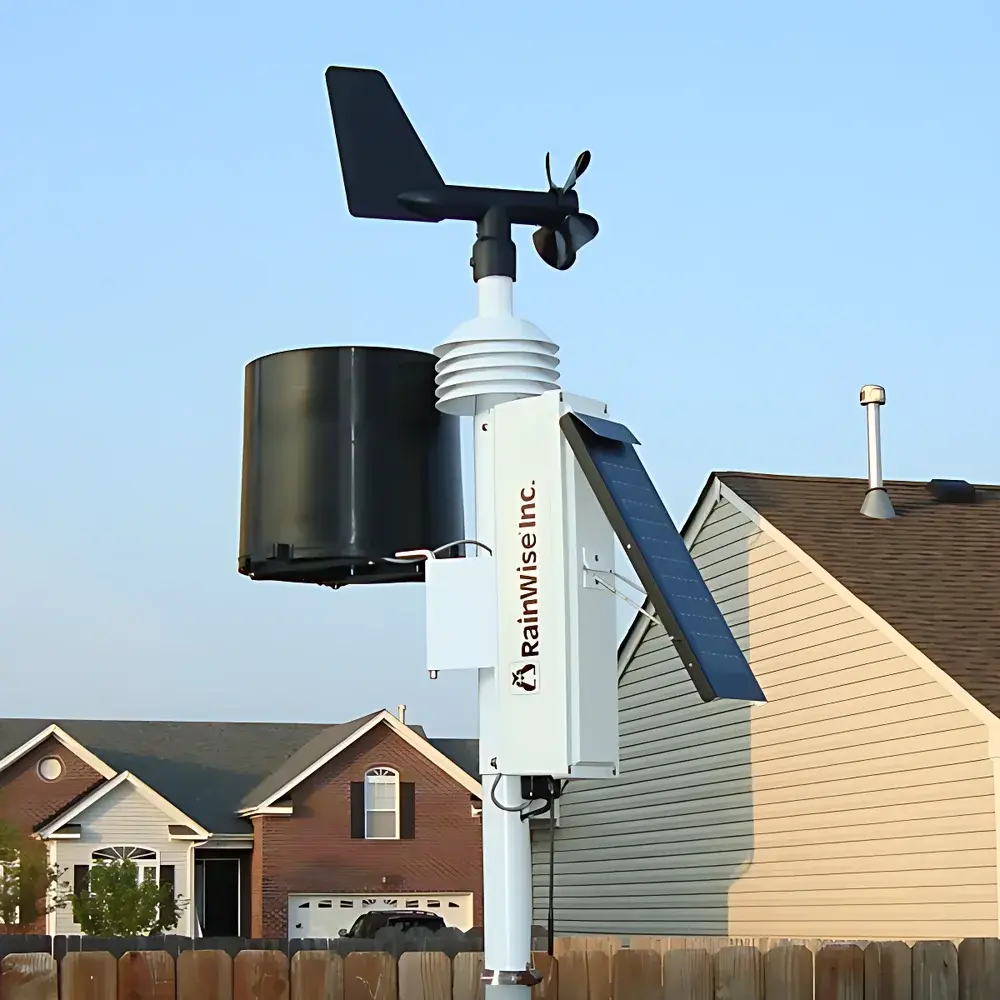
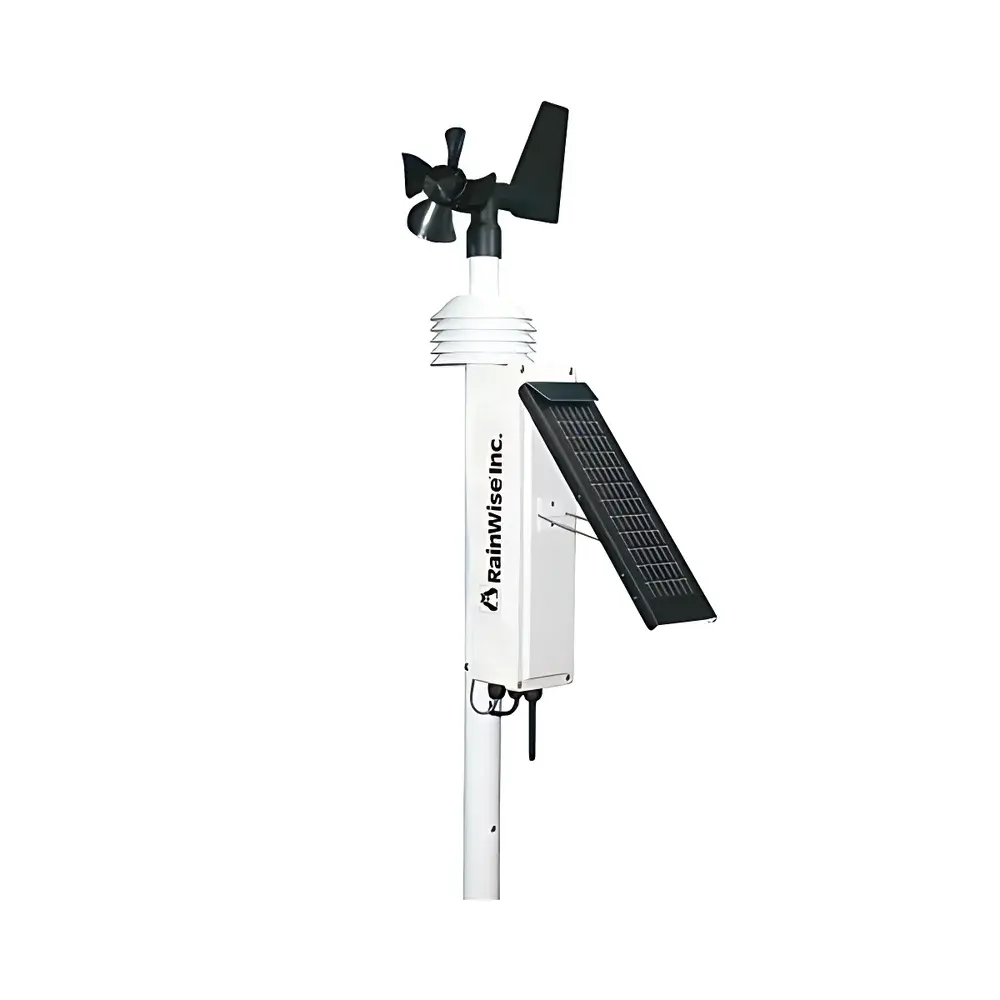
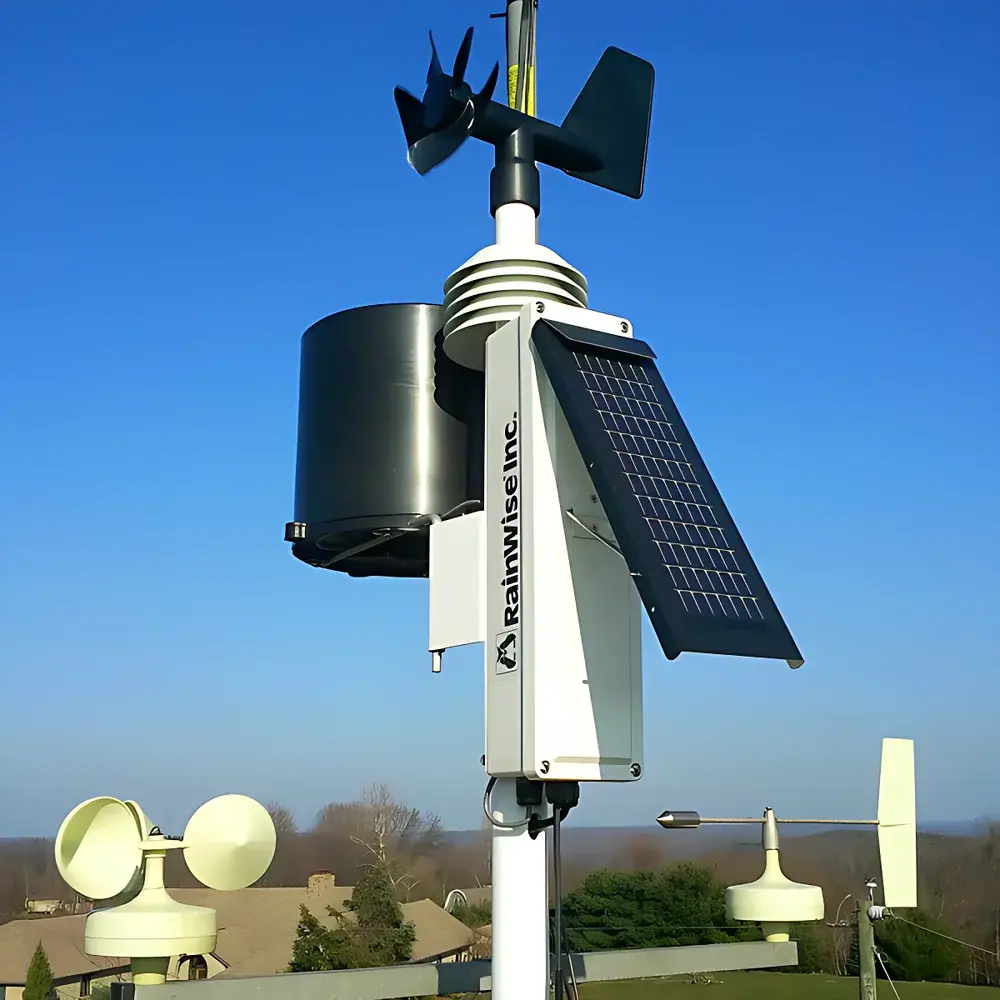
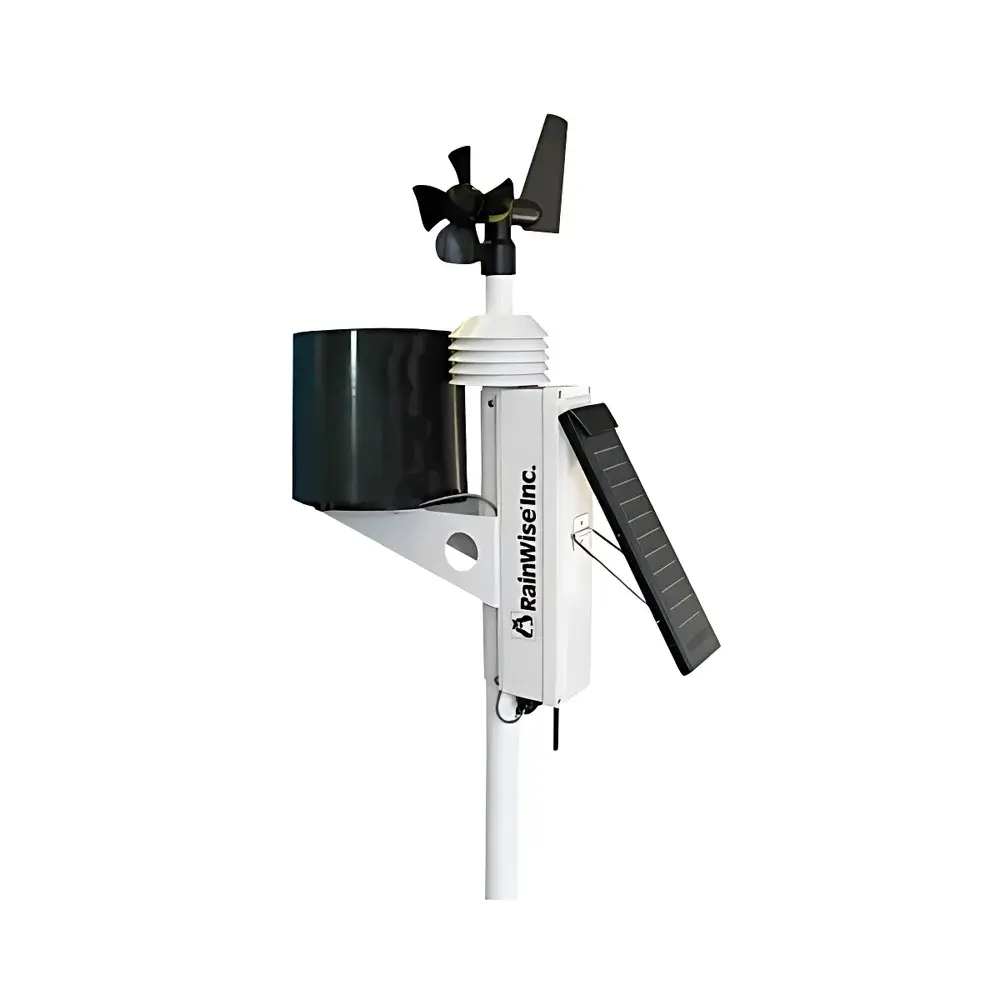
RainWise MK-III-LR Wireless Automatic Weather Station
| Brand | RainWise |
|---|---|
| Origin | USA |
| Model | MK-III-LR |
| Instrument Type | Portable Weather Station |
| Wireless Frequency | 2.4 GHz ISM Band |
| Max Line-of-Sight Transmission Distance | 1600 m |
| Wind Speed Range | 0–67 m/s |
| Wind Speed Accuracy | ±2% FS |
| Wind Direction Accuracy | ±3° |
| Temperature Range | −54 to +74 °C |
| Temp Accuracy | ±0.5 °C |
| Relative Humidity Range | 0–100% RH |
| RH Accuracy | ±2% (−40 to +85 °C) |
| Barometric Pressure Range | 300–1100 hPa |
| Pressure Accuracy | ±0.5 hPa @ 25 °C (temp-compensated) |
| Rainfall Resolution | 0.25 mm |
| Solar-Powered Battery Runtime | 60 days without sunlight |
| NIST-Traceable Calibration | Yes |
| Enclosure Materials | Stainless steel, fiberglass, UV-stabilized PVC |
| Mounting Options | Tripod or Mono mounting bracket |
| Compliance | FCC Part 15, IC RSS-247, CE RED Directive (EU variant) |
Overview
The RainWise MK-III-LR Wireless Automatic Weather Station is an industrial-grade, portable environmental monitoring system engineered for long-term reliability, high-fidelity data acquisition, and low-maintenance field deployment. Built on a modular architecture, it employs precision sensors operating on well-established physical measurement principles: cup-and-vane anemometry for wind speed and direction (per ASTM D5096), capacitive polymer humidity sensing with NIST-traceable calibration, platinum resistance thermometry (PT100-class equivalent) for air temperature, piezoresistive microelectromechanical systems (MEMS) for barometric pressure, and tipping-bucket mechanics for precipitation quantification. Its 2.4 GHz wireless transceiver operates within the globally harmonized ISM band, enabling robust telemetry in diverse topographies—ideal for agricultural microclimate networks, university atmospheric science programs, municipal environmental observatories, and infrastructure resilience monitoring. Designed for continuous unattended operation, the MK-III-LR meets core requirements of GLP-aligned environmental data collection protocols, including timestamped sensor output, battery health reporting, signal integrity diagnostics, and hardware-level overvoltage protection to mitigate lightning-induced transients.
Key Features
- Industrial-grade propeller-style wind sensor with 2-second sampling interval and mechanical redundancy for sustained accuracy under icing or dust-laden conditions.
- Solar-rechargeable sealed lead-acid battery system rated for 60-day autonomy at latitudes <60°N/S—validated per IEC 61427-1 cycle-life testing.
- True wireless sensor architecture: no conductive path between mast-mounted sensors and ground-based receiver, eliminating ground-loop interference and surge propagation pathways.
- NIST-traceable factory calibration applied to all primary environmental parameters (temperature, humidity, pressure, wind, rainfall), with certificate documentation supplied per ISO/IEC 17025-compliant practice.
- US National Weather Service (NWS)-referenced radiation shield for temperature/humidity sensors—designed to minimize solar loading error and ensure representative ambient air sampling per WMO Guide to Instruments and Methods of Observation (CIMO Guide, Chapter 12).
- Corrosion-resistant structural materials: marine-grade stainless steel fasteners, UV-stabilized fiberglass housing, and food-grade PVC conduit—all certified to ASTM D4329 for accelerated weathering resistance.
Sample Compatibility & Compliance
The MK-III-LR is optimized for outdoor atmospheric sampling in non-hazardous environments across USDA Plant Hardiness Zones 1–13. It complies with international electromagnetic compatibility (EMC) standards including FCC Part 15 Subpart C (USA), IC RSS-247 (Canada), and EN 300 440 v2.2.0 (EU RED Directive). Sensor outputs adhere to standard meteorological data formats defined in BUFR (Binary Universal Form for the Representation of meteorological data) and comply with NOAA’s NCDC metadata schema requirements. The system supports integration into networks conforming to the World Meteorological Organization’s (WMO) Integrated Global Observing System (IGOS) framework. All firmware and software components are designed to meet auditability requirements for environmental data used in regulatory reporting contexts, including EPA Method 216 and ISO 14001 Annex A.3.2 instrumentation traceability provisions.
Software & Data Management
Data acquisition and visualization are supported through three interoperable layers: the CC-3000 Smart Data Logger (USB 2.0 or RS-232 interface, 2 MB flash memory, internal temperature monitoring, and embedded 2.4 GHz receiver), Weatherview32 desktop software (with Home and Professional editions), and the IP-100 Ethernet/Wi-Fi gateway for cloud ingestion via RainwiseNet. Weatherview32 implements full 21 CFR Part 11 readiness—including electronic signatures, audit trails, role-based access control, and immutable data logging—making it suitable for GxP-aligned applications. The Professional Edition supports METAR parsing, satellite imagery overlay, automated email/SMS alerting based on user-defined thresholds (e.g., wind gust >25 m/s), and scheduled export to CSV, XML, or SQL databases. RainwiseNet provides secure TLS 1.2–encrypted data transport, ISO 27001-aligned infrastructure hosting, and granular permission controls for multi-user institutional deployments.
Applications
- Agricultural decision support: real-time evapotranspiration (ET₀) modeling using ASCE-standardized Penman-Monteith equations with integrated solar irradiance estimation.
- Renewable energy site assessment: wind resource characterization per IEC 61400-12-1 for small-scale turbine feasibility studies.
- Urban heat island (UHI) mapping: synchronized multi-node deployments with geotagged time-series logging for spatial thermal gradient analysis.
- K–12 and undergraduate atmospheric science education: curriculum-aligned datasets compatible with Python (Pandas, MetPy), MATLAB, and R for statistical climatology exercises.
- Disaster preparedness monitoring: early detection of rapid pressure drops preceding convective initiation or tropical cyclone approach.
- Construction site environmental compliance: continuous PM₁₀/PM₂.₅ proxy validation using wind-driven particulate dispersion modeling inputs.
FAQ
Is the MK-III-LR certified for use in regulated environmental reporting?
Yes—the system’s NIST-traceable calibration, audit-trail-capable software (Weatherview32 Pro), and adherence to WMO observational standards support its use in EPA, USDA, and state agency reporting frameworks where instrument qualification is required.
What is the expected service life of the solar-charged battery under typical field conditions?
Based on accelerated aging tests per IEEE 1188, the battery maintains ≥80% nominal capacity after 5 years of continuous charge/discharge cycling in temperate climates; replacement kits are available with full RoHS-compliant documentation.
Can the MK-III-LR integrate with third-party SCADA or building management systems (BMS)?
Yes—via Modbus TCP/IP (through IP-100), MQTT publishing (custom firmware option), or ASCII serial output from CC-3000, enabling direct ingestion into Ignition, Siemens Desigo, or Honeywell Experion platforms.
How does the system handle radio frequency interference in dense wireless environments?
The MK-III-LR implements adaptive frequency agility within the 2.4 GHz band, automatic channel selection on power-up, and packet-level CRC-32 error correction—validated against IEEE 802.15.4 coexistence test suites.
Are firmware updates delivered over-the-air or require physical access?
Firmware updates for CC-3000 and IP-100 are delivered via secure HTTPS push from RainwiseNet; MK-III-LR sensor modules require local USB update using Weatherview32, ensuring version consistency across distributed nodes.
Related Products







