
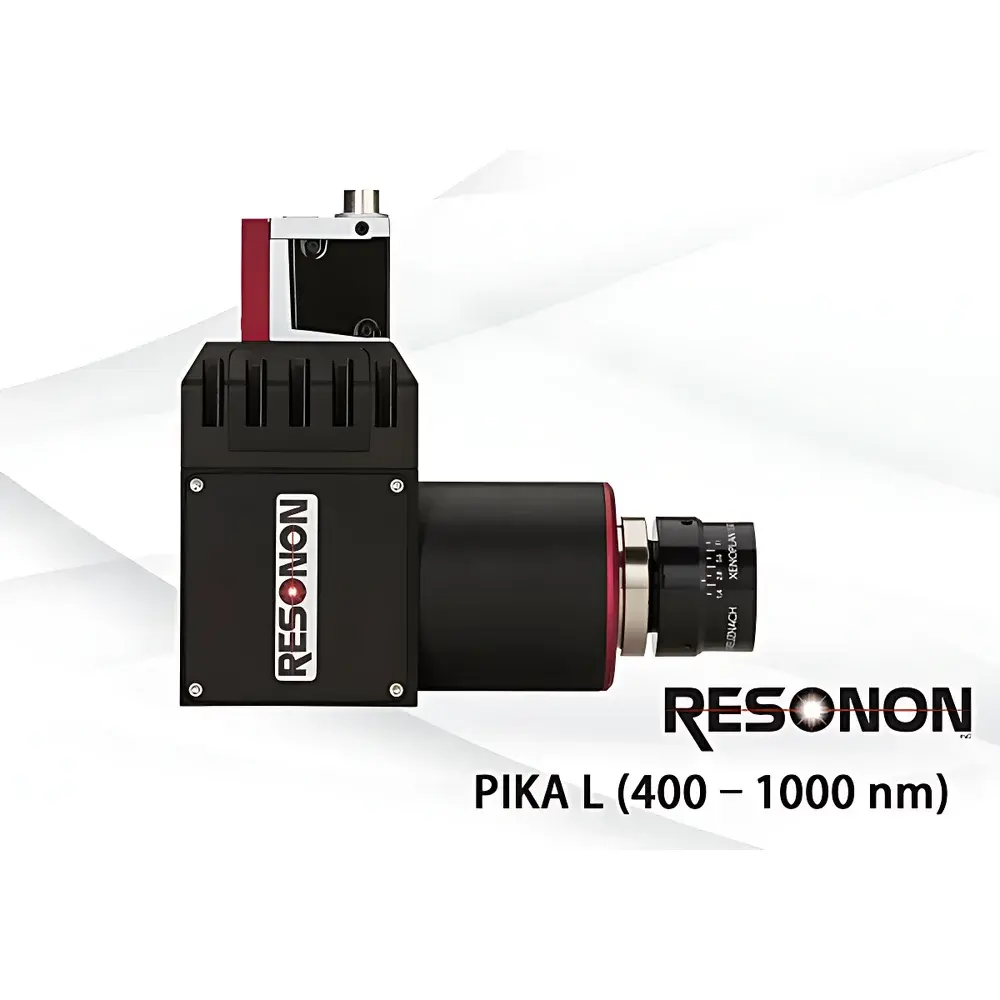
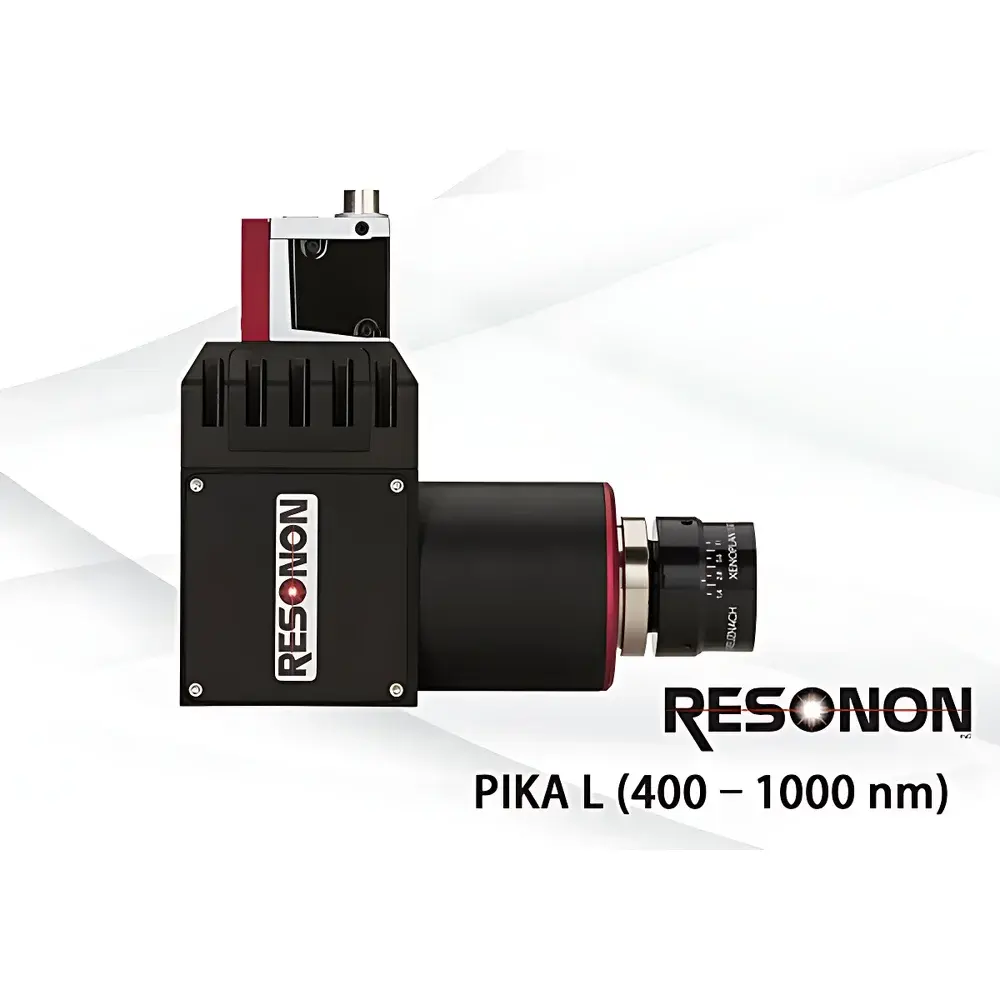
Resonon Pika L Hyperspectral Imaging System
| Brand | Resonon |
|---|---|
| Origin | USA |
| Model | Pika L |
| Operating Principle | Push-broom |
| Imaging Method | Dispersive |
| Platform Compatibility | Ground-based & Airborne |
| Spectral Range | 400–1000 nm |
| Spectral Resolution | 2.1 nm |
| Spatial Resolution (IFOV) | 0.2–0.65 mrad (configurable) |
| Field of View (TFOV) | 3.9°, 5.5°, or 12.0° (selectable) |
| Frame Rate | 249 fps |
| Spatial Pixels per Line | 900 |
| Spectral Bands | 281 |
| Bit Depth | 12-bit |
| Weight | 0.6 kg |
| Dimensions | 10.0 × 12.5 × 5.3 cm |
| Aperture | f/2.4 |
| Pixel Size | 5.86 µm |
| RMS Spot Radius (avg.) | 6 µm |
| Smile (peak-to-peak) | 4 µm |
| Keystone (peak-to-peak) | 5 µm |
| Interface | USB 3.0 |
| Operating Temperature | 5–40 °C |
Overview
The Resonon Pika L is a compact, lightweight push-broom hyperspectral imaging system engineered for high-fidelity spectral-spatial data acquisition across ground-based and airborne platforms. Based on dispersive prism-grating optics, the Pika L captures contiguous spectral bands from 400 to 1000 nm with a nominal spectral resolution of 2.1 nm—enabling discrimination of subtle material signatures in vegetation, minerals, coatings, and biological tissues. Its optical design minimizes smile and keystone distortions (≤4 µm and ≤5 µm peak-to-peak, respectively), ensuring geometric fidelity critical for quantitative pixel-level analysis. With a 12-bit digitization depth, f/2.4 aperture, and 5.86 µm pixel pitch, the sensor delivers high signal-to-noise ratio (SNR) performance under ambient illumination conditions typical of field-deployed remote sensing applications. The system’s 0.6 kg mass and compact form factor (10.0 × 12.5 × 5.3 cm) facilitate integration into UAV gimbals, laboratory scanning stages, conveyor-based industrial inspection rigs, and handheld survey configurations.
Key Features
- Push-broom architecture optimized for real-time line-scan acquisition at up to 249 frames per second
- Dispersive optical path with low-stray-light design, minimizing spectral crosstalk and radiometric uncertainty
- Selectable field-of-view options (3.9°, 5.5°, 12.0°) and corresponding instantaneous field-of-view (IFOV) settings (0.2, 0.3, 0.65 mrad) to match platform altitude and target scale requirements
- 281 contiguous spectral channels with uniform sampling across the visible–NIR range (400–1000 nm)
- High spatial fidelity: average RMS spot radius <6 µm; calibrated geometric correction coefficients supplied for orthorectification workflows
- USB 3.0 interface enables direct connection to embedded computing modules or host PCs without frame grabbers
- Operational temperature range of 5–40 °C supports deployment in diverse environmental conditions without active thermal stabilization
Sample Compatibility & Compliance
The Pika L is designed for non-contact, non-destructive spectral characterization of heterogeneous surfaces—including plant canopies, geological outcrops, painted substrates, pharmaceutical tablets, and food products. Its spectral response aligns with ASTM E2799–22 (Standard Guide for Hyperspectral Imaging Data Collection and Processing) and supports calibration traceability to NIST-traceable reflectance standards. While the instrument itself does not carry CE or FCC certification as a standalone module, it complies with electromagnetic compatibility (EMC) limits when integrated into certified platforms per IEC 61000-6-3 and IEC 61000-6-4. For regulated environments (e.g., GLP-compliant agricultural trials or FDA-aligned food safety screening), raw data capture and metadata logging meet minimum requirements for audit readiness—particularly when used with Resonon’s SDK-enabled software stack supporting time-stamped frame headers and sensor configuration logs.
Software & Data Management
The Pika L operates natively on Windows and Linux platforms via Resonon’s proprietary acquisition software, which provides real-time preview, exposure control, dark current subtraction, and radiometric calibration workflow management. A C++ Software Development Kit (SDK) is available for custom integration into third-party applications—including MATLAB, Python (via ctypes bindings), and ROS-based autonomous systems. All captured data are stored in standard ENVI-compatible BIL format (.hdr/.bil), preserving spectral and spatial metadata required for downstream processing in tools such as Specim IQ Suite, ENVI, QGIS with SCP plugin, or custom machine learning pipelines (e.g., CNN-based classification using TensorFlow or PyTorch). The SDK supports synchronous triggering, external GPS/IMU timestamp injection, and programmable region-of-interest (ROI) binning to optimize bandwidth usage during UAV telemetry-limited operations.
Applications
- Agricultural Monitoring: Detection of nitrogen stress, water deficit, and early disease onset via chlorophyll absorption features near 680 nm and water band ratios at 970 nm
- Mineral Exploration: Identification of iron oxides, clay species, and carbonate minerals using diagnostic absorption features between 700–2500 nm (with optional extended-range variants)
- Industrial Quality Control: Verification of coating uniformity, pigment dispersion, and substrate contamination on moving production lines
- Environmental Remote Sensing: Mapping invasive species, post-fire regrowth, and wetland vegetation composition at sub-meter GSD from fixed-wing or multirotor platforms
- Biomedical Research: Ex vivo tissue characterization for surgical margin assessment and histopathology correlation studies
FAQ
Is the Pika L suitable for drone-mounted operation?
Yes—the Pika L’s weight (0.6 kg), low power consumption (<3 W), and vibration-tolerant mechanical design make it compatible with Class II and III UAV platforms. Integration requires synchronization with GNSS/IMU units for georeferencing; Resonon provides sample ROS nodes and timestamp alignment protocols.
Does the system support radiometric calibration out of the box?
The Pika L ships with factory-measured relative spectral response (RSR) and dark frame libraries. Absolute radiometric calibration requires user-provided NIST-traceable reflectance panels and incident irradiance sensors—procedures documented in ASTM E2799–22 and Resonon’s Application Note AN-004.
Can spectral binning be applied during acquisition?
Yes—software-configurable spectral binning (2×, 4×) reduces data volume while preserving SNR for applications where spectral detail is secondary to spatial throughput or telemetry constraints.
What level of geometric correction is included?
Per-pixel smile and keystone correction coefficients are embedded in the header metadata. Full orthorectification requires external DEM/DSM and exterior orientation parameters—supported by open-source tools like OpenCV and commercial packages such as PCI Geomatica.





