
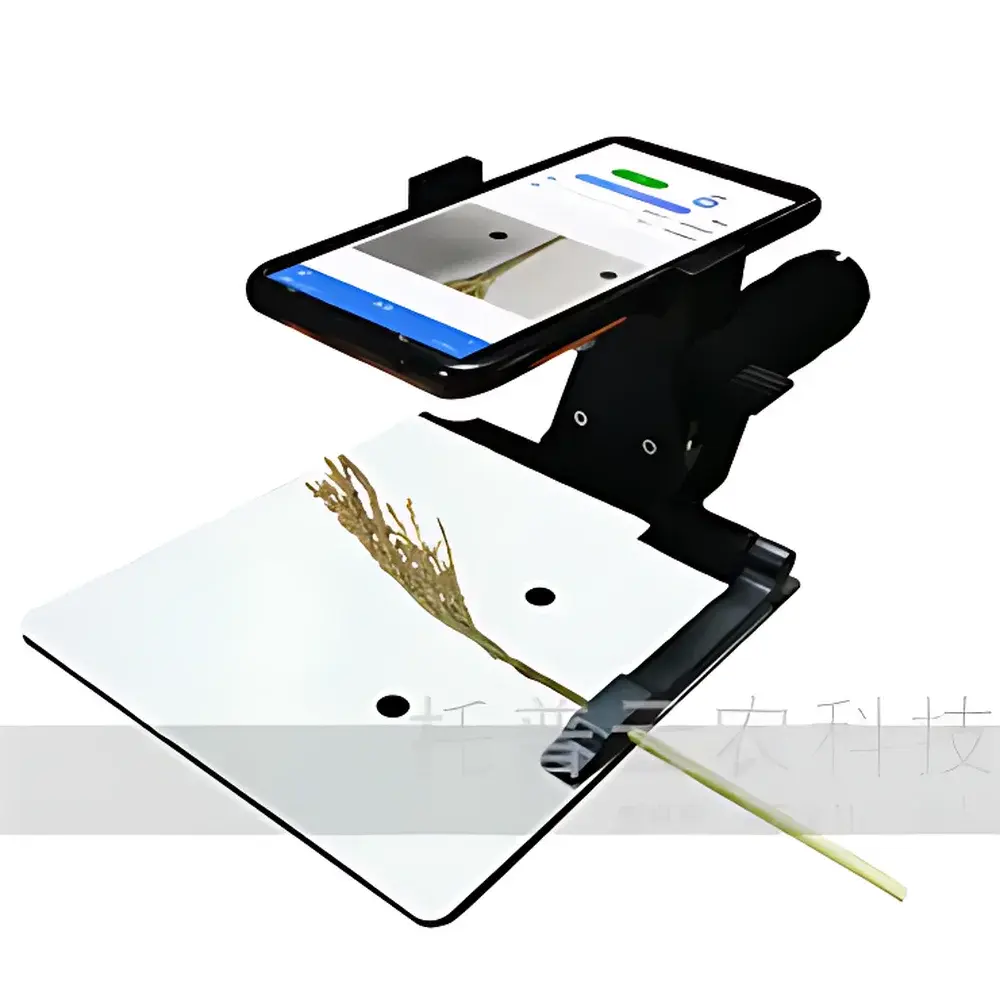
Top Cloud-agri TPZW-JC-1 Plant Stem Diameter & Internode Angle Phenotyping Analyzer
| Brand | Top Cloud-agri |
|---|---|
| Origin | Zhejiang, China |
| Manufacturer Type | Direct Manufacturer |
| Country of Origin | China |
| Model | TPZW-JC-1 |
| Pricing | Upon Request |
| Dimensions | 307 × 140 × 80 mm |
| Measurement Range | 0–6 cm |
| Accuracy | ±1% |
| Image Resolution | 2160 × 1080 |
| Display | Color Touchscreen (Android OS) |
| Camera | 20 MP |
| Storage | 50 GB Internal |
| Battery | 3010 mAh (≥5 h operation) |
| Connectivity | Wi-Fi & 4G |
| Background | White Matte PVC Waterproof Paper |
| Base Plate | Black Dual-Side Frosted Acrylic |
| Stem Fixation | Integrated Press Plate & Rotating Handle |
| Environmental Operation | Ambient Light Tolerant, In Vivo & Ex Vivo Compatible |
Overview
The Top Cloud-agri TPZW-JC-1 Plant Stem Diameter & Internode Angle Phenotyping Analyzer is a field-deployable, non-destructive optical phenotyping instrument engineered for high-throughput quantification of two critical morphological traits in crop physiology: stem diameter and stem-to-leaf petiole angle (commonly referred to as “crop angle” or “stem inclination angle”). Unlike conventional calipers or destructive sectioning methods, the TPZW-JC-1 employs a standardized imaging geometry—fixed-object distance, controlled background contrast, and adaptive white balance—to convert calibrated digital images into reproducible biometric measurements. Its core measurement principle relies on pixel-to-millimeter spatial calibration under consistent optical constraints, enabling sub-millimeter resolution without physical contact. Designed specifically for longitudinal studies in breeding programs, agronomic trials, and functional genomics, the device supports both in vivo (intact, standing plants) and ex vivo (detached stems) measurement protocols—making it suitable for time-series growth analysis, genotype-by-environment (G×E) experiments, and stress-response phenotyping under variable field lighting conditions.
Key Features
- Handheld, ergonomic form factor (307 × 140 × 80 mm) optimized for extended field use with minimal operator fatigue;
- Integrated dual-function mechanical fixture: a rotating handle coupled with a spring-loaded press plate ensures stable, repeatable stem positioning—mitigating motion artifacts caused by wind or operator variability;
- 20-megapixel Android-based imaging module with real-time auto white balance and ambient-light compensation, eliminating need for shading tents or supplemental lighting;
- Fixed-focus optical path (pre-calibrated working distance) guarantees geometric consistency across thousands of acquisitions—critical for longitudinal repeatability and cross-site comparability;
- On-device image processing engine delivers stem diameter and angle metrics within ≤3 seconds post-capture; batch analysis mode enables offline processing of stored image sets;
- 50 GB internal storage accommodates ≥2 years of high-resolution image + metadata archives (including GPS-tagged geolocation, timestamp, and environmental context);
- Dual-mode connectivity (Wi-Fi and 4G LTE) enables secure, encrypted data upload to cloud-based phenotyping platforms compliant with ISO/IEC 27001 information security standards;
- Comprehensive local data management: searchable history browser, export to .XLSX (Microsoft Excel-compatible), and automated report generation including measurement time, coordinates, raw image thumbnail, and derived phenotypic values.
Sample Compatibility & Compliance
The TPZW-JC-1 is validated for monocot and dicot species including but not limited to maize, rice, wheat, soybean, tomato, and Brassica spp. It operates effectively across developmental stages—from seedling emergence through reproductive maturity—and accommodates both herbaceous and semi-woody stems up to 6 cm in diameter. The matte-white PVC background and black frosted acrylic base provide optimal contrast for edge detection algorithms, independent of leaf chlorophyll content or surface waxiness. All hardware materials meet RoHS Directive 2011/65/EU requirements. Data acquisition workflows support GLP-aligned documentation practices, with immutable timestamps, GPS metadata, and audit-ready export logs—facilitating traceability in regulatory submissions or peer-reviewed phenotypic datasets.
Software & Data Management
The embedded Android application implements a deterministic image-processing pipeline: background subtraction, Otsu thresholding, Hough transform-based axis detection, and ellipse-fitting for diameter estimation. Angle calculation derives from vector alignment between stem central axis and gravity-referenced vertical (determined via integrated accelerometer). All processing parameters are locked and non-editable to ensure inter-user consistency. Cloud synchronization follows HTTPS/TLS 1.2+ encryption; uploaded datasets include SHA-256 checksums for integrity verification. Platform-level APIs support integration with BreedBase, BrAPI-compliant databases, and FAIR-aligned repositories (e.g., CyVerse, Phenome Networks). Audit trails record user ID, session start/end time, firmware version, and calibration status—meeting minimum requirements for FDA 21 CFR Part 11 electronic record compliance when deployed in GxP environments.
Applications
- High-resolution temporal profiling of relative stem elongation rate (RGR) and diurnal angle dynamics;
- QTL mapping and GWAS validation using stem morphology as quantitative trait loci;
- Evaluation of lodging resistance traits in cereals under mechanical stress simulation;
- Phenotypic screening of hormone-responsive mutants (e.g., auxin, gibberellin pathways);
- Calibration reference for proximal sensing systems (e.g., UAV-mounted multispectral cameras);
- Validation benchmark for deep learning models trained on synthetic or low-resolution stem imagery.
FAQ
What is the minimum and maximum stem diameter the TPZW-JC-1 can measure?
The device is calibrated for a linear range of 0–6 cm with ±1% measurement uncertainty across the full span.
Does the instrument require external power during field operation?
No—it operates autonomously on its rechargeable 3010 mAh Li-ion battery, supporting ≥5 hours of continuous use per charge.
Can measurements be performed under direct sunlight?
Yes—the adaptive white balance and high-contrast background eliminate dependency on controlled illumination; no遮光 (light-shielding) setup is required.
How is positional accuracy ensured across multiple users or sites?
Fixed optical geometry, factory-applied spatial calibration, and integrated accelerometer-based vertical reference collectively ensure inter-operator and inter-site measurement equivalence.
Is raw image data retained alongside processed metrics?
Yes—each measurement event stores the original 2160×1080 JPEG image, EXIF metadata (GPS, timestamp, device orientation), and processed CSV output in synchronized folders.
What cloud platforms are natively supported for data ingestion?
The device ships with preconfigured connectors for Top Cloud-agri’s AgriPheno™ Cloud and supports custom API endpoints compatible with BrAPI v2.0 and MIAPPE-compliant metadata schemas.






