
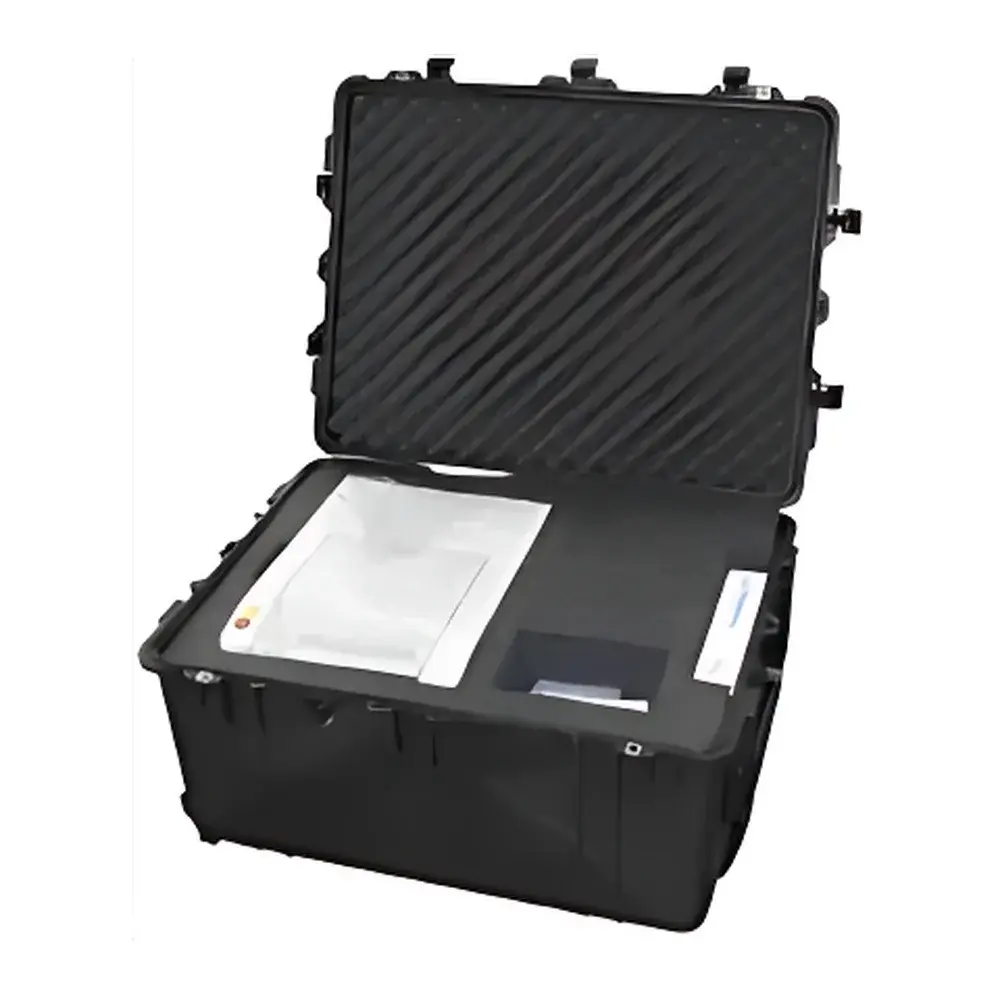
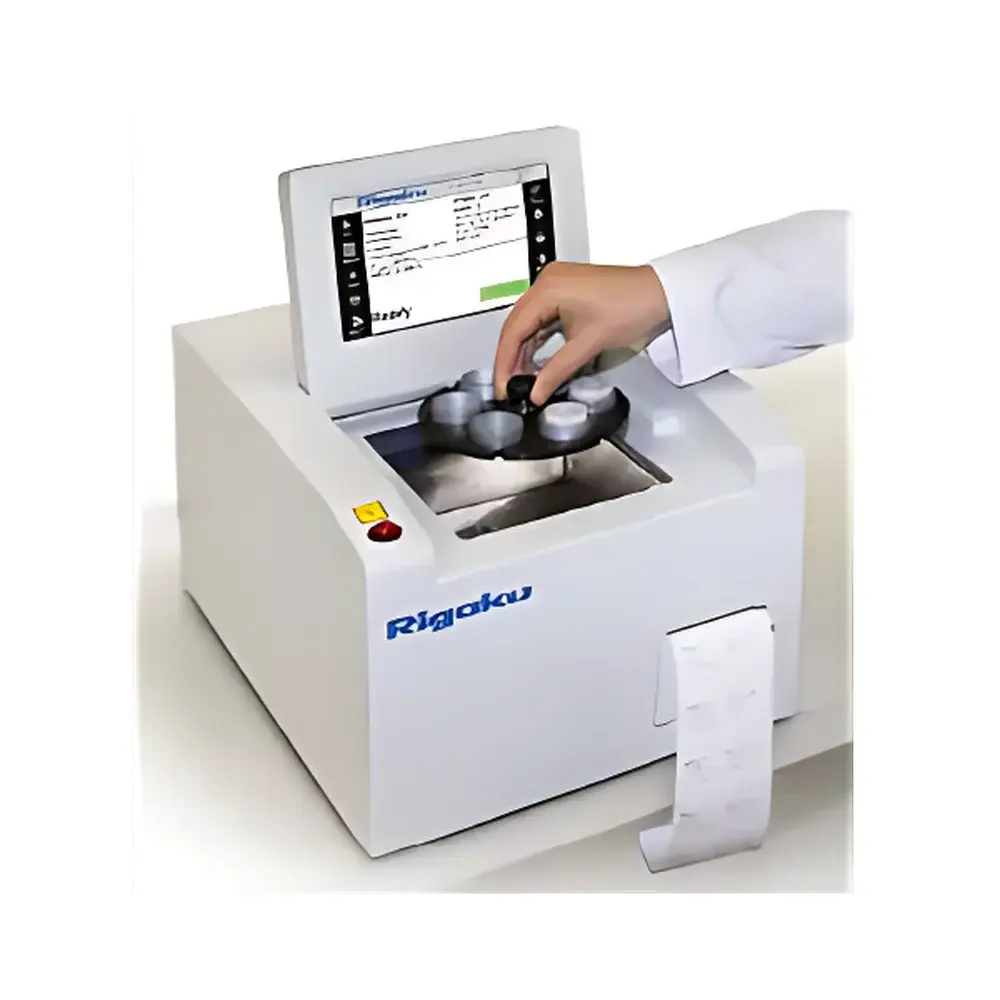
Rigaku NEX QC+ Portable Energy-Dispersive X-ray Fluorescence (EDXRF) Sulfur Analyzer for Petroleum Products
| Brand | Rigaku |
|---|---|
| Origin | USA |
| Model | NEX QC+ |
| Detection Principle | Energy-Dispersive X-ray Fluorescence (EDXRF) |
| Detection Limit | 2.3 ppm for S |
| Measurement Range | 0–10 wt% S |
| Accuracy (Relative Error) | ±0.0001 |
| Analysis Time | < 3 min (configurable from 1–999 s) |
| Sample Volume | < 5 mL |
| Elemental Range | Na (11) to U (92) |
| Compliance | ASTM D4294, GB/T 17040 |
| Portability | Handheld / Field-Deployable |
| Environmental Operating Range | 15–35 °C, RH < 85% (non-condensing) |
| Data Interface | USB + Ethernet |
| Matrix Correction | Compton Scattering C/H Ratio Normalization |
| Filtration | Multi-layer Composite Primary Beam Filters |
| Safety | Zero hazardous waste generation (no gas, liquid or solid effluent) |
Overview
The Rigaku NEX QC+ is a field-deployable, benchtop-portable energy-dispersive X-ray fluorescence (EDXRF) analyzer engineered for rapid, non-destructive quantification of total sulfur and multi-element composition in petroleum-based liquids and semi-solids. Unlike combustion-based methods (e.g., UV fluorescence or microcoulometry), the NEX QC+ relies on fundamental XRF physics: incident X-rays excite inner-shell electrons in sample atoms; characteristic fluorescent X-rays emitted during electron relaxation are energy-resolved by a silicon drift detector (SDD), enabling simultaneous elemental identification and quantification without chemical digestion or reagent consumption. Its design targets regulatory and operational needs across upstream, midstream, and downstream petroleum workflows—particularly where real-time sulfur compliance verification against ASTM D4294 (Standard Test Method for Sulfur in Petroleum and Petroleum Products by Energy-Dispersive X-ray Fluorescence Spectrometry) is required at the point of custody transfer, refinery blending unit, or field storage facility.
Key Features
- True portable architecture: Integrated battery option (optional), lightweight chassis (< 15 kg), and ruggedized enclosure rated for industrial environments (IP54 equivalent).
- Multi-element capability: Simultaneous detection and quantification of S, Pb, Cu, Mn, Ca, Fe, Ni, V, and other elements from sodium (Z=11) to uranium (Z=92), supporting ASTM D6443 and D7039 applications.
- High-fidelity matrix correction: Real-time Compton scattering normalization accounts for variations in hydrocarbon chain length, density, and heteroatom content—critical for accurate sulfur measurement in complex matrices such as vacuum residue, heavy fuel oil, and cracked feedstocks.
- No consumables or hazardous byproducts: Operates without gases, acids, catalysts, or high-temperature furnaces; fully compliant with OSHA HAZWOPER and EPA waste minimization guidelines.
- Configurable acquisition: Analysis time adjustable from 1 to 999 seconds per measurement, enabling optimization between precision (longer dwell) and throughput (short dwell).
- Integrated thermal printer and dual data export: Direct hardcopy reporting plus timestamped CSV/Excel-compatible output via USB or Ethernet, supporting audit-ready documentation.
Sample Compatibility & Compliance
The NEX QC+ accepts liquid and viscous petroleum samples—including crude oil, naphtha, jet fuel (Jet A-1, JP-8), diesel, lubricating oils, waxes, and residual fuels—without dilution or pre-treatment. Samples are loaded into standard 10–20 mL XRF sample cups sealed with polymer films (e.g., Mylar™ or Polypropylene). The instrument’s low-power X-ray tube (50 kV, 1 mA max) and optimized beam filtration ensure stable excitation across varying densities and sulfur speciation (e.g., thiophenes, sulfides, mercaptans). It meets ASTM D4294 performance criteria for precision (repeatability ≤ 0.002 wt% S for concentrations ≥ 0.05 wt%), accuracy (bias within ±0.001 wt% S vs. reference materials), and robustness across ambient temperature fluctuations (15–35 °C). Full traceability is maintained through embedded calibration verification standards and GLP-compliant audit logs.
Software & Data Management
The proprietary NEX QC+ software suite provides intuitive workflow control, spectral visualization, and statistical reporting. Each measurement stores raw spectrum, processed peak intensities, matrix-corrected concentrations, uncertainty estimates (k=2), and operator metadata. Data files conform to ASTM E1358 and ISO/IEC 17025 digital record requirements. Optional 21 CFR Part 11 compliance package enables electronic signatures, role-based access control, and immutable audit trails for regulated laboratories. Export formats include .csv, .xlsx, and .pdf reports with embedded instrument ID, calibration history, and environmental monitoring logs (temperature/humidity).
Applications
- Custody transfer verification of sulfur content in marine fuels (IMO 2020 compliance)
- In-line quality assurance of distillate fuels during refinery blending
- Field screening of crude oil sulfur stratification prior to pipeline injection
- Monitoring catalyst poisoning elements (Ni, V) in heavy feedstocks
- Regulatory reporting for EPA Tier 3 gasoline and ULSD specifications
- Research-grade multi-element profiling in petrochemical R&D labs
FAQ
Does the NEX QC+ require daily recalibration?
No—factory-installed calibrations are stable for ≥6 months under normal operation; quarterly verification using certified reference materials (e.g., NIST SRM 2724b) is recommended per ASTM D4294 Annex A2.
Can it analyze solid or slurry-phase samples?
Yes—when homogenized and presented in flat, uniform layers (e.g., filtered particulates on filter paper or pressed pellets), though liquid-state analysis delivers optimal precision per ASTM D4294.
Is radiation safety certification required for operators?
The NEX QC+ operates in Class I radiation mode (fully shielded, < 0.1 µSv/h at 5 cm); no user licensing is mandated under 21 CFR 1020.40, but site-specific radiation safety protocols should be reviewed.
How is instrument performance validated over time?
Built-in drift correction algorithms monitor detector gain and X-ray tube output stability; automated daily self-check routines log spectral resolution (Mn Kα FWHM ≤ 145 eV) and background count rate deviations.
What sample preparation accessories are included?
Standard configuration includes XRF sample cups, polymer films, calibration verification standards, and a sample homogenizer kit for viscous feeds; optional accessories include heated sample holders and automated cup loaders.






