
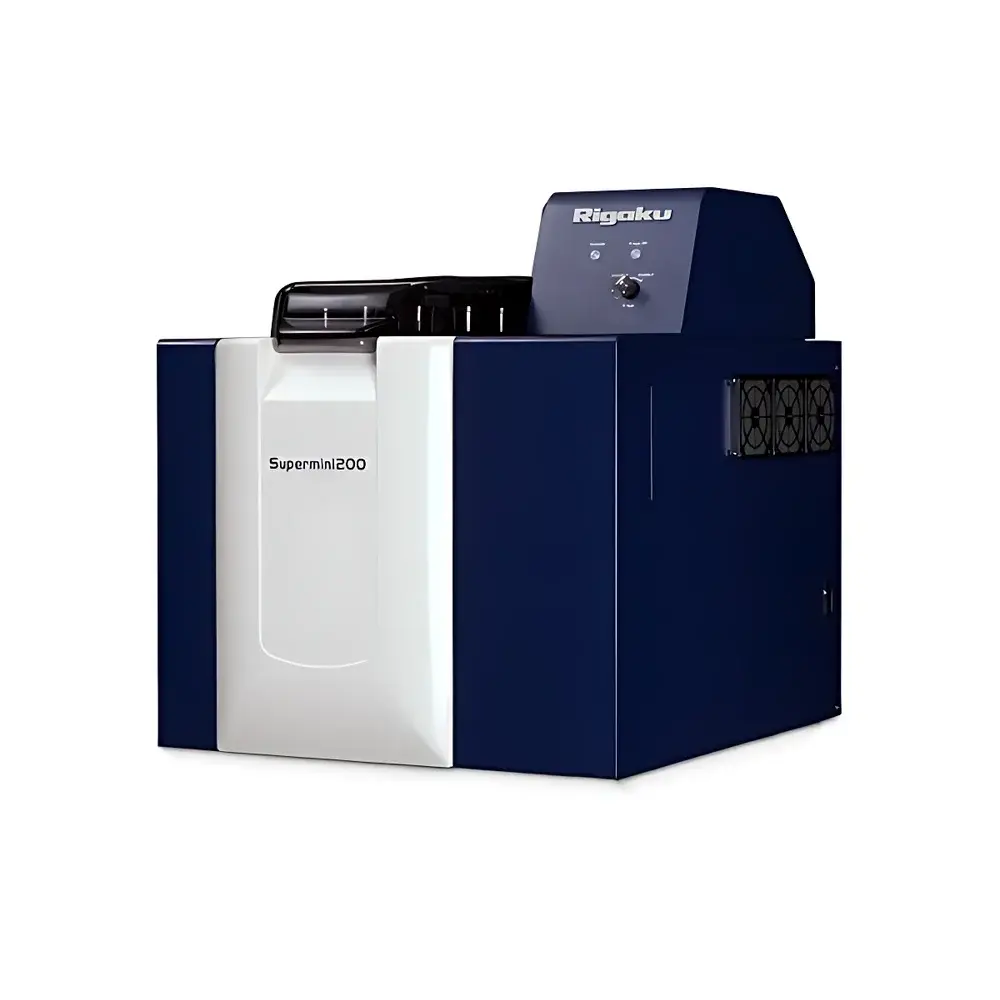
Rigaku Supermini200 S Wavelength-Dispersive X-Ray Fluorescence (WDXRF) Total Sulfur Analyzer per ASTM D7039
| Brand | Rigaku |
|---|---|
| Origin | Japan |
| Model | Supermini200 S |
| Instrument Type | Benchtop WDXRF Spectrometer |
| Excitation | Monochromatic Pd-target X-ray Tube (50 kV, 4 mA, 200 W) |
| Analyte Elements | Total S (ASTM D7039), Total Cl (ASTM D5059), Total Si (SH/T 0993), Total Pb (ASTM D5059) |
| Detection Limits | S: 0.1 ppm, Cl: 0.1 ppm, Si: 0.5 ppm, Pb: 0.2 ppm |
| Quantification Range | 0–99.99 wt% |
| Detector Linear Range | kcps |
| Beryllium Window Thickness | µm |
| Sample Forms | Liquids (gasoline, diesel, naphtha, jet fuel, crude oil, residuum, aqueous samples), Solids (catalysts, polypropylene), Powders |
| Compliance Standards | ASTM D7039, ASTM D5059, SH/T 0842, SH/T 0977, SH/T 0993 |
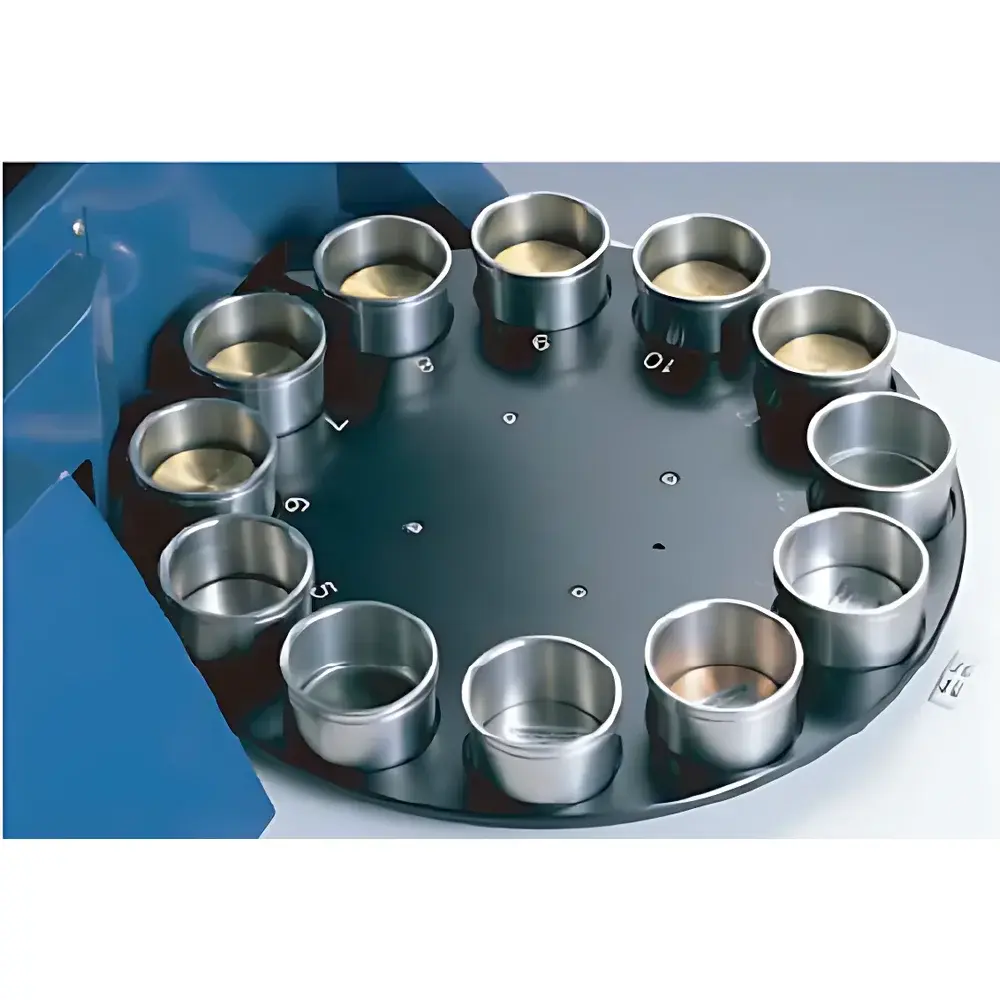
| Automation | Integrated 12-position autosampler |
| Optical System | Multi-crystal automatic switching optics with monochromatic excitation |
Overview
The Rigaku Supermini200 S is a benchtop wavelength-dispersive X-ray fluorescence (WDXRF) spectrometer engineered for high-precision, regulatory-compliant quantification of total sulfur (S), chlorine (Cl), silicon (Si), and lead (Pb) in petroleum products and related matrices. Unlike energy-dispersive (EDXRF) systems, the Supermini200 S employs monochromatic excitation—using a palladium (Pd) anode X-ray tube operating at 50 kV and 4 mA (200 W)—to selectively irradiate samples with a single, precisely defined wavelength. This eliminates spectral overlap and background scatter, significantly enhancing peak-to-background ratios and enabling sub-ppm detection limits. The instrument adheres strictly to ASTM D7039 for total sulfur determination in hydrocarbon fuels, as well as ASTM D5059 (for Cl and Pb), SH/T 0842 (S), SH/T 0977 (Cl), and SH/T 0993 (Si), making it suitable for quality control laboratories operating under ISO/IEC 17025, API RP 541, or refinery-specific QA/QC protocols.
Key Features
- Monochromatic WDXRF architecture delivering superior spectral resolution and minimal matrix interference—especially critical for low-chlorine, high-sulfur samples where overlapping L-lines would compromise accuracy in EDXRF systems.
- High-power 200 W Pd-target X-ray source—more than double the output of conventional 70 W monochromatic analyzers—enabling improved counting statistics, lower detection limits, and enhanced reproducibility (RSD < 1.5% at 10 ppm S in diesel).
- Automated multi-crystal optical system with crystal switching logic optimized for each target element, ensuring optimal Bragg-angle alignment and intensity calibration without manual intervention.
- Benchtop footprint (600 × 650 × 450 mm) with integrated 12-position autosampler—designed for unattended operation in constrained QC lab environments, including mobile labs and refinery on-site testing facilities.
- Optimized sample handling for heterogeneous matrices: accommodates liquids (neat or diluted), aqueous phases (including wastewater), solid catalysts, polymer pellets (e.g., polypropylene), and powdered residues—without requiring digestion or chemical derivatization.
- Robust vacuum-compatible sample chamber with adjustable beryllium window thickness to balance transmission efficiency and detector protection across low-Z (Cl, S) and mid-Z (Pb, Si) elements.
Sample Compatibility & Compliance
The Supermini200 S is validated for direct analysis of undiluted and minimally prepared samples per industry-standard test methods. It supports gasoline, diesel, naphtha, aviation turbine fuel (Jet A/A-1), aviation gasoline (Avgas), crude oil, vacuum residuum, process water, and wastewater—without internal standard addition or calibration dilution. Solid-phase compatibility includes spent FCC catalysts, hydrotreating catalysts, and polyolefin polymers. All quantitative routines are traceable to NIST SRMs (e.g., NIST 2723a for S in fuel oil) and comply with ASTM interlaboratory precision criteria. Instrument performance verification includes daily drift correction via built-in reference standards and optional GLP audit trails for FDA 21 CFR Part 11–aligned environments.
Software & Data Management
Rigaku’s proprietary analysis software provides full method development, calibration curve generation (linear, quadratic, or empirical fit), and automated spectral deconvolution. It supports qualitative screening, quantitative analysis with internal standard correction, and standardless semi-quantitative estimation using fundamental parameter (FP) algorithms. Software features include optical path alignment diagnostics, thin-film correction modules for coated substrates or layered catalysts, and spectral library matching for unknown contaminant identification. Data export conforms to ASTM E1382-compliant ASCII formats and LIMS-ready CSV/XML structures. Audit logs record all user actions, calibration events, and instrument parameter changes—supporting GMP/GLP documentation requirements.
Applications
- Refinery sulfur compliance monitoring per EPA Tier 3, Euro 5/6, and China VI fuel specifications.
- Monitoring Cl-induced corrosion in hydrotreater feedstocks and overhead systems.
- Quantifying Si fouling in FCC units from antifoam additives or catalyst attrition.
- Lead content verification in legacy aviation gasoline formulations.
- QC release testing of finished fuels prior to pipeline injection or marine bunkering.
- Research applications involving catalyst deactivation studies and additive interaction analysis.
FAQ
Does the Supermini200 S require liquid nitrogen or cryogenic cooling?
No—the detector uses a Peltier-cooled silicon drift detector (SDD) with thermoelectric stabilization, eliminating LN₂ dependency and reducing operational overhead.
Can the instrument be upgraded to support additional elements beyond S, Cl, Si, and Pb?
Yes—hardware configuration allows future expansion to other mid-Z elements (e.g., Ca, Zn, Ni) via crystal and calibration kit updates, subject to regulatory validation.
Is method transfer possible from existing EDXRF or UV-Vis sulfur analyzers?
Yes—Rigaku provides cross-platform correlation protocols and certified transfer standards to align results with legacy ASTM D5453 (UV-Fluorescence) or D2622 (EDXRF) workflows.
What maintenance intervals are recommended for the X-ray tube and crystals?
The Pd tube has a rated lifetime of ≥20,000 hours; crystal alignment verification is recommended quarterly, with full optical recalibration annually or after relocation.
How is data integrity ensured during unattended overnight runs?
All analyses are timestamped, digitally signed, and stored with checksum-verified raw spectra; autosampler position tracking prevents sample misassignment, and software enforces sequence-based pass/fail logic per predefined QC rules.



