
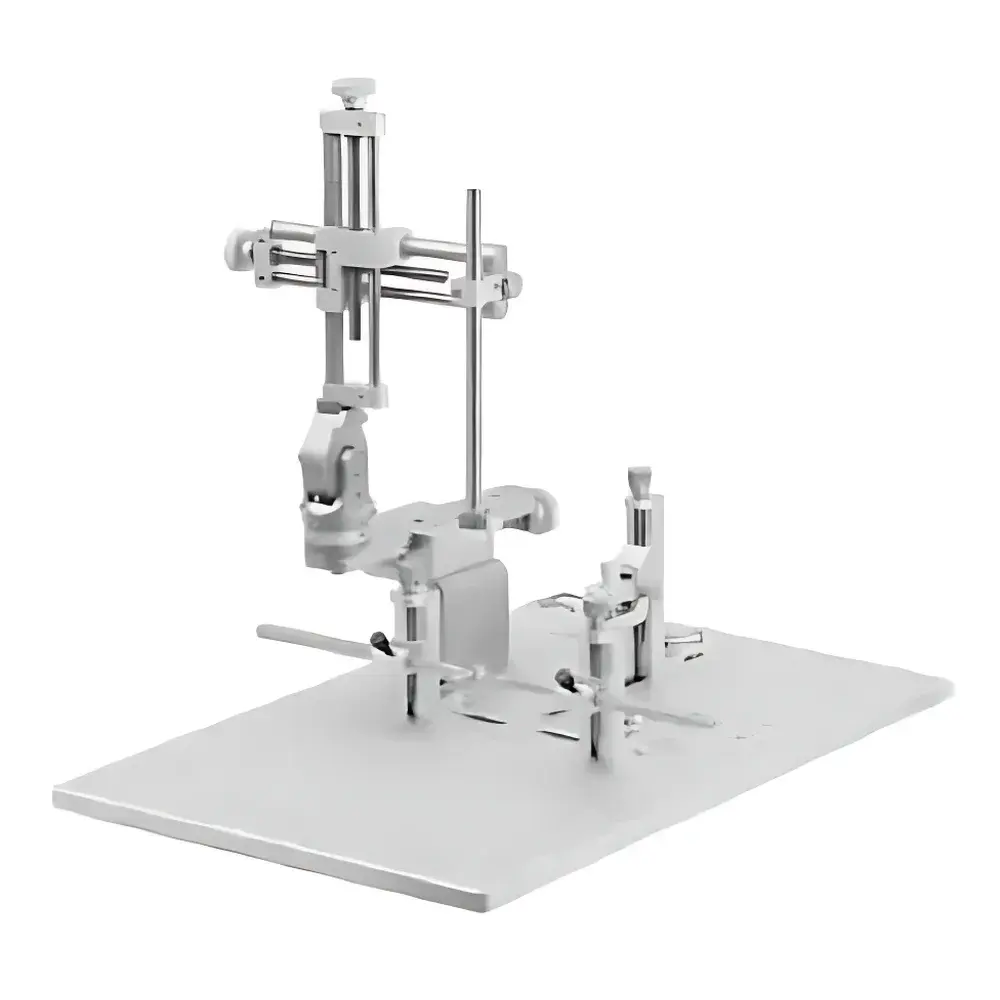
RWD 68526 Lightweight Stereotaxic Instrument for Rodents (Rat & Mouse)
| Brand | RWD |
|---|---|
| Origin | Guangdong, China |
| Manufacturer Type | Direct Manufacturer |
| Origin Classification | Domestic (China) |
| Model | 68526 |
| Pricing | Available Upon Request |
Overview
The RWD 68526 Lightweight Stereotaxic Instrument is an engineered precision tool designed for consistent and reproducible intracranial targeting in rodent neurosurgical procedures. Based on the fundamental principles of stereotaxic coordinate geometry—where three-dimensional anatomical locations are defined relative to standardized bregma and lambda landmarks—the instrument enables accurate placement of electrodes, cannulae, microinjection needles, or optical fibers into discrete brain regions of both rats and mice. Its modular architecture centers on a universal base plate compatible with interchangeable adapters and ear bars, eliminating the need for separate instruments when switching between species or experimental paradigms. This design significantly reduces setup time, minimizes inter-operator variability, and supports longitudinal studies requiring repeated interventions across developmental stages or strain types.
Key Features
- Universal base platform accepting both rat- and mouse-specific adapters and ear bar assemblies without structural modification
- Single-arm articulated arm system with calibrated micrometer-driven movement (X/Y/Z axes), providing sub-millimeter positioning resolution
- Lightweight aluminum alloy construction optimized for benchtop stability and ease of repositioning within biosafety cabinets or surgical suites
- Non-slip, anti-static base mounting surface compatible with standard stereotaxic frames and vacuum-assisted animal holders
- Tool-free adapter interchange mechanism enabling rapid transition between species-specific configurations in under 90 seconds
- Integrated scale markings and zero-reference indicators aligned to the stereotaxic coordinate system (Paxinos & Watson atlas conventions)
Sample Compatibility & Compliance
The RWD 68526 accommodates adult Sprague-Dawley and Wistar rats (250–500 g) as well as C57BL/6, BALB/c, and CD-1 mice (18–35 g) using validated adapter kits (RWD Part Nos. 68526-A for mice, 68526-B for rats). All components comply with ISO 13485:2016 design control requirements for laboratory medical devices and meet biocompatibility standards per ISO 10993-5 for short-term tissue contact. The instrument is routinely used in GLP-compliant preclinical neuroscience studies and aligns with NIH Office of Laboratory Animal Welfare (OLAW) guidelines for minimally invasive surgical instrumentation. Documentation packages include traceable calibration records and material certifications for stainless steel and anodized aluminum components.
Software & Data Management
While the 68526 is a manually operated mechanical instrument, it integrates seamlessly with third-party digital workflow systems. Coordinate data generated during surgery can be logged directly into electronic lab notebooks (ELN) such as LabArchives or Benchling via standardized CSV export from companion planning software (e.g., Stereotaxic Atlas Navigator v3.2+). Optional digital readout modules (RWD 68528/68529 variants) support USB data logging compliant with FDA 21 CFR Part 11 requirements—including user authentication, audit trails, and electronic signature capability—for regulated pharmacology and toxicology studies. All firmware and calibration protocols undergo annual verification per internal SOP-QC-07.
Applications
- Implantation of chronic EEG or LFP electrodes for seizure monitoring and circuit mapping
- Stereotactic microinjection of viral vectors (AAV, lentivirus), tracers (CTB, Fluoro-Gold), or pharmacological agents
- Targeted optogenetic fiber optic cannula placement in nucleus accumbens, ventral tegmental area, or hippocampal subfields
- Lesion studies using electrolytic or excitotoxic methods with precise volumetric control
- Validation of functional MRI or PET findings through post-hoc histological correlation
- Training platform for graduate-level neurosurgical technique instruction in academic core facilities
FAQ
Is the 68526 compatible with skull screw-based head fixation systems?
Yes—the base plate includes standardized 2.5 mm threaded holes conforming to common headplate mounting patterns (e.g., NeuroPort, Omnetics).
Can this instrument be sterilized using autoclaving?
The aluminum frame and stainless steel components withstand steam sterilization at 121°C for 20 minutes; however, polymer adapters and ear bar padding require low-temperature alternatives (e.g., ethylene oxide or hydrogen peroxide plasma).
Does RWD provide stereotaxic atlas integration support?
RWD supplies annotated coordinate templates aligned to the Paxinos & Franklin Mouse Brain Atlas (4th ed.) and Paxinos & Watson Rat Brain Atlas (7th ed.), available in PDF and .stl formats for 3D printing reference guides.
What is the maximum load capacity of the articulated arm?
The single-arm configuration supports up to 1.2 kg static load at full extension while maintaining ≤15 µm positional drift over 60-minute observation periods.
Are replacement adapters and ear bars available as standalone parts?
Yes—RWD maintains full backward compatibility: Part Nos. 68526-A (mouse), 68526-B (rat), and 68867S (single-arm base only) are stocked globally through authorized distributors.




