
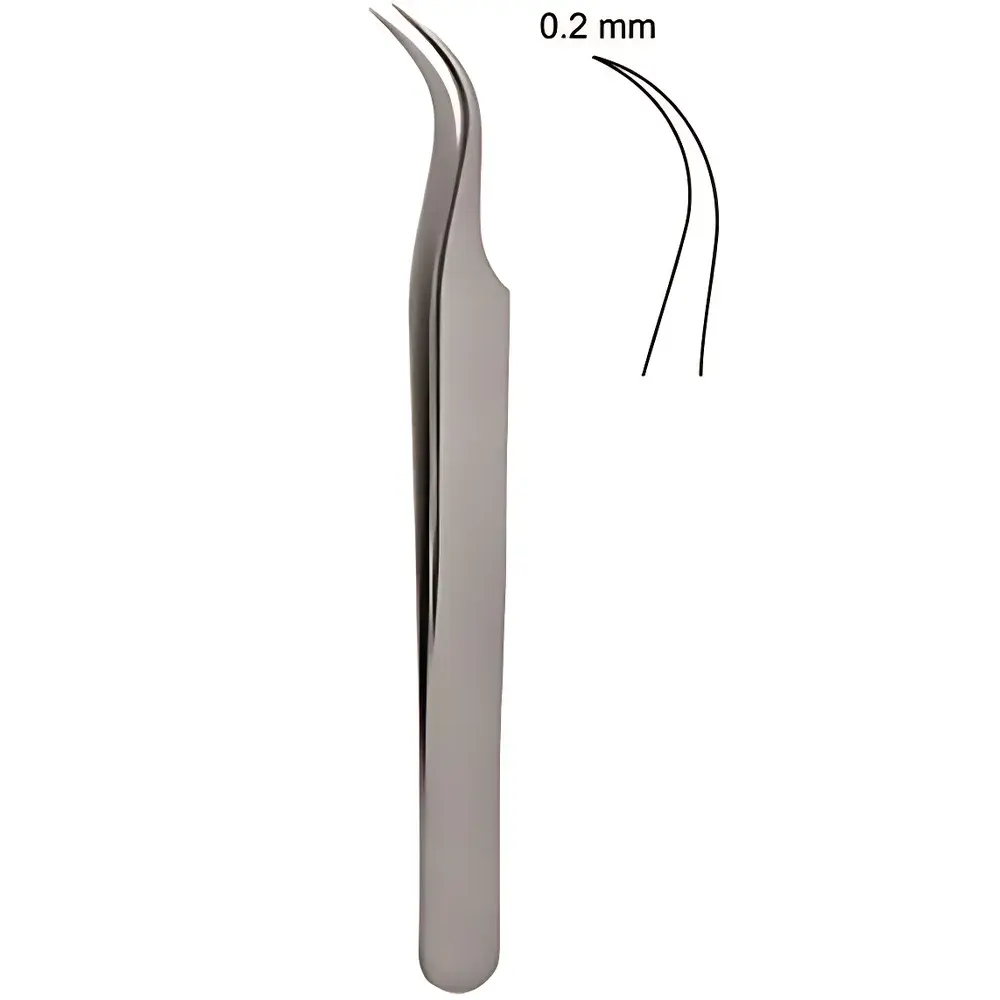
RWD F11004-11 & F11005-11 Curved Microforceps
| Brand | RWD |
|---|---|
| Origin | Shenzhen, China |
| Manufacturer Type | Direct Manufacturer |
| Origin Category | Domestic (China) |
| Models | F11004-11, F11005-11 |
| Tip Width | 0.2 mm (F11004-11), 0.4 mm (F11005-11) |
| Length | 110 mm (F11004-11), 115 mm (F11005-11) |
| Tip Geometry | Curved, Dual-Tooth (2-prong) |
| Material | Premium Stainless Steel (AISI 304/316 equivalent), Electropolished Surface Finish |
Overview
The RWD F11004-11 and F11005-11 Curved Microforceps are precision-handled surgical and micro-manipulation instruments engineered for high-accuracy tissue handling, neural dissection, embryonic manipulation, and delicate in vitro procedures. Designed with a controlled curvature and dual-tooth (2-prong) tip geometry, these forceps provide enhanced tactile feedback and mechanical advantage during fine grasping—critical for minimizing lateral shear stress on fragile biological structures such as axons, capillaries, or cultured monolayers. The instruments operate on fundamental biomechanical principles of lever-based force transmission, where the curved profile optimizes line-of-sight access in confined anatomical or chamber-based workspaces while maintaining ergonomic wrist alignment for extended use. Each pair is manufactured under strict quality control protocols aligned with ISO 13485–certified production standards for medical-grade instrumentation.
Key Features
- Precision-engineered curved profile (radius ≈ 12–15 mm) enables unobstructed visualization during deep-tissue or microchamber interventions
- Dual-tooth (2-prong) tip design ensures distributed contact pressure—reducing localized deformation of soft tissues or hydrogel-embedded samples
- Electropolished stainless steel surface (Ra < 0.2 µm) minimizes protein adhesion and facilitates rapid sterilization via autoclaving (134°C, 3 min), ethylene oxide, or hydrogen peroxide plasma
- Ergonomic handle geometry with micro-textured grip zones reduces operator fatigue during prolonged microsurgical sessions (>2 hr)
- Tip width tolerance maintained within ±0.02 mm across production batches—validated via optical profilometry and certified calibration reports
- Non-magnetic construction compatible with MRI-guided microprocedures and live-cell imaging setups requiring zero magnetic interference
Sample Compatibility & Compliance
These microforceps are routinely employed in applications involving primary neuronal cultures, zebrafish embryo dechorionation, mouse cortical slice preparation, and organoid transplantation. Their biocompatibility has been verified per ISO 10993–5 (cytotoxicity) and ISO 10993–10 (sensitization/irritation) testing protocols. The electropolished finish meets USP requirements for surgical instrument surface integrity. Instruments are supplied non-sterile; end users must validate sterilization cycles per their institutional biosafety and GLP-compliant SOPs. Traceability is supported via laser-engraved batch codes and full material certification (MTR) documentation upon request.
Software & Data Management
While standalone mechanical instruments, the F11004-11 and F11005-11 are fully interoperable with digital microscopy workflows. When integrated with motorized micromanipulators (e.g., Sutter MP-285, Scientifica PatchStar), they support synchronized video logging and position-tagged annotation in acquisition platforms such as NIS-Elements AR, MetaMorph, or μManager. Audit trails—including usage logs, sterilization cycle records, and maintenance history—can be maintained in LIMS-compatible formats (CSV, XML) to satisfy FDA 21 CFR Part 11 requirements for electronic records in regulated research environments.
Applications
- Microneurosurgery: Dorsal root ganglion explant isolation, peripheral nerve fascicle separation
- Developmental biology: Chick embryo windowing, Xenopus laevis blastomere ablation, C. elegans gonad dissection
- Regenerative medicine: Scaffold seeding under laminar flow, hiPSC-derived cardiomyocyte cluster transfer
- Electrophysiology: Patch pipette positioning assistance, electrode array alignment on brain slices
- Microfluidics: Hydrogel plug insertion into PDMS channels, valve actuator engagement in organ-on-chip devices
FAQ
Are these forceps suitable for sterile tissue culture work?
Yes—provided they undergo validated sterilization (autoclave, EO, or H₂O₂ plasma) and are handled using aseptic technique. Electropolishing significantly reduces endotoxin retention.
What is the recommended cleaning protocol between uses?
Rinse immediately in warm deionized water, followed by ultrasonic cleaning in enzymatic detergent (e.g., Tergazyme®) for 10 min, then passivation in 20% nitric acid per ASTM A967.
Can tip width be customized beyond 0.2 mm and 0.4 mm?
RWD offers OEM customization for tip widths ranging from 0.1 mm to 0.8 mm, subject to minimum order quantities and engineering review.
Do these forceps comply with EU MDR 2017/745 classification?
As Class I non-measuring, non-sterile surgical instruments, they fall under Annex VIII Rule 1; CE marking is affixed following conformity assessment by a Notified Body (NB 0120).
Is there a warranty or recalibration service available?
RWD provides a 24-month limited warranty against manufacturing defects; tip geometry verification and re-polishing services are available through authorized service centers globally.





