
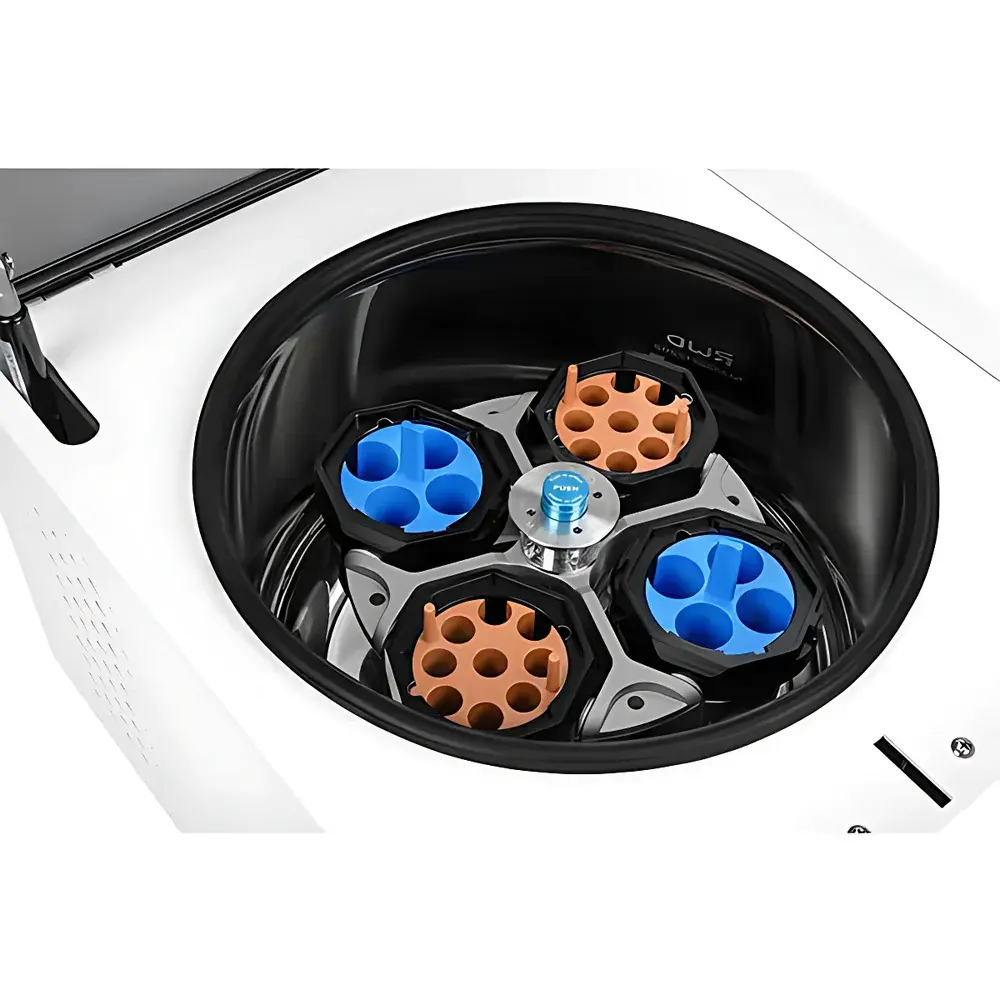
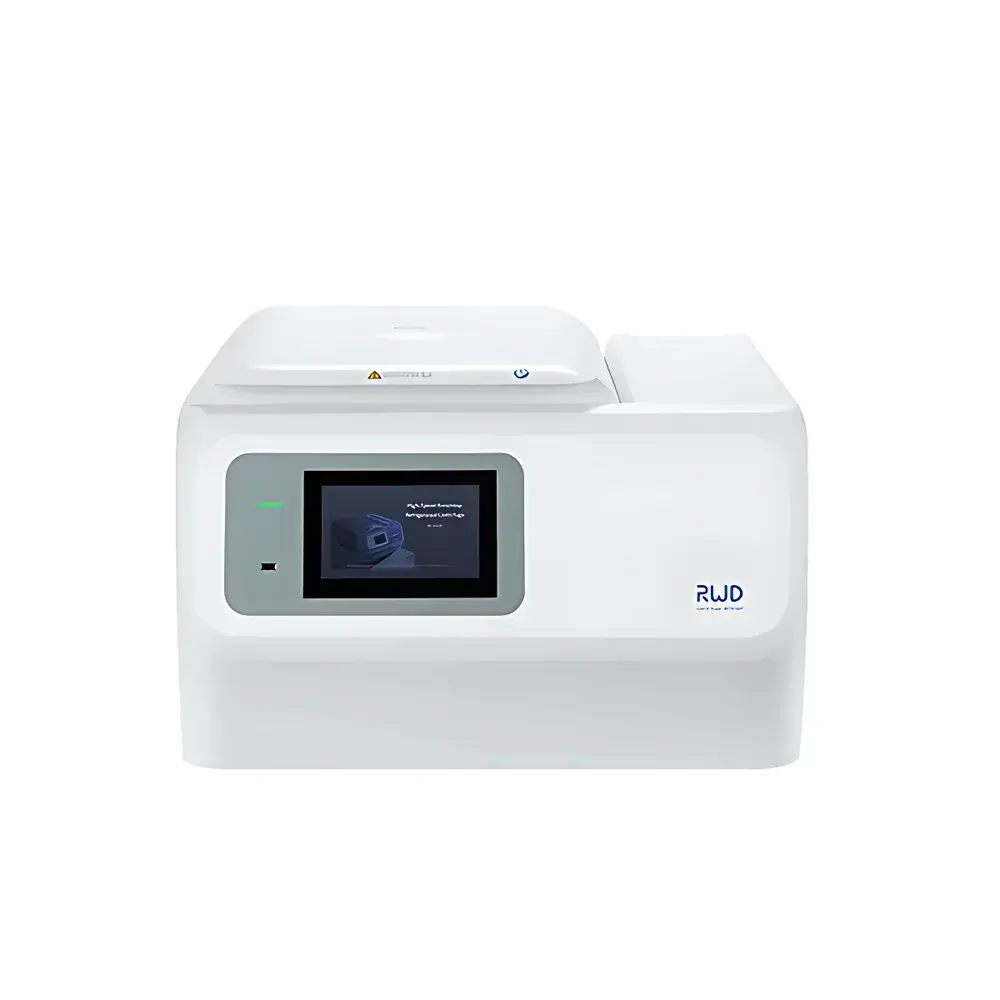
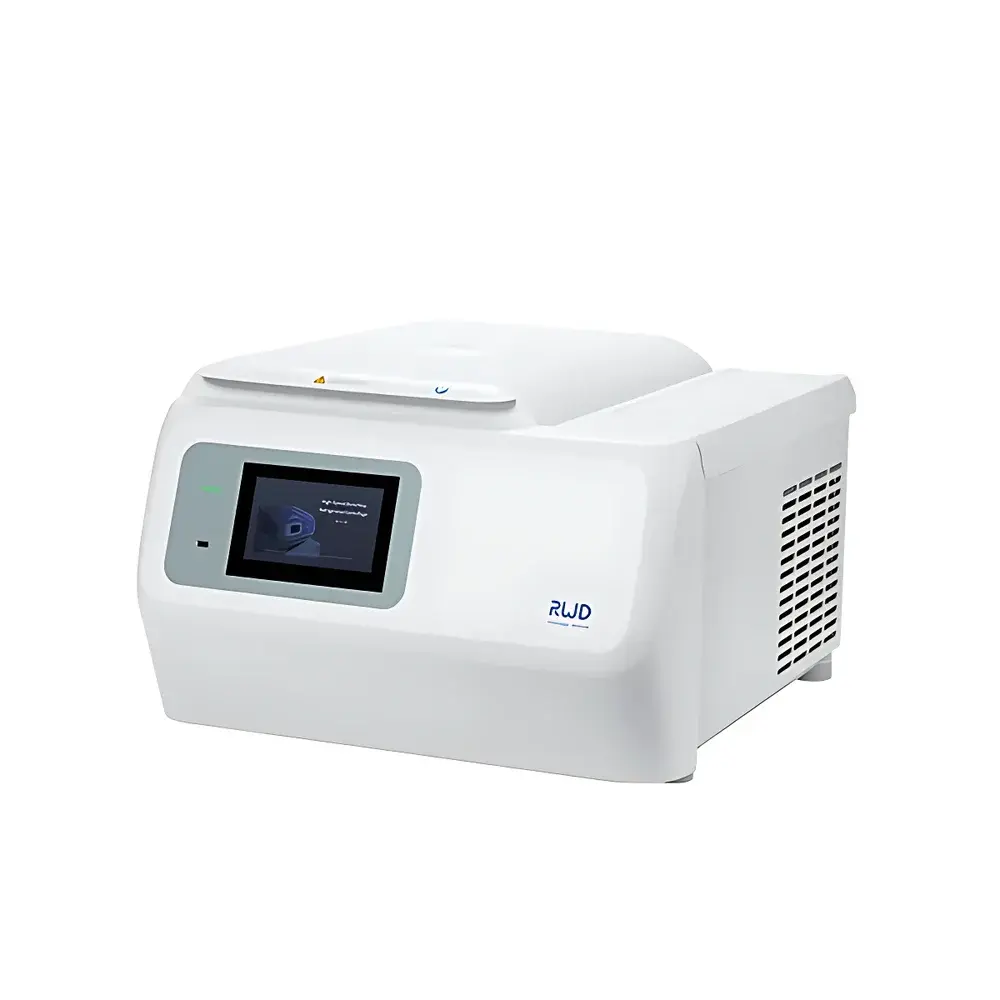
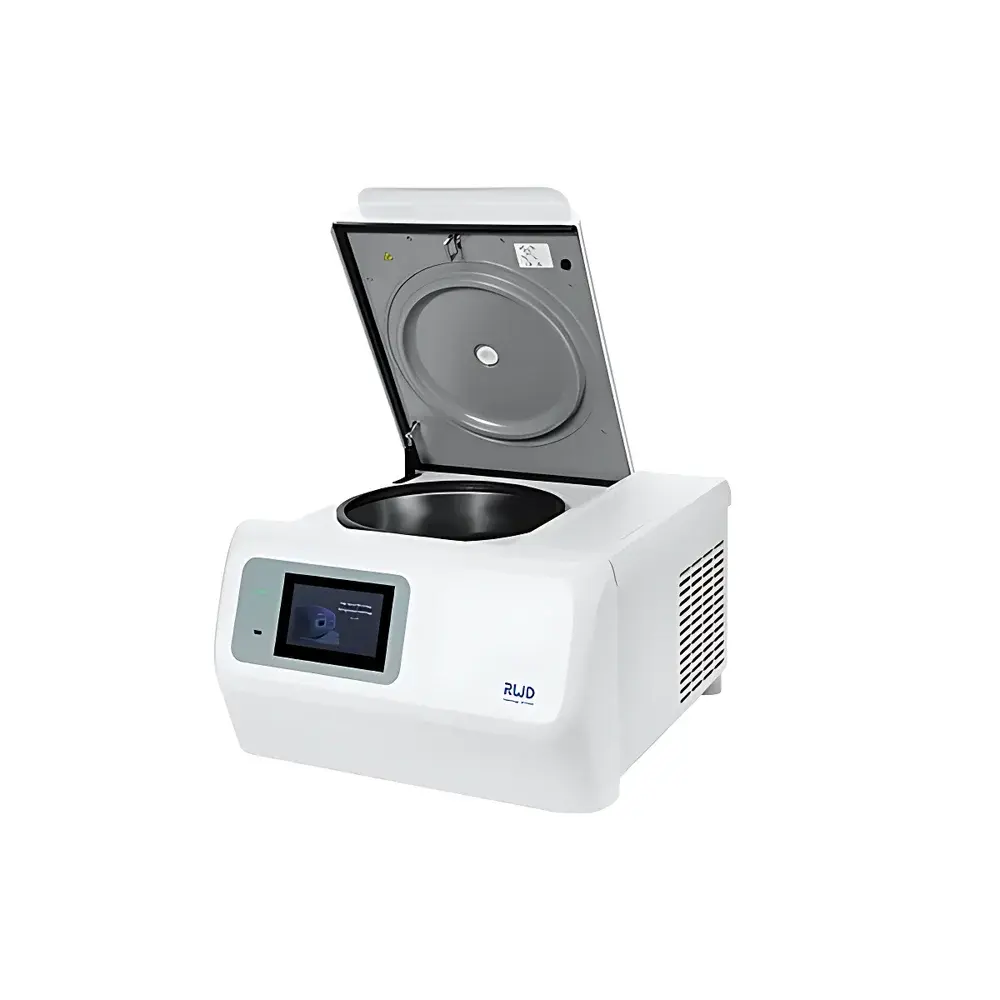
RWD M1416R High-Speed Benchtop Refrigerated Centrifuge
| Brand | RWD |
|---|---|
| Origin | Guangdong, China |
| Manufacturer Type | Direct Manufacturer |
| Product Category | Domestic |
| Model | M1416R |
| Instrument Type | Benchtop Centrifuge |
| Function | Refrigerated Centrifuge |
| Maximum Capacity | 4 × 400 mL |
| Maximum Speed | 18,000 rpm |
| Maximum RCF | 31,152 × g |
| Dimensions (W×D×H) | 620 × 670 × 400 mm |
| Temperature Range | −10 °C to +40 °C |
| Noise Level | 56 dB(A) |
| Acceleration/Deceleration Profiles | 9 acceleration / 10 deceleration settings |
| Program Storage | Up to 100 user-defined protocols (multi-step) |
| Weight (without rotors) | 96.5 kg |
Overview
The RWD M1416R is a high-performance benchtop refrigerated centrifuge engineered for precision separation in demanding life science and clinical laboratories. It operates on the principle of sedimentation under controlled gravitational force (RCF), enabling rapid and reproducible pelleting, clarification, and density-gradient separations across diverse sample types—from mammalian cells and subcellular organelles to nucleic acids, proteins, and blood components. Its integrated refrigeration system maintains precise temperature control between −10 °C and +40 °C throughout operation, critical for preserving thermolabile biomolecules and ensuring assay integrity during extended runs. Designed for regulatory-compliant environments, the M1416R supports GLP- and GMP-aligned workflows through audit-trail-capable program logging, multi-level user authentication, and hardware-based rotor identification—features essential for QC/QA labs subject to ISO 17025, CLIA, or FDA 21 CFR Part 11 requirements.
Key Features
- Self-locking rotor interface with tool-free installation and 3-second rotor exchange, minimizing downtime between protocols.
- Integrated static rotor ID recognition: automatically detects rotor type, validates maximum speed/RCF limits, and prevents unsafe parameter combinations.
- Dual-rotor versatility: compatible with a full suite of horizontal swing-out rotors (e.g., M-S4-400-P, M-S2-DWP-P) and fixed-angle rotors (e.g., M-F24-2QG, M-F6-100QG), supporting volumes from 0.2 mL microtubes to 400 mL bottles.
- Advanced thermal management: high-efficiency compressor and optimized airflow design ensure stable chamber temperature even at maximum speed and full load.
- Programmable scheduling: pre-cool function initiates refrigeration prior to run start; time-stamped protocol execution enables consistent daily workflows.
- Enhanced safety architecture: automatic imbalance detection, lid interlock with mechanical and electronic redundancy, and emergency brake with dynamic deceleration profiling.
- Intuitive 7-inch capacitive touchscreen with customizable home screen, lockable interface, and real-time graphical display of speed, RCF, temperature, time, and remaining runtime.
Sample Compatibility & Compliance
The M1416R accommodates standard laboratory consumables including conical-bottom tubes (15–50 mL), microcentrifuge tubes (0.2–2 mL), PCR strips, deep-well plates (96- and 384-well), and custom adapters for specialized containers. All rotors—including aluminum, stainless steel, and carbon fiber variants (e.g., M-F8-50CF)—are certified to ISO 15883-1 and IEC 61010-2-020 for mechanical safety and electrical protection. The instrument meets EN 61326-1 (EMC) and EN 61000-6-3 standards. Optional carbon-fiber rotors provide enhanced fatigue resistance and reduced rotational inertia, extending service life under high-cycle usage. For regulated applications, rotor lifetime tracking, calibration certificate traceability, and firmware version logging are embedded in the system’s event history.
Software & Data Management
The onboard operating system supports up to 100 fully programmable methods, each configurable with up to 9 sequential steps (speed, time, temperature, acceleration/deceleration ramping). All protocols are timestamped and associated with user login credentials. Audit trails record parameter changes, rotor swaps, door openings, error events, and temperature deviations—exportable via USB as CSV or PDF for internal review or external audits. No proprietary software installation is required for basic operation; optional RWD CentriLink PC software enables remote monitoring, batch report generation, and integration into LIMS via standard RS232 or Ethernet (TCP/IP) interfaces. Firmware updates are delivered via encrypted USB key to maintain data integrity and cybersecurity compliance.
Applications
- Cell biology: Harvesting adherent and suspension cells (e.g., HEK293, CHO, PBMCs) at 300–2,000 × g; mitochondrial isolation using differential centrifugation protocols.
- Molecular biology: Plasmid DNA purification (≥12,000 × g), viral pellet concentration (M-F24-2QG at 18,000 rpm), and RNA extraction with cold rotor preconditioning.
- Clinical diagnostics: Serum/plasma separation from whole blood (M-F30-15C rotor, 5650 rpm), exosome isolation via ultracentrifugation-compatible protocols.
- Protein biochemistry: Clarification of lysates, immunoprecipitation pellets, and size-exclusion fractionation support.
- Vaccines & biologics: Downstream processing steps requiring strict temperature control and repeatable RCF delivery per batch record requirements.
FAQ
What is the minimum and maximum operating temperature range?
The chamber temperature is adjustable from −10 °C to +40 °C, with ±1 °C accuracy maintained across the full speed range.
Does the M1416R support validation documentation for GxP environments?
Yes—factory calibration certificates, IQ/OQ templates, and electronic audit trail exports are available upon request to support 21 CFR Part 11 compliance.
Can carbon fiber rotors be used interchangeably with aluminum rotors on the same instrument?
Yes, all listed rotors—including carbon fiber models—are mechanically and electronically compatible with the M1416R main drive assembly and rotor recognition system.
How does the self-locking rotor mechanism improve operational safety?
It eliminates manual bolt tightening, ensures consistent torque application, and prevents accidental loosening during acceleration; combined with automatic imbalance sensing, it reduces risk of catastrophic failure.
Is remote monitoring or network connectivity supported?
Standard RS232 and optional Ethernet (TCP/IP) interfaces enable integration with lab networks, SCADA systems, or centralized equipment monitoring platforms.



