
RWD R462 Precision Syringe Pump
| Brand | RWD |
|---|---|
| Origin | Shenzhen, China |
| Manufacturer Type | Original Equipment Manufacturer (OEM) |
| Product Category | Domestic Instrument |
| Model | R462 |
| Instrument Type | Micro-syringe Pump |
| Flow Rate Range | 0.0001 µL/min to 102 mL/min |
| Accuracy | ±0.35% |
| Repeatability | ±0.05% |
Overview
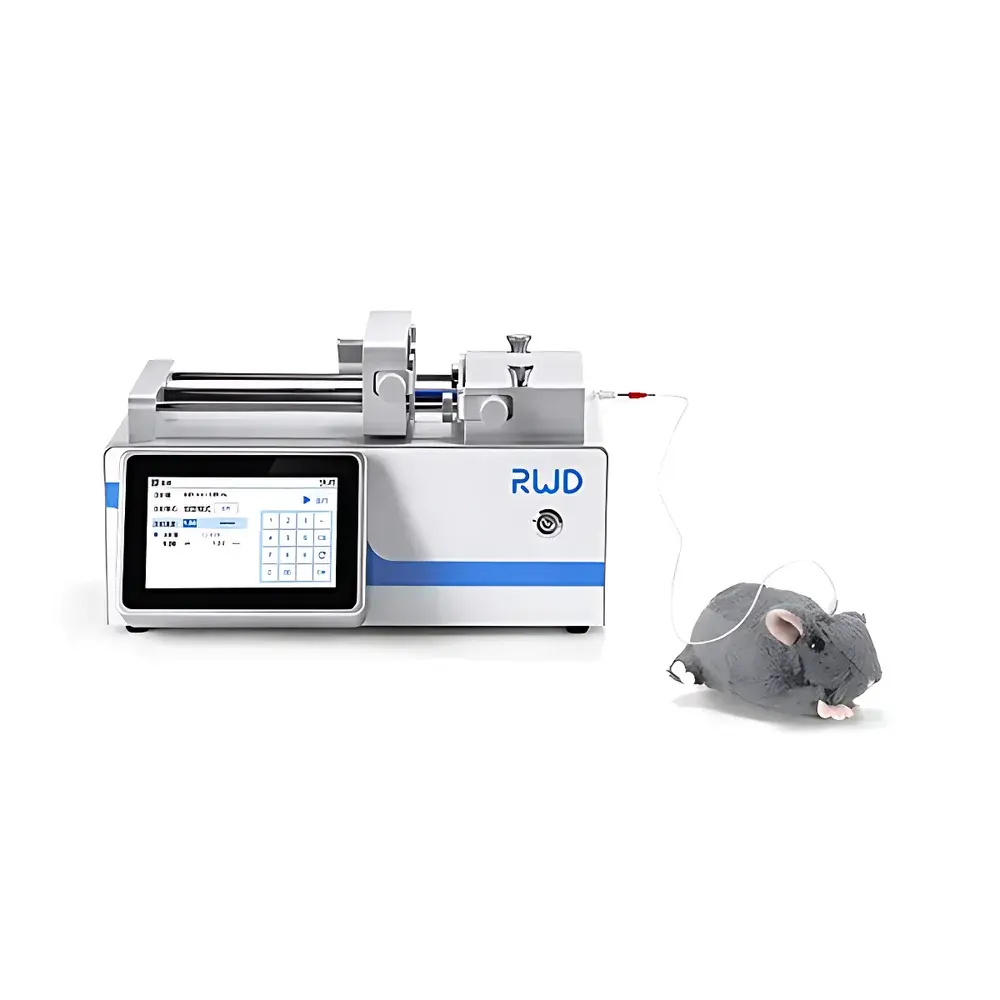
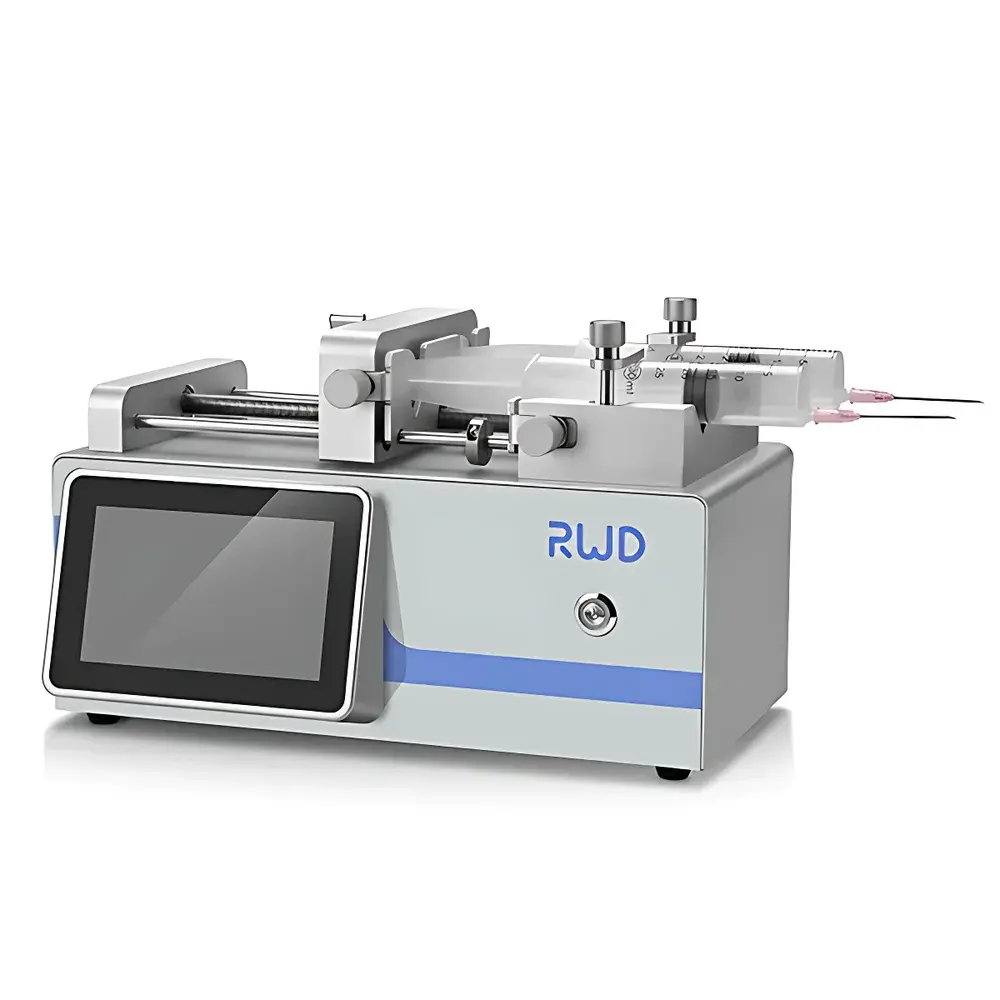
The RWD R462 Precision Syringe Pump is an electromechanically driven fluid delivery system engineered for high-accuracy, low-flow-rate applications in life science research laboratories. Based on a closed-loop stepper motor–lead screw actuation architecture, the pump converts rotational motion into precise linear displacement of the syringe plunger via a coupled nut assembly. This mechanical design ensures minimal backlash and thermal drift, enabling stable, continuous infusion or withdrawal over extended durations—critical for chronic in vivo dosing, microdialysis sampling, and time-resolved pharmacokinetic studies. Unlike peristaltic or piston-based alternatives, the R462 operates exclusively with standard glass or plastic syringes, eliminating fluid-path contamination risks associated with tubing-based systems. Its calibrated flow control is traceable to volumetric displacement rather than pressure-dependent estimation, supporting ISO/IEC 17025-aligned validation protocols when integrated into GLP-compliant workflows.
Key Features
- Three preconfigured operational modes: Constant Flow, Ramp (linear gradient), and Pulse (programmable on/off intervals), plus a fully customizable Program Mode supporting up to 100 sequential steps with independent flow rate, volume, and dwell time parameters.
- Bidirectional operation: programmable injection and withdrawal (refill) functions with synchronized direction reversal—essential for bidirectional microdialysis probe calibration and washout protocols.
- Wide syringe compatibility: validated for use with standard Luer-lock syringes ranging from 0.5 µL micro-capillary barrels to 60 mL reservoirs, accommodating both ultra-low-volume neuropharmacology injections and high-throughput reagent dispensing.
- Integrated 5.0-inch capacitive touchscreen LCD with intuitive icon-driven navigation, real-time flow visualization, and on-device parameter logging—no external PC required for basic operation.
- Extensive I/O interface suite: TTL-compatible digital input/output ports (start/stop, pause/resume, direction trigger), analog voltage input (0–5 V) for external flow modulation, and RS-485 serial communication for multi-pump synchronization and SCADA integration.
Sample Compatibility & Compliance
The R462 maintains compatibility with chemically inert syringe materials including borosilicate glass, polyethylene (PE), polypropylene (PP), and PTFE-coated barrels—supporting aqueous buffers, organic solvents (e.g., DMSO, ethanol), and viscous formulations (up to 500 mPa·s at 25°C). It complies with IEC 61000-6-2 (electromagnetic immunity) and IEC 61000-6-4 (emission) standards. While not certified for clinical or GMP manufacturing use, its firmware supports audit-trail-enabling configurations (e.g., user login, parameter change logging) suitable for preclinical GLP study documentation per OECD Principles of Good Laboratory Practice. Device calibration certificates are available upon request and conform to internal metrological procedures aligned with ISO/IEC 17025 requirements.
Software & Data Management
The R462 operates natively via embedded firmware but also supports optional PC-based control through RWD SyringePump Control Software (Windows 10/11, x64). The software provides advanced scheduling, real-time graphing of delivered volume vs. time, CSV export of timestamped flow logs, and batch protocol deployment across multiple pumps. All parameter changes—including flow rate, target volume, and mode selection—are recorded with user ID, timestamp, and pre-/post-value fields. For regulated environments, optional 21 CFR Part 11 compliance packages include electronic signature enforcement, role-based access control, and immutable audit trail generation—validated using NIST-traceable flow meters during installation qualification (IQ).
Applications
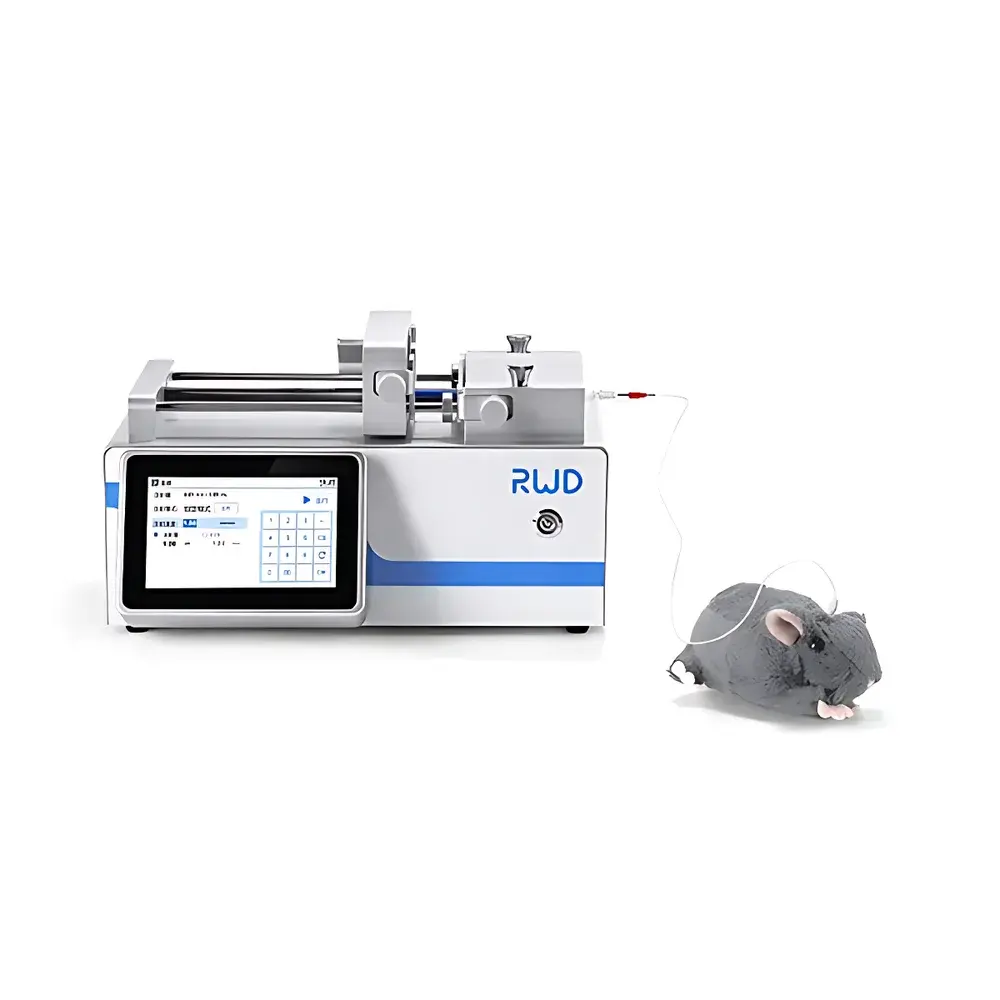
- Chronic intracerebral drug delivery in rodent models using stereotaxic RWD® microinjection cannulas, with sub-nanoliter precision per minute for receptor occupancy studies.
- Push-pull microdialysis: synchronized dual-pump operation (R462 + auxiliary pump) for simultaneous perfusate delivery and analyte collection via Eicom probes.
- In vitro blood-brain barrier (BBB) model perfusion, where laminar, pulseless flow at 0.1–5 µL/min mimics capillary shear stress without endothelial damage.
- Automated reagent addition in enzyme kinetics assays, where programmable ramp profiles replicate physiological concentration gradients during substrate titration.
- Calibration of mass spectrometry nanospray sources using ultra-stable 50–200 nL/min flows to stabilize electrospray ionization (ESI) signal intensity.
FAQ
What syringe sizes are officially validated for use with the R462?
RWD validates performance across syringes from 0.5 µL (capillary glass) to 60 mL (polypropylene), with full accuracy specifications guaranteed only within this range. Use outside these limits may compromise linearity or mechanical stability.
Does the R462 support remote triggering via TTL signals?
Yes—the device features two opto-isolated TTL inputs (start/stop and direction control) and one TTL output (operation status), enabling hardware-level synchronization with electrophysiology rigs, behavioral tracking systems, or laser stimulation units.
Can flow rate be modulated in real time using an external analog voltage signal?
Yes—applying a 0–5 V DC signal to the analog input port linearly scales the current flow rate between 0% and 100% of the set value, facilitating closed-loop feedback control in dynamic experimental paradigms.
Is firmware update capability available?
Yes—firmware updates are performed via USB flash drive using RWD-provided signed binaries; version history and release notes are published on the official RWD technical support portal.
What is the maximum allowable fluid viscosity for reliable operation?
For optimal repeatability and motor torque margin, fluids up to 500 mPa·s at 25°C are supported. Higher viscosities require reduced maximum flow rates and may necessitate syringe pre-wetting or temperature-controlled housing to maintain consistency.



